Tuesday, August 31, 2010

Von Boyage

So as fellows depart from Research!America it has become a tradition for them to write a sign off post. After doing a google image search using phrases like "goodbye" and "adios", I put in what I thought was how you say goodbye in French - Von Boyage. To my surprise, this phrase not only doesn't exist, but "bon voyage", the real phrase, doesn't mean "goodbye". Does this explain why Parisian's have always been so rude to me whenever I have visited their beautiful city? (My strategy to communicate with foreigners by speaking English loudly and slowly works pretty well in other countries.)

Writing this is bittersweet. I will not admit to how much I have learned as a Science and Technology Policy Fellow at Research!America because it would reveal how little I knew three months ago upon arrival. Writing for the New Voices blog has been one of many fun responsibilities – what other forum would provide an opportunity to expound on everything from beer to brain tumors?

Between teaching, doing research, internships, and fellowships, I have had seven different positions in Washington since moving here a year and a half ago. While you learn a lot jumping from job to job every couple months, I am thrilled to be starting a permanent science policy position with the American Chemical Society. The ACS is the world's largest scientific society and a perfect environment to continuing advocating for research.

Goodbye to the great people at Research!America. It has been my pleasure to have been part of such a motivated and dynamic team this summer. I intend to stay a part of the New Voices community and look forward to seeing what exciting things lie in store for all of its members. ciao, sayanora, kamsahamnidah, l'hitraot, kol tuv, shalom, arrivaderci, do svidanja, au revoir, hasta la vista, bis freitagabend, and xi chien.

Bookmark and Share

Monday, August 30, 2010

A=B; B=A

Ever wonder how connected science policy and science research is? About as much as Siamese twins attached at the head. Look at some of the current policy issues that affect research (and vice versa).

Climate Change
Serious health and environmental concerns may be triggered by increases in UV radiation and a depleted ozone layer. A climate change bill passed through the House in ‘09 but is facing obstacles in the Senate. The success or failure of current and future climate change legislation will be influenced by scientists and researchers

Stem Cell Regulation
In ’05 and ’07 the Stem Cell Research Enhancement Act was passed by Congress but was vetoed by the President. Although President Obama has lifted some barriers to stem cell research, the ‘09 version of the Stem Cell Bill has not passed either branch of Congress.

Genetic Testing
Should consumers have the right to personally administer genetic tests on themselves? In 2008 the Genetic Information Nondiscrimination Act (GINA) restricted employers and insurance company from discrimination based on results from genetic tests, but no federal policy regulates how the tests are conducted.

The Environment and Offshore Drilling
Researchers and engineers will play an integral role in determining the Congressional legislative reaction to the BP oil spill. In ‘08, a 27 year offshore drilling ban was lifted, which may now be reinstated.

Cloning
The FDA allows animals to be cloned and their meat sold for human consumption - should scientists be allowed to clone human organs for research or transplant? Should we be allowed to clone extinct or endangered species? Legislation addressing such issues will be framed soon.

Health Records and Internet Privacy
Should restrictions exist when accessing health records electronically? Do search engines have the right to save search data? In ‘10 an online privacy bill was presented in the House, which will effect digital privacy laws and medical record storage. Doctors and researchers will dictate these quality of these regulations.

Tax Credit for Research
The Federal Research and Development tax credit was worth $5.6 billion to U.S. companies in ‘09. The credit includes qualified research, computer time-sharing costs, and a percentage of contract research expenses. It is a temporary program that has been renewed annually for 28 years, but whether it becomes part of the permanent tax code has not been decided.

Competitiveness
The 2010 America COMPETES Act is currently being considered by Congress. It will not only affect NSF funding for the next five years, but legislate energy, STEM education, and technology transfer efforts.

No matter what field you're in or what type of research you do, you should work to affect the policies that affect research.


This is Part 3 of 3 in the Science of Advocacy series.
Part 1 - Senator PhD?
Part 2 - Baby don't cry, baby don't get no milk
Part 3 - A=B; B=A

Bookmark and Share

Friday, August 27, 2010

Baby don't cry, baby don't get no milk

Is it frightening to you that American's spend more money on their lawn and gardens than the National Institutes of Health receive to try and cure cancer, AIDS, Alzheimer's and diabetes? How about that the budget of the National Science Foundation is a quarter of what we spend on video games? There are many reasons why researchers should be increasing their role in science policy, but perhaps the most relevant is economic.

Research funding is a constant and annual process and no amount of money is predictable or ever guaranteed. Researchers should be screaming from the rafters how badly they need money - hence the title of this post.

Want proof that advocacy works? The graph on the left demonstrates the changing budget of the NIH since 1970. Notice that from 2002 to 2008 the funding trend flattens out but then jumps up significantly during 2009 and 2010. This is due to the hard work of health research advocates such as Research!America. Being vocal and aggressive about the importance of increasing research funding resulted in the NIH receiving billions of extra dollars from the American Recovery and Reinvestment Act (ARRA) funds. For this trend to continue, scientists and researchers must make a lot more noise than they are right now.


This is Part 2 of 3 in the Science of Advocacy series.
Part 1 - Senator PhD?
Part 2 - Baby don't cry, baby don't get no milk
Part 3 - A=B; B=A

Bookmark and Share

Thursday, August 26, 2010

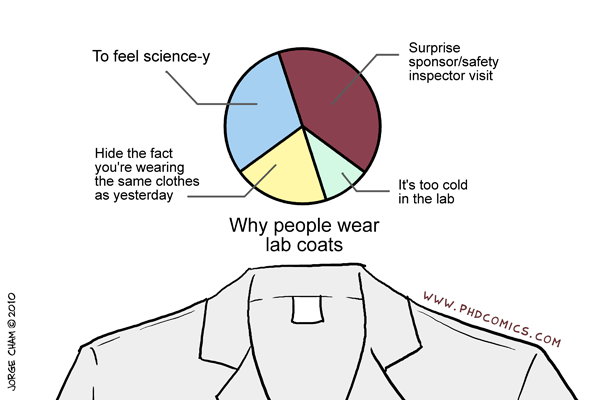
Comic Break

Comic credit: PhD Comics

We figured that if we needed a little laugh to get us through until Friday, you might too.

Bookmark and Share

Wednesday, August 25, 2010

Meet Yung Lie, PhD, Scientific Director - Non-profit

Today we're introducing you to New Voice Yung Lie, Scientific Director at the Damon Runyon Cancer Research Foundation.

NV: What do you do?

Yung: I am the scientific director at the Damon Runyon Cancer Research Foundation. I oversee our grant-making programs for early career scientists. In addition, I am a liaison between scientists and the foundation as well as the donors. I’m the only scientist on staff, so I often answer questions about the research our scientists are doing. We’re working to better communicate the importance of scientific research.

NV: Why did you move into policy (from research)?

Yung: When I was in academia I was in an environment that was relatively stagnant and in this role I get to interact with both scientists and non-scientists and have a broader impact. It’s great to have the opportunity to talk to people about why it’s important to fund basic research, something I didn’t get to do when I was in an academic research environment.

NV: What limited your ability to do advocacy in your previous work?

Yung: Not knowing what opportunities existed for outreach and advocacy. I was always interested in the idea of it, but unless you’re presented with an opportunity you’ll find you just don’t take the initiative. Some labs are better at this than others, depending on whether lab heads and PIs are involved in outreach and advocacy.

NV: What motivates you to do advocacy?

Yung: You know, it’s an integral part of my job. And now that I’ve left my lab I see more why it’s so important to be out there talking about science. I see that there are so many non-scientists in the world who don’t understand why it’s important to have researchers working on many of these projects. Scientists need to be speaking about their work and the importance of it to the public.

NV: In what ways does your outreach affect those who receive it?

Yung: I think it’s an amazing opportunity for people to learn. I think that often people are basing their opinions on the articles they read in newspapers and magazines. And that reporting is often inaccurate and gives the wrong impression on research and money in research. Like with cancer, lots of false impressions have been given about how very little or no progress has been made despite how much money is put into research, when in fact, enormous progress has been made.

A lot of the responsibility to get the information out there falls on the scientists to not let the media give the wrong impression. The donors [at Damon Runyon] are always very pleased to have the opportunity to speak directly to scientists, to hear about their motivations for doing research and to learn why research is so important for understanding and treating human disease.


Thank you to Yung for giving us her time via phone so we could learn more about her and her career.

This is part of the ongoing Profiling New Voices series.


Bookmark and Share

Tuesday, August 24, 2010

Senator, PhD?

This summer I created an outreach piece for Research!America that was aimed at motivating researchers to become more involved in science policy. It is not hard to identify reasons for researchers to increase their roles in policy. For me, one of the more salient reasons to get involved is how underrepresented they are in Congress.

Out of 100 senators, guess how many have a Ph.D.? If the number you guessed resembles a bird egg, you'd be correct. More than three quarters of those currently in the U.S. Senate were either lawyers or businesspeople before they were elected.

The House of Representative isn't much better. To the right is a map of the U.S. and all 435 of its Congressional districts. Districts that are represented by Ph.D level researchers are in red, and sadly in this Congress there are only six. It is even more bleak when we consider Vernon Ehlers of Michigan is stepping down this term, and Jerry McNerney of California and Roscoe Barlett in Maryland are both facing very tough races. This means the number of researchers in Congress could be getting cut in half.

While all types of outreach and advocacy from researchers is crucial, we need some to actually run for office. Isn't it frustrating to think that the lawmakers that control how you do your work have completely different background from you?


This is Part 2 of 3 in the Science of Advocacy series.
Part 1 - Senator PhD?
Part 2 - Baby don't cry, baby don't get no milk
Part 3 - A=B; B=A

Bookmark and Share

Monday, August 23, 2010

So Long, Farewell

Me and my daughter on a recent family vacation.

The Sound of Music
is one of my favorite movies, and the scene where the von Trapp children sing their goodnights has to be one of the most memorable. I've probably known the words to the song since I was about four, but saying them now to my colleagues at Research!America is one of the hardest things I've had to do.

I have learned and experienced so much in the past six years. I am so proud of what we at Research!America--and especially the Policy and Outreach team--have been able to accomplish. It's amazing what a small group of people can do when they're committed to a mission. As Mahatma Gandhi said, "You must be the change you want to see in the world."

To that end, I have decided to go back to school to be a high school science teacher. If all goes as planned, I should be in the classroom by next fall. I see teaching as a different path to accomplishing the same goal of making science and research a higher national priority. I will personally continue to be a part of the New Voices community, and I hope I can inspire some of my future students to be the next generation of researchers and science advocates.

So, to Stacie, Heather, Michelle all of the interns and fellows I've worked with over the years, my colleagues at Research!America and all of the New Voices, thank you.

Bookmark and Share

Friday, August 20, 2010

Mystery Labs Revealed

Thank you to everyone who participated in the Mystery Lab Contest this week - submitters and guessers alike. The winning image is from Day 1!

Congratulations to Nicole, who describes her work as follows:

"My general field is engineering or biomedical engineering. This image is from an intermediate step in a computer vision project aimed at better detection of breast cancer in mammograms. The original image is an x-ray of the breast, or mammogram, and through automated image analysis my goal is to determine if the normal structure of the breast tissue has been disrupted by abnormal growth, for example cancer.

Radiologists train for years to be able to detect abnormalities in mammograms with their natural equipment, i.e. their eyes and their brain. The goal of my project, and projects similar to mine, are to teach computers to "see" images at least as well as a human can, and perhaps to add to human abilities with additional mathematical tricks that computers can use and are not easy for humans to do."

Nicole is currently a PhD working on her MD in Chicago. She'll be receiving her copy of Unscientific America: How scientific illiteracy threatens our future soon and we look forward to hearing more about her research and career. We already know she's a good communicator, because she got the message out and received 43 comments for a total of 9,847 points!

Our other contestants also deserve kudos for submitting amazing research images.
Remember you can always submit photos of your research to the New Voices Images from Around the Lab series by emailing an picture to hbenson at researchamerica.org. We look forward to seeing your research!

Bookmark and Share

Thursday, August 19, 2010

Mystery Lab Contest - Day 4

This week on New Voices we'll be sharing images of research submitted by readers. Help your fellow researchers win the contest by guessing what type of research is being done based on the image below. Can today's image beat yesterday's? Come back tomorrow to see who won and find out what's been going on in the Mystery Lab!


Today is the last day of the Mystery Lab Contest , but you can always submit photos of your research to the New Voices Images from Around the Lab series by emailing an picture to hbenson at researchamerica.org.

Bookmark and Share

Wednesday, August 18, 2010

Mystery Lab Contest - Day 3

This week on New Voices we'll be sharing images of research submitted by readers. Help your fellow researchers win the contest by guessing what type of research is being done based on the image below. Can today's image beat yesterday's or Monday's?

You can submit your entry into the Mystery Lab Contest by emailing an image to hbenson at researchamerica.org. If we receive more submissions than we have room for in the competition, those images will be considered for our Images from Around the Lab series.

Bookmark and Share