Showing posts with label environment. Show all posts

Thursday, December 9, 2010

COWS: Turning Trash into Green


Have you ever wondered what happens to all the food waste produced by restaurants, supermarkets, and cafeterias? It turns out that these businesses spend billions of dollars every year to dispose of the waste in landfills, where it slowly decomposes and releases methane, a potent greenhouse gas. A new company called ReGenerate wants to change this. ReGenerate is developing a technology that can turn food waste into biogas and a rich fertilizer – on site.

In doing so, companies would no longer have to pay for food waste disposal and could use the biogas to generate most of the hot water for their business by connecting it to their existing heating system. The result is a net decrease in greenhouse gas emissions (since the food waste is essentially being recycled) and the creation of valuable commodity (biogas and fertilizer). And by keeping the waste on site, it will no longer take up space in the landfills that have become a point of controversy for communities across the nation.

How does this technology work? It relies on the same principles for digestion as a cow. Yes, a cow. Pulped food waste is fed into an anaerobic chamber (without oxygen) where bacteria break down the waste into natural gas (methane) and fertilizer components. ReGenerate affectionately refers to the technology as the Compact Organic Waste System (COWS). The company estimates that the fertilizer components would be picked up once every 20 days and transported to a nearby composting partner for sale to local businesses.

The idea and team that drive ReGenerate were formed at the University of Michigan. Believe it or not, the founding members were affiliated with the biogas club and formed a collaboration that was cemented between classes and happy hours. So far, the team has won funding from competitions sponsored by the University and state businesses, which were integral in driving the formation of the company and development of the technology.

ReGenerate has developed a business model that takes something with negative value (food waste) as a feedstock and transforms it into a valuable commodity. At the same time, they are reducing greenhouse gas emissions and saving companies money. This is exactly the type of innovative thinking and ingenuity that will be required for the US and the world to address the global environmental challenges that will define our time.



Bookmark and Share

Monday, August 30, 2010

A=B; B=A

Ever wonder how connected science policy and science research is? About as much as Siamese twins attached at the head. Look at some of the current policy issues that affect research (and vice versa).

Climate Change
Serious health and environmental concerns may be triggered by increases in UV radiation and a depleted ozone layer. A climate change bill passed through the House in ‘09 but is facing obstacles in the Senate. The success or failure of current and future climate change legislation will be influenced by scientists and researchers

Stem Cell Regulation
In ’05 and ’07 the Stem Cell Research Enhancement Act was passed by Congress but was vetoed by the President. Although President Obama has lifted some barriers to stem cell research, the ‘09 version of the Stem Cell Bill has not passed either branch of Congress.

Genetic Testing
Should consumers have the right to personally administer genetic tests on themselves? In 2008 the Genetic Information Nondiscrimination Act (GINA) restricted employers and insurance company from discrimination based on results from genetic tests, but no federal policy regulates how the tests are conducted.

The Environment and Offshore Drilling
Researchers and engineers will play an integral role in determining the Congressional legislative reaction to the BP oil spill. In ‘08, a 27 year offshore drilling ban was lifted, which may now be reinstated.

Cloning
The FDA allows animals to be cloned and their meat sold for human consumption - should scientists be allowed to clone human organs for research or transplant? Should we be allowed to clone extinct or endangered species? Legislation addressing such issues will be framed soon.

Health Records and Internet Privacy
Should restrictions exist when accessing health records electronically? Do search engines have the right to save search data? In ‘10 an online privacy bill was presented in the House, which will effect digital privacy laws and medical record storage. Doctors and researchers will dictate these quality of these regulations.

Tax Credit for Research
The Federal Research and Development tax credit was worth $5.6 billion to U.S. companies in ‘09. The credit includes qualified research, computer time-sharing costs, and a percentage of contract research expenses. It is a temporary program that has been renewed annually for 28 years, but whether it becomes part of the permanent tax code has not been decided.

Competitiveness
The 2010 America COMPETES Act is currently being considered by Congress. It will not only affect NSF funding for the next five years, but legislate energy, STEM education, and technology transfer efforts.

No matter what field you're in or what type of research you do, you should work to affect the policies that affect research.


This is Part 3 of 3 in the Science of Advocacy series.
Part 1 - Senator PhD?
Part 2 - Baby don't cry, baby don't get no milk
Part 3 - A=B; B=A

Bookmark and Share

Wednesday, May 26, 2010

Call to Action

Image credit: A6U571N

The bottom line is that environmental chemicals, such as endocrine disrupting chemicals, are a real concern, but the specific health threats are still poorly understood. Environmental health research is key to improving public health, because it will help us determine how we can prevent rather than treat environmentally related effects.

The ultimate outcome of this research will be information that can be used to guide policy by identify chemicals of concern, determine exposure levels that lead to health effects, and evaluate the effectiveness of prevention efforts. But beyond policy, this data will allow people to make better choices, such as where to live or types of health care they need.

Investment in environmental health research clearly has the potential to improve Americans quality of life and reduce economic and societal costs that result from environmentally-related health effects. As voters, we have the power to encourage investment in this research by telling the representatives we elected that it is how we want our tax dollars spent. The greatest impact you can have is by communicating with your representatives.

I am writing letters to my Senators and Representatives on how I believe environmental health research should be a priority, will you join me?


This is Part 10 in the Chemical Exposures and Public Health series.
Part 1 - From Interest to Passion
Part 2 - An Environmental Health Risk
Part 3 - Lead: A Regulatory Success Story
Part 4 - Something My Body Needs Anyway?
Part 5 - Obesity's Elephant: Environmental Chemicals
Part 6 - Why Our Approach to Toxicology Must Change
Part 7 - Failures of U.S. Chemical Regulation
Part 8 - Cleaning Up Our Act
Part 9 - Environmental Health Research Saves Lives and Money
Part 10 - Call to Action

Bookmark and Share

Monday, May 24, 2010

Environmental Health Research Saves Lives and Money

Along with public opinion and advocacy, research is another important driver of policy decisions. Research is the an essential tool for the identification of safe alternatives for chemicals in commerce that are a health concern. Efforts by scientists in areas such as green chemistry aim to design new chemicals that have little to no negative effects on our health.

The same research tools can also be used to guide chemical regulatory policy. To encourage regulation of a specific chemical, research needs to prove it poses a threat to human health. To better understand the risk posed by chemical exposures, scientists first needed to develop methods to identify which chemicals are getting into our bodies and at what levels. One technique is bio-monitoring; which involves looking at both the environment a person lives in and samples from the person themselves.

Historically, human exposures were estimated from the concentration of a chemical in the environment, food, water, or consumer goods. But advances have enabled scientists to directly measure the concentration of a chemical or metabolites in specimen, such as blood, urine, or bone. A recent CDC study detected over 212 chemicals in the U.S. population. Even DDT was found at a detectable level in children, despite the fact that it had been banned decades before they were born.

But what does bio-monitoring data mean for public health? The problem is that bio-monitoring studies on their own do not determine the relationship between chemical exposures and health effects. Bio-monitoring is the first step, but can only determine what enters our bodies. In order for regulatory action to be taken, these chemical exposures must be linked to specific effects, as was done for children's lead exposure and mental deficits. Unfortunately, for endocrine disrupting chemicals (EDCs) many links remain unknown.


To better determine links between environmental exposures and health effects, a multi-agency collaboration is conducting a national research effort called the National Children’s Study . The study will track 100,000 children from before birth to the age of 21 collecting data on their chemical exposures and potentially related health effects. Then, researchers will analyze the data to learn how environment influences health, including evidence identifying which chemicals in our bodies are making us sick.

The study is focusing on children because research has documented their unique vulnerability to chemicals, and how exposures during development can set us up for chronic health problems and the development of diseases later in life.

Because of the sheer size and length, the National Children’s Study will be expensive. To get the full benefit, it is critical that funding is maintained. This study is about prevention, we need to try to stop environmentally related health effects before they start. Investment in environmental health research is important because of the clear potential to save both lives and treatment costs.


This is Part 9 in the Chemical Exposures and Public Health series.
Part 1 - From Interest to Passion
Part 2 - An Environmental Health Risk
Part 3 - Lead: A Regulatory Success Story
Part 4 - Something My Body Needs Anyway?
Part 5 - Obesity's Elephant: Environmental Chemicals
Part 6 - Why Our Approach to Toxicology Must Change
Part 7 - Failures of U.S. Chemical Regulation
Part 8 - Cleaning Up Our Act
Part 9 - Environmental Health Research Saves Lives and Money
Part 10 - Call to Action

Bookmark and Share

Thursday, May 20, 2010

Cleaning Up Our Act

Image credit: Method

In my last post, I described some of the legislative hurdles for U.S. chemical regulation. How can Americans encourage positive change? The best ways to influence policy is through public support since legislators respond to their constituents concerns. Advocacy is an effective tool to raise public awareness and is most powerful when backed by research.

A public opinion poll conducted in August 2009 for Safer Chemicals, Health Families showed that Americans are concerned with the way the U.S. currently regulates chemicals. When given a description, 74% say they support the Toxic Substances Control Act (TSCA). 87% expressed concern when they learned that chemicals in existence prior to TSCA were simply presumed safe and grandfathered. And 71% were in support of proposed changes for the legislation.
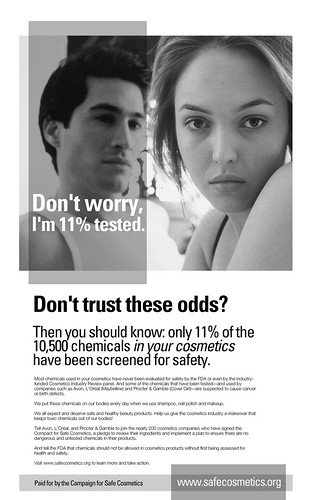
Image credit: Campaign for Safe Cosmetics

This public support is being generated and maintained by advocacy. Advocates try to educate the public about regulatory issues through books, such as Not Just A Pretty Face by Stacy Malkan, which raises concerns about chemicals in personal care products, and Slow Death by Rubber Ducky by Rick Smith and Bruce Lourie, which examines how everyday items we use are polluting our bodies. Advocates also use advertisements to raise awareness about harmful chemicals in makeup, from the Campaign for Safe Cosmetics, or cleaning products, from Method.

In response to public concern, many companies have already begun to reformulate products, removing specific chemicals without government intervention. Two endocrine disrupting chemicals that have already begun to be phased out are BPA, which is used to make reusable water bottles, baby bottles, and carbonless paper receipts, and phthalates, a group of chemicals used to soften children’s plastic toys and to help fragrances last longer.

However, a specific chemical being removed does not guarantee the new product is any safer. Manufactures simply swap one chemical for another, but just like the initial chemical, the alternatives are not being thoroughly tested for safety. It becomes a game of 'whac-a-mole', with
another concerning chemical popping up every time you knock one down. Regulatory changes are critical so that we don’t have to remove dangerous chemicals from products, but instead are preventing them from getting to the market in the first place.

What's the best way to ensure that the environmental chemicals we are exposed to are safe? Research. Stay tuned for the next part of this series on the benefits of Environmental Health Research.

This is Part 8
in the Chemical Exposures and Public Health series.
Part 1 - From Interest to Passion
Part 2 - An Environmental Health Risk
Part 3 - Lead: A Regulatory Success Story
Part 4 - Something My Body Needs Anyway?
Part 5 - Obesity's Elephant: Environmental Chemicals
Part 6 - Why Our Approach to Toxicology Must Change
Part 7 - Failures of U.S. Chemical Regulation
Part 8 - Cleaning Up Our Act
Part 9 - Environmental Health Research Saves Lives and Money
Part 10 - Call to Action

Bookmark and Share

Thursday, May 13, 2010

Failures of U.S. Chemical Regulation

Image credit: Echoey13

In previous posts, I've shared how research demonstrates a link between endocrine disrupting chemicals (EDCs) and negative health effects, such as obesity. Since EDC exposures are a health concern, the government needs to identify chemicals of concern and implement policies to reduce exposures, as was done for lead. Unfortunately, U.S. chemical regulation is not a straightforward process.

Chemical regulation is split between several agencies. Two of the main agencies are the U.S. Food and Drug Administration (FDA) and the Environmental Protection Agency (EPA). The FDA oversees chemicals we are exposed to through certain consumer products like pharmaceuticals, cosmetics, and food additives, while the EPA regulates exposures that are more environmental, such as air pollution.

Some authorities are further split, as is the case for water, with bottled water being regulated by the FDA and tap water by the EPA. As a result, individual contaminants could end having different maximum permissible amounts in bottled vs. tap water.

This fragmented regulation makes it difficult to protect public health. But there were also a large number of chemicals in commerce that were initially unregulated if they were not covered under other existing laws, such as the Federal Food, Drug, and Cosmetics Act which regulates pharmaceuticals. In an attempt to close this gap, Congress passed the Toxic Substances Control Act (TSCA) in 1976, which gave EPA the authority over all unregulated chemicals.

A major flaw is that TSCA treats new chemicals differently than chemicals that existed before the act. Existing chemicals were not evaluated and were just presumed safe. At the time TSCA passed, there were already about 62,000 chemicals in commerce. Regulation of new chemicals isn’t much better and has limited requirements. Companies are only required to submit available data and don’t have to test for toxicity. It is estimated that only 15% of new chemicals have complete health and safety data.

TSCA had the potential to unify regulatory authority, by giving the EPA authority over chemicals of unreasonable risk to health or the environment. For example, BPA is approved by the FDA as an indirect food additive, but because of concerns for human health, the EPA is using its authority under TSCA to investigate BPA.

However, the phrase “unreasonable risk” created another major hurdle, because it places the burden of proof on the EPA, and requires a significant level of evidence prior to regulatory action that can take years to develop. As a result, chemicals are only regulated when proven harmful rather than requiring they are proven safe to enter the market.

TSCA was introduced over 30 years ago. Today, there are over 80,000 chemicals approved for use in the products we use, such as household cleaners, shampoo, and makeup. But to date, the EPA has only been able to regulate 5 chemicals and require testing for about 200. I feel the numbers clearly show that TSCA has failed to protect Americans.

Image credit: Abeeeer

The U.S. Government Accountability Office (U.S. GAO), the agency that evaluates the effectiveness of government programs and policies, also believes TSCA has not given the EPA the necessary authority to protect human health and the environment. U.S. GAO put the EPA's process for "assessing and controlling toxic chemicals" on its "high-risk" list in 2009. The list includes federal programs, policies, and operations that should be a top priority for reform

Currently, Congress is considering legislation to reform TSCA. Senator Frank Lautenberg (D-NJ) introduced a bill called the Safe Chemicals Act of 2010 in the Senate. Representatives Bobby Rush (D-IL) and Henry Waxman (D-CA) have released a discussion draft of the Toxic Chemicals Safety Act of 2010 in the House. Only time will tell if these bills will provide Americans with meaningful reform that will improve public health.

This is Part 7 in the Chemical Exposures and Public Health series.
Part 1 - From Interest to Passion
Part 2 - An Environmental Health Risk
Part 3 - Lead: A Regulatory Success Story
Part 4 - Something My Body Needs Anyway?
Part 5 - Obesity's Elephant: Environmental Chemicals
Part 6 - Why Our Approach to Toxicology Must Change
Part 7 - Failures of U.S. Chemical Regulation
Part 8 - Cleaning Up Our Act
Part 9 - Environmental Health Research Saves Lives and Money
Part 10 - Call to Action


Bookmark and Share

Tuesday, May 11, 2010

Why Our Approach to Toxicology Must Change

Exposures to endocrine disrupting chemicals (EDC) are a particular concern for children. Because children are developing rapidly, hormone disruption can have a greater impact; resulting in chronic health problems or making children susceptible to the development of illnesses later in life.

Research has shown that chemicals in a mother's body are able to cross the placenta, and therefore, children are being exposed to environmental chemicals even while they are in the womb. As infants, they are exposed to chemicals at higher levels because consume more food relative to body weight, but also because their immune systems are less developed, and therefore, less able process and remove chemicals from their bodies.

For lead, proper regulation took several decades because we initially had a poor understanding of its health effects. We face the same problem today with EDCs.

The famous adage the "dose makes the poison" describes the assumption toxicologists use when determining safe chemical exposure levels. Toxicology studies currently assume that a greater dose, or exposure level, will produce a greater effect.

To determine safe exposure levels, animals are exposed to varying amounts of a chemical and a dose that does not produce observable effects is identified. Then, a series of uncertainty factors are applied to that dose in order to calculate an acceptable level for human exposure. The uncertainty factors account for different sensitivities between the animals studied and humans but also to account for varying sensitivities between humans.

So, what is wrong with the current approach?

Scientists who study the endocrine system have recognized for a while that hormones have a different relationship between dose and effect. Hormones and hormone mimicking chemicals, like EDCs, can produce opposite effects at different exposure levels. A low level exposure can turn a process on, while a high level exposure could shut the process off.

Since EDCs have a different dose-effect relationship, the current assumptions used in toxicology studies are outdated. High-dose experiments can not be effectively used to predict low-dose results for EDCs, and therefore, safety testing needs to be adapted to make sure that potential low-dose effects are investigated. In order to address our evolving understanding of endocrine disruption, the Endocrine Disruptor Screening Program was established by the Environmental Protection Agency to develop a battery of tests to properly identify EDCs, information that will enable us to update the way we conduct toxicology studies.

The scientific understanding of how endocrine disruption can be identified and measured is still in the early stages, and research will be our best chance to close these knowledge gaps and identify chemicals that are a real public health threat.


This is Part 6 in the Chemical Exposures and Public Health series.
Part 1 - From Interest to Passion
Part 2 - An Environmental Health Risk
Part 3 - Lead: A Regulatory Success Story
Part 4 - Something My Body Needs Anyway?
Part 5 - Obesity's Elephant: Environmental Chemicals
Part 6 - Why Our Approach to Toxicology Must Change
Part 7 - Failures of U.S. Chemical Regulation
Part 8 - Cleaning Up Our Act
Part 9 - Environmental Health Research Saves Lives and Money
Part 10 - Call to Action


Bookmark and Share

Monday, May 10, 2010

Obesity's Elephant: Environmental Chemicals

Today, obesity is the fastest rising health concern in the U.S. Obesity is a problem that people have tried to use both diet and exercise to combat, yet a growing body of research is suggesting there is another component of this problem, our exposure to environmental chemicals.

Endocrine disrupting chemicals (EDCs) are a public health concern because they mimic natural hormones and interfere with our endocrine system. Research shows a potential link between children being exposed to EDCs during development and the increased burden of chronic health problems, such as obesity.

One EDC you may have heard about recently is Bisphenol-A (BPA). BPA has been used for years in the production of reusable water bottles and baby bottles, but now many companies are now offering BPA-free products.

The reason BPA is becoming a public health concern is that research has demonstrated a link between children's exposure to BPA during critical developmental windows - such as in the womb or as infants - and obesity. For example, Nikaido et al. exposed pregnant rats to BPA to determine the effects on fetal development [1]. The results showed that prenatal exposure to BPA at human-relevant doses accelerated weight gain of the female offspring compared to offspring of the mothers not exposed to BPA.

This study is one of many that demonstrate chemical exposures could be a factor, changing our bodies in ways that make us obese.


References
1. Nikaido, Y. et al. Reprod. Toxicol. 2004; 18: 803-811.


This is Part 5 in the Chemical Exposures and Public Health series.
Part 1 - From Interest to Passion
Part 2 - An Environmental Health Risk
Part 3 - Lead: A Regulatory Success Story
Part 4 - Something My Body Needs Anyway?
Part 5 - Obesity's Elephant: Environmental Chemicals
Part 6 - Why Our Approach to Toxicology Must Change
Part 7 - Failures of U.S. Chemical Regulation
Part 8 - Cleaning Up Our Act
Part 9 - Environmental Health Research Saves Lives and Money
Part 10 - Call to Action


Bookmark and Share

Friday, May 7, 2010

Something My Body Needs Anyway?

Image Source: Time Magazine

The impact of environmental chemicals on health is becoming a defining concern of this century. I’m sure you’ve seen the increasing number of articles published by the mainstream media questioning the safety of chemicals in consumer products, like plastics. Research has shown that these chemicals are getting into our bodies and can mimic our hormones.

Hormones are signals that regulate biological processes by communicating messages to cells. Hormones bind to a receptor like a key fits into a specific lock, which tells the cell to carry out a specific action.

One example is human growth hormone. As children, growth hormone is released in our body to tell limbs and organs to grow. But when we become our adult size, our body stops releasing the growth hormone, so the cells are no longer receiving the message to grow. Hormones are regulated by a group of glands called the endocrine system.

Image credit: Principles and Explorations, Teaching Transparencies.
Copyright 1996 by Holt, Rinehart and Winston.

Certain unnatural chemicals entering our bodies can mimic our natural hormones. They are called endocrine disrupting chemicals (or EDC) because of their ability to interfere with our endocrine system.


The problem with EDCs is that they are not made by your body, and therefore, your body is not able to regulate EDCs like it regulates your natural hormones. But at the same time, EDC’s (green) can bind to the receptors (purple) of specific natural hormones (orange), initiating the same cell response. Research suggests that EDCs artificially switching processes on and off and at the wrong time is contributing to the rising burden of illness in America.

I am particularly interested in EDCs because we are just now discovering the sheer number of chemicals that have the ability to act this way, but we don’t yet know which chemicals, or at what exposure levels, are linked to which real public health threats.

The government again needs to decide if regulatory action is necessary, a decision that depends largely on whether the chemicals pose a threat to U.S. health.


This is Part 4 in the Chemical Exposures and Public Health series.
Part 1 - From Interest to Passion
Part 2 - An Environmental Health Risk
Part 3 - Lead: A Regulatory Success Story
Part 4 - Something My Body Needs Anyway?
Part 5 - Obesity's Elephant: Environmental Chemicals
Part 6 - Why Our Approach to Toxicology Must Change
Part 7 - Failures of U.S. Chemical Regulation
Part 8 - Cleaning Up Our Act
Part 9 - Environmental Health Research Saves Lives and Money
Part 10 - Call to Action

Bookmark and Share

Thursday, May 6, 2010

How Clean is Your Air?

Yesterday, Sarah wrote about how removing lead from gasoline decreased air pollution and improved health. While lead is no longer a threat, there are still plenty of chemicals in the air. Interested to see how your city and state are doing? Check out this project by the American Lung Association, which details (and grades!) cities and counties based on ozone and particle pollution.

Based in the DC metro area, I knew New Voices probably weren't breathing the cleanest possible air, but it's interesting to compare our air to the city immediately next to ours and see notable differences. How did your city do? And if you live in a failing area (as I do), what are you going to do about it?

How about sending a note to your member of Congress about the value of research:
With continued investment in research and the work at the National Institutes of Health’s National Institute of Environmental Health Sciences, the Centers for Disease Control and Prevention and other government agencies, we can continue to find the answers we need to improve the quality of air we breathe.

Thanks to Jennifer Chow for her help constructing this post.

Bookmark and Share

Wednesday, May 5, 2010

Lead: A Regulatory Success Story

Research!America's former chairman, the Honorable Paul G. Rogers recognized that environmental factors played a major role in health effects and was a consistent advocate for changing environmental policy to improve public health. His work to pass the Clean Air Act is actually part of a larger story about how research played a major role in the 20th century guiding policy to successfully regulate lead.

Today, we know that lead exposure is a problem for children’s health, but this wasn’t always the case. Research evolved the scientific understanding of lead poisoning, which can be broken down into four stages [1].
  1. Children assumed not to be affected by lead
  2. Cases of acute lead poisoning were identified but were thought to result in either death or recovery
  3. Lasting mental deficits only occur when children had clinical symptoms of lead poisoning
  4. Children without clinical symptoms can still have mental deficits in language, IQ, or attention
In response to research, the Center for Disease Control and Prevention (CDC) adjusted its definition of a safe blood lead level for children, which prompted regulations to reduce lead exposure.


There were two major sources of lead exposure for children: leaded gasoline and lead paint.

Lead was a standard additive in gasoline, but in 1965, research demonstrated that the increased lead concentrations in the air were the direct result of human activities, like burning leaded gasoline. This clear link between air quality and health was why Paul Rogers led the fight to pass the Clean Air Act. Passage of the Clean Air Act paved the way for the phase-out of lead in gasoline by 1996.

Lead based paints were commonly used in homes in the early 1900s. Research linking lead exposure to children's health effects prompted a 1978 federal limit on the lead content in paints used in residential buildings.


Together, these policy actions were extremely successful at reducing lead exposure. Banning leaded gasoline reduced the average air lead concentration by 94%. This ban, in conjunction with the limit on the lead content in paint, reduced the average blood lead level in children more than 7 times below the 1970s level.

This reduction in the United States is estimated to have resulted in an economic gain between $110 and $319 billion dollars for children born in a given year [2]. This economic gain was calculated using the increased worker productivity that will result from the improved cognitive ability of children with lower lead exposures.

Lead regulation is a great example of how research can lead to policy changes that can benefit public health and save money.


References
1. H. Needleman. Annu. Rev. Med. 2004; 55: 209-222.
2. Grosse, S.D. et al. Environ. Health Perspect. 2002; 110: 563-569.


This is Part 3 of 10 in our Chemical Exposures and Public Health series.
Part 1 - From Interest to Passion
Part 2 - An Environmental Health Risk
Part 3 - Lead: A Regulatory Success Story
Part 4 - Something My Body Needs Anyway?
Part 5 - Obesity's Elephant: Environmental Chemicals
Part 6 - Why Our Approach to Toxicology Must Change
Part 7 - Failures of U.S. Chemical Regulation
Part 8 - Cleaning Up Our Act
Part 9 - Environmental Health Research Saves Lives and Money
Part 10 - Call to Action


Bookmark and Share

Tuesday, May 4, 2010

An Environmental Health Risk

Feeling The Heat (8396)
Image credit: Echoey13

How often do you think about the chemicals in products you buy and if they could affect your health? We use a number of products every day from shampoo to cleaning products and we expect that the government regulates these products to make sure they are safe.

Unfortunately, in the past, certain chemicals have been discovered to affect our health only after they reached the market, as was the case for lead paint. Today, this is happening again with a group of compounds called endocrine disrupting chemicals, which mimic our hormones.

WWII increased demand for products, resulting in the development new uses for natural chemicals, which exposed us at higher levels, and the acceleration of the production of chemicals not previously found in nature. But no one thought about potential effects on our health, until Rachel Carson published Silent Spring. Her book raised awareness that chemicals could interact with our bodies.

Image credit: Beverly & Pack

Carson published evidence that the pesticide, DDT, had put the bald eagle on a path towards extinction, and if it was hurting wildlife, it could potentially be harmful to humans as well. DDT was considered a miracle pesticide and was used for everything from combating malaria to protecting cotton. However, Carson's book spurred national action that ultimately led to a ban of DDT.

Silent Spring was the beginning of an environmental movement, which I'll share some results of in more detail tomorrow.


This is Part 2 of 10 in our Chemical Exposures and Public Health series.
Part 1 - From Interest to Passion
Part 2 - An Environmental Health Risk
Part 3 - Lead: A Regulatory Success Story
Part 4 - Something My Body Needs Anyway?
Part 5 - Obesity's Elephant: Environmental Chemicals
Part 6 - Why Our Approach to Toxicology Must Change
Part 7 - Failures of U.S. Chemical Regulation
Part 8 - Cleaning Up Our Act
Part 9 - Environmental Health Research Saves Lives and Money
Part 10 - Call to Action

Bookmark and Share

Monday, May 3, 2010

From Interest to Passion


As a kid, I was always vocal about my concern for the impact of pollution on the environment. Back in March, I wrote a more detailed post about my interests, but here is a recap:

I wrote a letter to President Clinton when I was eleven, on U.S. international environmental policy. In seventh grade, we were required to conduct a science fair project, and clearly my project focused on an environmental problem. I investigated the effects of chemicals in products we use, like antifreeze or detergent, on plant growth. As I expected, my research findings showed that nearly all the plants were less healthy than the unpolluted plants (I've included a photo of one of the posters as proof). Looking back, I now like to think of this project as foreshadowing.

Shortly after, I became interested in the clear connection of environmental pollution and human health. I studied chemistry to gain an understanding of how chemicals interact with our environment and our bodies. While my doctoral research was not directly environmental, I took every liberty I had to learn about current environmental problems. My graduation requirements included designing a research project outside of my field. I used that opportunity to learn about bioremediation, or using nature as a tool to remove contaminants from the environment. Specifically, I was looking to solve the problem of the estrogen from our birth control getting in the water, since research was showing it was causing developmental problems for male fish.

Here at Research!America, my policy project continued the theme and had an environmental focus. I examined the intersection of Chemical Exposures and Public Health, which is becoming a defining concern of the century. Environmental health research is on of the most direct ways the U.S. can use research and prevention to save both lives and treatment costs.

Over the next 9 posts, I will share with you my research results, tell you about the things I believe we need to be concerned about, and finally what actions we can take to make a positive change.


This is Part 1 of 10 in our Chemical Exposures and Public Health series.
Part 1 - From Interest to Passion
Part 2 - An Environmental Health Risk
Part 3 - Lead: A Regulatory Success Story
Part 4 - Something My Body Needs Anyway?
Part 5 - Obesity's Elephant: Environmental Chemicals
Part 6 - Why Our Approach to Toxicology Must Change
Part 7 - Failures of U.S. Chemical Regulation
Part 8 - Cleaning Up Our Act
Part 9 - Environmental Health Research Saves Lives and Money
Part 10 - Call to Action

Bookmark and Share

Thursday, April 22, 2010

Environmental Re-Revolution

Happy Earth Day, New Voices! Today is the 40th anniversary of Earth Day. The first Earth Day was held in 1970; founded by Senator Gaylord Nelson. After seeing the devastation caused by a massive oil spill off the coast of Santa Barbara in 1969, Senator Nelson was infuriated by the lack of action in Washington, DC. He suggested holding a nationwide “teach-in” in response to growing environmental degradation.

Nelson said, “I was satisfied that if we could tap into the environmental concerns of the general public and infuse the student anti-war energy into the environmental cause, we could generate a demonstration that would force this issue onto the political agenda.”

At the end of the day, it was clear Earth Day was a success. The widespread involvement has been attributed to the grassroots organizing, with more than 20 million people participating. April 22, 1970 was the first Earth Day, but also marked the beginning of the modern environmental movement.

Forty years later, Earth Day is more widely attended and has become an international celebration. However, the event does not carry the same sense of urgency. Recent polls highlight the trend of the American public’s dampened concern over environmental issues. Americans increasingly believe that environmental issues, such as climate change are being over exaggerated.

Image credit: Gallup

This societal shift is, in part, because the environmental threats we face today are not things we can easily observe. In the 1970s, celebrating Earth Day was taking action against clouds of smog in Los Angeles, oil soaked wildlife that companies were not held accountable for, and a river in Ohio that caught fire. Today, Earth Day raises awareness for several environmental issues that are difficult to perceive for most Americans. Worldwide, drinkable water is becoming scarcer, yet in the U.S. it flows freely from our taps. The average global temperature has been on a long-term upward trend, but this winter Mother Nature crippled cities like Washington, DC and Baltimore, MD with record-breaking snowfall.

It is time to renew the call to action. Here's a powerful video put together by Greenpeace, evoking the memory of JFK to deliver a call to action for world leaders to address environmental issues, such as climate change.


Video credit: Greenpeace


This Earth Day make the commitment to advocate for environmental protection, and to also make small changes in your life that could really add up if they became part of a revived movement. Here is a list of some things you can change right now to make a difference:

If you aren’t using it, unplug it.
Even though you’ve turned an appliance off, if it is plugged into an outlet it is still drawing power. Unplugging appliances could result in a reduction in 10% of your household energy use, which can add up to real savings. If you appliances are plugged into a power strip, you can simply turn the power off.

Switch from bottled to filtered water. Bottled water requires much more energy to package and ship AND it costs you more money in the end.

Eat less meat. Meat production is estimated to produce 18% of global CO2 emissions.

Eat local. I was surprised to learn that the food we buy in the supermarket has traveled 1,500 miles on average to get from where it is grown to our plate. That requires a large amount of energy used just to move your food from point A to your plate.

Stop the leaky faucet. Not only is it an irritating sound to hear, it is also costing you money. The EPA website has some information about how you can do-it-yourself.

Be mindful of your water usage. Do you ever notice the person in the public restroom who leaves the water running not only while they lather their hands, but also while they go for the paper towels to dry off? I sure do. There are many times you can conserve by not leaving the water running, like washing your hands, brushing your teeth, or hand washing dishes.

Reduce Toxic Exposures. The EPA has started a great program called “Design for the Environment.” Companies with the label have worked with the EPA to reformulate products with safer chemicals.

Recycle Your Electronic Waste. Seventy percent of the heavy metals that end up in our landfills come from our discarded electronics, even though they are only about 2% of our discarded waste. Recycling keeps these toxic chemicals out of our environment.

How will you celebrate?

I myself will be attending “The Climate Rally” Earth Day event which is taking place this Sunday on the National Mall in Washington, DC. Festivities start at 11am and go on until at least 7pm. So if you are in the DC area, stop on by!

Bookmark and Share

Tuesday, March 23, 2010

Advocating Outside the Box (Or Outhouse?)

Photo Credit: NRDC

Think back to a time that you were so concerned about an issue that you took action. What did you do to make your opinion heard?

As a kid, I always felt the word advocate carried a connotation that made it only applicable to people who took significant action to fight for a cause, like Martin Luther King Jr., for civil rights, or Rachel Carson, for the environment. However, I now understand that advocacy is simply taking action to promote change no matter how simple the action may seem.

Advocacy includes a wide range of actions from the classics - such as lobbying, protests, and civil disobedience - to newer actions that are developing alongside technology. As the internet became a fixture of everyday life, we saw a rise of electronic advocacy, which can include spreading news on social-networking sites or using the internet to organize collective actions like email campaigns.

Increasingly, events are being organized through viral marketing, which takes advantage our tendency to post information to sites like Twitter to disperse information through a self-replicating process similar to how viruses spread.

A recent example of viral marketing includes mass actions organized for World Water Day. March 22nd was designated in 1992 by the United Nations as an international day to raise awareness about the world’s water crisis.

This year, a large number of people celebrated World Water Day as advocates by participating in a global mass action. Thousands of people in over 72 countries stood up for clean water and sanitation by lining up behind a toilet. The purpose of this event, aptly called the World’s Longest Toilet Queue, was to bring people together to voice their support for international government action to fight the water crisis.

This international event was organized promoted using social sites like Facebook and Twitter. A queue was even formed near New Voices neighborhood today, on Capitol Hill in Washington, DC!

More pictures across the globe can be seen at the World’s Longest Toilet Queue’s Flickr page.

The Toilet Queue wasn’t the only event held for World Water Day. Did any of you, our readers, participate in events? We’d love to hear about it!

Bookmark and Share


Friday, March 12, 2010

Looking Forward to Spring


Winter is my favorite season; but only for three reasons: my birthday is in February, I'm from the Midwest and I adore snow. Most people dread cold weather and the short days of winter, but the colder months can also be a time where some are more prone to sadness or depression.

Seasonal Affective Disorder (SAD) is a type of depression that linked to seasons. People may find that in the winter that they have intense cravings for carbs, afternoon slumps, increased appetite with weight gain, and excessive sleepiness during the day. If you are diagnosed with SAD, treatments include therapy and exposure to special light that imitates sunlight.

Scientists have been studying vitamin D, the “sunshine vitamin”, as a possible link to SAD. Since sunlight is decreased in winter months, Vitamin D levels can also decrease in the body. As of now, research is inconclusive about Vitamin D’s effects, but it’s still beneficial to ensure that you get your daily requirements in for good nutrition. Research shows that vitamin D can prevent colon and breast cancers, osteoporosis and heart disease. Some great sources of vitamin D are milk, whole eggs, tuna, salmon and mackerel.

Growing up in Milwaukee, I knew spring was coming when robin red breasts started hopping around the city. Since I’m new to the DC area, I hear the thing to do to celebrate the end of winter is to visit the Cherry Blossom Festival. What plans do you have to welcome back warmer weather?

Bookmark and Share