Friday, May 29, 2009

Soda as Sin


As we work towards raising the NIH budget and improving the quality and quantity of research in this country, it’s important to think about how it can all be paid for - especially when we take into account the current health care reform proposal set to cost about $700 billion over 10 years. Given the current economic crisis, people are naturally curious about where the government is going to come up with $70 billion a year. One of the most intriguing possible solutions: a soda tax.

As anyone who was ever gone on a diet or attempted to begin a program of regular exercise knows, changing established behavior patterns is difficult even when you know it’s good for you (and sometimes because you know it’s good for you). So the appeal of the soda tax is two fold:
  1. It has the potential to provide significant revenue streams to help defray the cost of health care
  2. It will discourage people from drinking soda which will have a positive impact on health.
The question then becomes, what does a soda tax have to look like in order to dent the health care costs? And, assuming there is a drop in consumption that corresponds to the price increase, will it help America’s ever expanding waistline?

It’s helpful to compare soda with other items subject to a sin tax: cigarettes and alcohol.


Cigarettes recently underwent a 150% tax increase from $0.40 to $1.01 per pack, but even at the previous tax rate, federal revenues on cigarettes came to approx $15B in 2007. That’s both a lot of money and absolutely shocking number of cigarettes (assuming 20 cigarettes a pack, that’s 750 trillion and an entirely separate health problem).

Alcohol gets a tax rate that differs between beer, wine and spirits, but combined the sin tax brings in around $5B. If we use the beer tax of $0.05 as a guideline for a potential soda tax, we get some large numbers.

Last year Americans consumed 10.2B cases of soda (at 24 cans in a case thats 244,800,000,000 cans). Not diet soda mind you, the incredibly sugary (and better tasting if we’re honest) soda. If we apply the beer tax of $0.05 to this, we get $12.4B in revenue or 19% of President Obama’s proposed health care initiative. This doesn’t affect diet sodas, juices or iced tea. That’s 19% of the massive health care reform taken care of being charging you an extra nickel for your coke.

That's a ten percent increase on a can of soda bought in a 12-pack. In the past a 10% increase in the price of soda saw a decrease in consumption of as much as 8%. Now correlation is not causation, but it’s impossible to look at those numbers and not see that they’re linked.

The economically disadvantaged are most at risk for obesity and part of that is they are the leading consumers of soda. Soda is often the cheapest item in the store.


So, to some degree, the tax targets the economically disadvantaged. But, they stand to benefit the most from the proposed health care reform this kind of economic behavioral incentive is designed to support.

As for those who think this kind of economic incentive doesn’t work, try to remember that 42% of Americans smoked in 1965. 42%. While health awareness campaigns have certainly played a role in the decline, the rising cost of cigarettes (primarily due to taxation) has significantly contributed to the decline of American smokers.

We can’t begin to confront the obesity problem until we begin to confront the sources of that problem. It’s nice to encourage exercise and diet as a means of losing the weight, but the best medicine is the preventive kind. I think if we can cut soda consumption and pay for 19% of a reformed health care system, I say bring it on.

Besides, I’m a juice drinker anyways.


Sources:
All tax data taken from www.taxpolicycenter.org
Price data taken from www.peapod.com

Thursday, May 28, 2009

So long, and thanks for all the fish


Chronicles of a Science Policy Fellow
I'm moving on - to what , I don't know yet. Along the way, I've learned some lessons to live by and I thought I'd share.

#1. I'll always be a scientist.
I had just started my policy fellowship when I met Famous Scientific Organization Head. I was stammering, awed that I was in his presence when he asked me what I did. I said
"Well, I used to be a scientist...". He interrupted me and said,
"You'll always be a scientist. You may not be at the bench, but you'll always be a scientist. Never forget that."
He's right. I'll never stop analyzing, asking the how? when? where? why? weighing evidence and in general seeking out answers and information. I'll always be a scientist.

#2. People will surprise you.
People will surprise you- with their kindness, generosity, patience and willingness to help. They will also surprise you by letting you down, disappointing you, being mean and being (seemingly) irrational. For every mentor, superior, person-I-looked-up-to who let me down, I found someone else who helped lift me up. People who (I thought) didn't know or wouldn't care found the time and the energy to be there for me. I will always be grateful for them and now I know that I will keep finding them in unexpected ways and places.

#3. Its okay to not have all the answers.

When I was in high school I wanted to be a zoo-keeper. I love animals and I really wanted to work in conservation. In my senior year, I took a class in genetics and I loved it. I decided to do research and pursue a Masters' in life sciences.

I worked in a lab that summer, in a famous research institute. The lab was looking at the genetic basis of diseases like schizophrenia. I loved being in lab. I still remember the first time I extracted genomic DNA - no fancy kits back then, it was the ole' phenol-chloroform and the glass stick to spool the long, beautiful threads of genomic DNA. I remember calling my Mom from lab, breathless and giddy..." Guess what? I isolated DNA today."

That made me decide to get my PhD.

I worked in a fruit-fly lab researching embryonic development. At that time, all I wanted to do was become an academic researcher. I thought I finally knew the path, the way. I was fairly good at what I did- picking up awards and publications. I loved the work itself, so I thought I was all set.

But, I found myself becoming more and more drawn to the world of policy and advocacy. It took me a long time wrestling with the idea of leaving the bench and the goal of running my own lab, before I finally made peace with it. I decided to do the policy fellowship. It has been an extremely rewarding experience and I've enjoyed every minute of it.

What I'm trying to say is:
It's okay to change your mind.
It's okay to let life happen to you.
You don't have to know exactly what you'll be doing 10-20 years from now. And that's okay too.
So, dear readers, its been fun and I'm sure I'll run into you again in the blogosphere.


FlyGal is stepping down as a regular blogger for New Voices after four months of insightful posts. Her last regular post will appear next Monday. We love hearing her perspective and look forward to seeing her back as a guest blogger in the future.

Wednesday, May 27, 2009

Advocating for Human Capital

Welcome to Part 6 in our series on Human capital and knowledge-based economy.

In the past we have examined what it takes to train a scientist and how tough the competition is to become an independent researcher. The statistics look rather bleak for Dr. Cy Ence and his band of fellow researchers. So what can we do about it?

Become advocates for science and scientists.

Funding science (and therefore scientists) is not only about satisfying our intellectual curiosities and finding cures for diseases, today it is about having an edge in the knowledge-economy. Training and supporting the next generation of researchers ensures our capacity to continue innovating and thus continue to be a competitive economy.

When people want to know why we should care about research and researchers, you can tell them all about the issues we explored in the last 4 posts. You can talk to them about the predicament of the current generation of post-docs and grad students and you can pull out statistics and numbers. You can also make three simple points:
  • Research is the foundation for a better tomorrow.
  • Investing in research ensures that we will have a better quality of life.
  • Research will also allow us to have a healthy, strong and vibrant economic future.
If you're reading this, you already have the foundation you need to become a strong advocate for science. Here are some simple steps:

We hope you've enjoyed our series on Human capital and knowledge-based economy and we look forward to your comments and thoughts.


This is Part 6 of 6 in our Human Capital and Knowledge-based Economy series.
Part 1 - A Knowledge-based Economy
Part 2 - U.S Competitiveness and Innovation

Part 3 - The Making of a Scientist
Part 4 - From Training to Practice: Joining the Faculty
Part 5 - A Race to Save the Lab Rats
Part 6 - Advocating for Human Capital

Tuesday, May 26, 2009

A Race to Save the Lab Rats

Welcome back to our series on Human Capital and the Knowledge-based Economy.

Today we will continue examining Dr. Cy Ence's career path.

Assuming Dr. Ence does get a tenure-track position at Prestigious American University, he now has to find money to run his lab. Since he is in the life sciences, he will have to do that by getting some grants funded.

First, he (and/or his students) will have to collect preliminary data in support of his research hypothesis. Based on the initial results, he will have to write a research proposal and submit a grant to a funding agency. The largest funding agency in the life sciences is the National Institutes of Health (NIH). There, his grant will be reviewed by a committee of his peers and then further by a committee of professional grant managers. Then his grant will be scored and depending on his score, he may or may not get funded.

Just like when he was applying for faculty positions , the numbers don't look so good for Cy. The number of first time NIH grant winners has declined from about 1,800 in 1980 to about 1,350 in 2007.

One reason for this is an increasing hyper-competitive environment for grants. When Dr. Ence starts up his lab, he will be competing with established researchers who have had labs for five, ten, or 15 years and therefore 5,10 or 15 years to establish themselves as opposed to our favorite newbie Cy. They are all applying for the same pool of money, and grants are graded and scored the same way.


A result of this system has been a steady decline in the number of first time investigators as compared to established investigators winning grants in any given year. It has gone from about 40% of first time investigators being successful in the early 60's to only about 24% being successful in 2006.

Why is this important?

When a researcher can't get funding, they are basically unable to keep their research program going - meaning no money for research personnel, for chemicals, for animals etc. It means that
they can't carry out experiments in a timely fashion, which results in few or no publications which in the worst case scenario means that they run the risk of losing their lab.

The current crop of graduate students and post-docs are watching this happen around them everyday and fewer and fewer of them want to even attempt a career as faculty in academia.

Basically, we are pulling the rug from underneath the feet of the next generation of academic researchers.
You can lose a generation of researchers pretty fast—in five or ten years. Once it happens, we won’t get those people back.”
Joshua Boger, PhD
founder, Vertex Pharmaceuticals,
& chairman, BIO
Another consequence of this funding environment has been the reluctance of granting agencies to fund the more high-risk, high-reward projects.There is a limited pool of resources which they are responsible for distributing and are also accountable for. So, they have done what every other agency in their position would do- they have chosen to bet on the sure horse; they primarily fund more traditional, conservative science. This means that although we are making steady progress- it is progress in small steps instead of progress in leaps and bounds.

So, is everything just dismal and negative? Should we just give up?

On Thursday we'll wrap up this series by responding to your comments and suggesting next steps for improving the way our country invests in the future of science.


Sources: National Institutes of Health (NIH)/Office of Extramural Research (OER), A broken pipeline?


This is Part 5 of 6 in our Human Capital and Knowledge-based Economy series.
Part 1 - A Knowledge-based Economy
Part 2 - U.S Competitiveness and Innovation

Part 3 - The Making of a Scientist
Part 4 - From Training to Practice: Joining the Faculty
Part 5 - A Race to Save the Lab Rats
Part 6 - Advocating for Human Capital

Click image for full comic strip. Credit: PhD Comics

Monday, May 25, 2009

Memorial Day


New Voices is officially off today in remembrance of the brave men and women who lost their lives defending the United States of America. We thank all of our armed forces for serving our country and preserving our rights to life, liberty, and the pursuit of happiness.

In that pursuit of happiness, we're also celebrating Towel Day. Bring your towel with you as you head out to those neighborhood picnics and barbeques and come back on Friday when we more thoroughly expand on a great science fiction theme.

Happy Memorial Day!

Friday, May 22, 2009

Upcoming Town Hall Meetings


There's nothing more American than apple pie, baseball, picnics, and town hall meetings. Okay, so not all of those things are your first thought on an upcoming long weekend, but we're advocates, right?

With the upcoming Memorial Day recess, many Members of Congress will be in their districts this week having town hall meetings. We hope you'll take some time to go and talk to your elected officials. Here are some of the Members who'll be out and about this week:

Thursday, May 21, 2009

How To: Make an Appointment with an Elected Official

There's no better way to let your elected officials know what's on your mind than to actually tell them. The U.S. Congress will be on Memorial Day recess next week (Tuesday, May 26 to Friday, May 29) so many Members will be at home in their districts. Save yourself a trip to DC and make your appointment to meet with your Member today!

But how do you make an appointment? Below we've outlined 5 simple steps to make an appointment with your elected official. Our model is based on meeting with Members of Congress, but the same basics are applicable whether you're trying to meet with a member of the school board or the majority leader of your state senate.
  1. Request the meeting as far in advance as possible, but no more than a month out. (Schedules won't be set and it'll be hard to set a firm date and time.)
  2. If the Member is not available, accept a meeting with the appropriate staff person. Staff are influential and a great resource - meeting with them is as valuable as meeting with your elected official.
  3. When calling or emailing an office, ask for the scheduler’s name so you can address them directly.
  4. Send the meeting request per their preference.
    • Include your complete contact information.
    • Clearly state what issue or topic you wish to discuss, so the scheduler can direct you to the right staff member if your Member is not available.
    • Save other background materials for your meeting.
5. Follow-up by phone and email.
    • Meetings with Members may not be secured until a day or two before the meeting.
    • Be flexible – every office is different!
Any readers have other tips for making an appointment?

Wednesday, May 20, 2009

From Training to Practice: Joining the Faculty

Welcome to Part 4 of the Human Capital and the Knowledge-based Economy series. Last time we examined the investment needed to train a single independent researcher - Dr.Cy Ence. Today, lets look at what it will take for Dr. Ence to become an independent researcher at Amazing American University.

But before that a quick re-cap: Dr. Ence is now in his late 30s. He has finished 7 years of graduate school and 9 years of post-doctoral training. He has published great articles, attended conferences and given talks. He's putting together his curriculum vitae (CV), so he can start applying for jobs as an assistant professor. What are his chances?

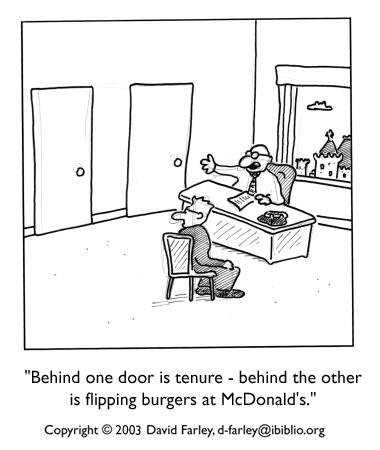
According to a forum convened by the National Academies, the chances of a life scientist under the age of 35 getting a tenure-track position fell from 10% in 1993 to 7% in 2003; as the number of life sciences PhD graduates went from 11,000 to 16,000 and tenure-track positions held steady at about 1,200 positions. That means that Dr. Ence has to be one of the top 7 out of every 100 life science PhDs applying for a job as an independent researcher to get the position.
“These trends have made job competition among young scientists very Darwinian.”
~Norka Ruiz Bravo, former deputy director for intramural research at NIH

In medical schools the numbers are worse. In the graph below, the blue bars represent the total number of medical school faculty members with a PhD and the red bars are the number of new faculty hires with a PhD in a given year. The green trend line represents the percentage of new hires when compared to the total number of faculty with a PhD.

Graph 6 - Trends in Medical School Faculty Positions
So, for example in 1970, the total number of PhD faculty in med schools* was about 8,800 and med schools hired about 1,100 new faculty with a PhD, which is about 13% of the total. By 2006, the number of faculty with PhDs in med schools had increased to about 38,000. But, only about 1,100 new faculty were hired meaning a increase of about 3%.

These are dismal numbers. Cy and others like him have an incredible battle before them. Why is it so difficult to get a faculty position? How did the competition get so steep? What happens after getting a faculty position? Is everything roses then?

We'll explore these questions and more next week, as we continue our series on Human Capital and Knowledge-based Economy.


*Medical schools certainly hire MDs, MD/PhDs and other graduate degree holders, but this just looks at PhD hires because it is the most reliable and readily available data.


Sources: National Institutes of Health (NIH)/Office of Extramural Research (OER), Association of American Medical Colleges (AAMC)


This is Part 4 of 6 in our Human Capital and Knowledge-based Economy series.
Part 1 - A Knowledge-based Economy
Part 2 - U.S Competitiveness and Innovation

Part 3 - The Making of a Scientist
Part 4 - From Training to Practice: Joining the Faculty
Part 5 - A Race to Save the Lab Rats
Part 6 - Advocating for Human Capital

Tuesday, May 19, 2009

New Voices in Scientia Pro Publica

Image credit: Jacques Marcoux

Congratulations to New Voices guest bloggers Tyrone Spady and Pascale Quignon for being featured in Scientia Pro Publica #4! Their April 15th post On Dogs and Research discussed the genetic variation in man's best friend and how research in animals can improve human health as well.

Scientia Pro Publica is a blog carnival that highlights the best science blogging written for the public. The carnival appears bi-weekly in the blogosphere and this fourth edition is being hosted by Eric Johnson at The Primate Diaries.

Thank you to Eric for selecting Tyrone and Pascale and a special thanks to GrrlScientist* for getting this amazing carnival started.

Go check out all the featured pieces!


*If you love libraries, help GrrlScientist advocate for the New York Public Library.

Monday, May 18, 2009

The Making of a Scientist

Welcome back to the Human Capital and Knowledge-based Economy series. As I mentioned in previous posts, the economy is changing and ideas and innovation are drivers of the knowledge-based economy. Hence, researchers are one of the bases of the economic infrastructure. I've examine what it takes to train a researcher- the investment needed both financial and in terms of time and I wanted to focus on life scientists.

To become a researcher today one can take many routes, and the options are ever increasing. To make things easier lets follow the journey of Cy Ence. He's about to finish his first year in kindergarten, and though he doesn't know it yet, he has just taken his first step on his path towards becoming an independent researcher. Like many who'll enter the life sciences, Cy will eventually want to become an independent academic researcher* (a principal investigator or PI) so he can spend his days working in his own lab at a university.

But that's a long time from now. Right now, he's looking forward to a summer of catching tadpoles and we're going to look at how much time and money it's going to take to get Cy from Hometown Elementary to his dream job. All of this will be based on using the most recent numbers available and assuming that nothing changes in the next 30 some-odd years.

So here's Cy's basic path**:
  1. K-12 Education (13 years)
  2. College (4 years)
  3. Graduate School- PhD (7 years)
  4. Post-doctoral training(2-7 years)
  5. Independent researcher
Step1- K-12 education.

The Department of Education charts the average cost per student per school year across the U.S. They have been maintaining their records going back to the early 1900s. I've started in the late 70s- a time when some of you (and many of today's young researchers) started school.

Graph 1 - U.S Investment in K-12 education

In the late 70's, the average investment per child per school year was $1,855. Today, that figure stands at $8,701. These are just the directly measurable costs meaning, teacher's salaries, school lunches, books etc., so the actual number is a lot higher. But, for simplicity's sake, we'll stick with the smaller and more easily obtainable data.

So the investment in young Cy (@ $8,701 / year - if nothing changes) - will be about $113,000.

After he graduates high school, Cy will be heading off to Average American University.

Graph 2 - Average Annual Cost for U.S. Undergraduate Education (room, board, tuition)

As the graph shows, the investment in room, board and tuition alone per student per year of college across the U.S (both public and private schools) was $7,452 in the early 90's. Today, that figure is about $14,629. This of course, does not take into account all the other expenses associated with college - books, transportation, beer and the like.

For Cy - the minimum investment will probably be about $58,000 and 4 years.

Since Cy Ence, B.S. will not be enough for our favorite student, he's going to head off to another university to work towards his PhD. Assuming it takes him the median seven years*** to finish his doctoral degree, the total investment for his graduate stipend will be about $145,000. This is not accounting for the reagents he uses for his experiments, his animals etc.

Graph 3 - Average Annual Graduate Student Stipends


Now it is officially Dr. Cy Ence and he is well on his way to becoming an independent academic researcher. In the life sciences, there is often one more step: post-doctoral training. Post-docs can range from two to seven years and it is becoming common to do more than one post-doc.

Graph 4 - Average Annual Post-doc Stipends


Since Cy Ence, PhD is the average American researcher, he is not going to immediately find a permanent academic position. Instead, he is going to follow his first (short) post-doc with a much longer one. When he is finally done being a student (29 years from now), the minimum investment in his education and training will be about $633,000 dollars.

Graph 5 - Total Educational Investment in Cy Ence
That's right. Training a single independent researcher requires a minimum investment of $630 thousand dollars and over 30 years.

We'll continue following Cy and discuss what the future holds for him as we continue our series on Wednesday with a look at the competition for academic positions and how independent researchers are funded.


*Independent researchers can be employed in many sectors - Academia, Industry, Government etc. I have chosen to focus on Academia because, our current graduate curricula are largely structured to train Academic researchers.

**This is the most common path today, but by no means the only path taken to become a researcher ;some people go to community college first or work towards Masters, Medical, or Veterinary degrees, etc. before becoming researchers.

*** According to NSF, the median time for graduating with a PhD in the life sciences today is 7 years.

Sources: Department of Education, National Center for Education Statistics, National Institutes of Health (NIH)/Office of Extramural Research (OER), National Research Service Award (NRSA), National Science Foundation (NSF)/Division of Science Resources Statistics (SRS).


This is Part 3 of 6 in our Human Capital and Knowledge-based Economy series.
Part 1 - A Knowledge-based Economy
Part 2 - U.S Competitiveness and Innovation

Part 3 - The Making of a Scientist
Part 4 - From Training to Practice: Joining the Faculty
Part 5 - A Race to Save the Lab Rats
Part 6 - Advocating for Human Capital