In Wednesday’s post, Where Football and Brain Science Collide, I introduced some emerging science that suggests a link between sports injuries and a condition called chronic traumatic encephalopathy. On that same day, there was a hearing held by the House Judiciary Committee to discuss the very same issue.
The reports are out, and apparently, there were some heated moments. The main highlights that have everyone talking... Rep. John Conyers (D-MI-14th) showing no mercy as he asked NFL commissioner Roger Goodall to directly state if there is a link between head injuries on the football field and brain disease later in life, and Rep. Maxine Waters’ (D-CA-35th) stern rebuke of Goodell and the NFL's inaction, following this by suggesting that the time has come for Congress to review the antitrust exemption for broadcasting that is arguably responsible for the multi-billion dollar industry that is now the NFL.
In all, the result of the hearing was a call for further review of the data that started this discussion, a good first step to protecting these athletes. Another positive result… the formation of the Concussion and Traumatic Brain Injury Committee by the NFL Players Association.
To read the Associated Press article covering the hearing, click here.

Friday, October 30, 2009


Thursday, October 29, 2009
The History of Public Health
On the Monday before Thanksgiving, Research!America and leading public health organizations take time to recognize public health professionals who work tirelessly every day to protect us. From the ordinary to the extraordinary, these heroes keep our drinking water safe, air clean and children healthy. Read about the work some public health heroes are doing around the country.
In anticipation of Public Health Thank You Day, I’m doing a series of posts on the history of public health and medicine. Beginning next week, we’ll post three entries highlighting different eras in history: one focusing on ancient times, another on the 1800s, and one about the 20th century.
To provide some context, I’ve created a short timeline about public health and medical history. It is based primarily on the 1993 edition of George Rosen’s A History of Public Health, and will hopefully give you a sense of the underlying principles of public health as well as how far we’ve come.

 The Ancient Era (800s BCE-500s CE)
A focus on cleanliness, sanitary measures including public baths, and the availability of public hospitals and city physicians helped to keep ancient societies healthy. Doctors also developed methods for diagnosing disease and determining how it spread.
The Middle Ages (400s-1500s)
High population densities resulting from the urbanization of Europe during this time led to sanitation problems and hastened the spread of disease, especially among the poor. In response to these problems, societies introduced public health improvements that included greater numbers of hospitals, hospices, and bathhouses; better treatments for disease were also sought.
The Renaissance (1300s-1500s)
Greater interest in science generated advancements in medicine and public health. Work by people like Andreas Vesalius, who studied human anatomy, and William Harvey, who discovered circulation of the blood, increased society’s knowledge about the body’s structure and functions. The transmission of disease to new places with military explorations, trade, and travel provided new information about how disease spreads. Statistics emerged as a useful tool for investigation.
Early Modern Period (1500s-1700s)
Public welfare became increasingly entwined with state welfare as governments connected the health of their country with the state’s power. Statistics were first used to calculate mortality rates, life expectancy, and fertility, providing a better picture of the health of populations.
The Enlightenment (Mid-1600s to 1790s)
The championing of reason over traditional sources of authority and a deeper interest in science were crucial to the evolution of public health. With a greater focus on self-improvement, people became more interested in ways to improve wellness and image, often leading to interesting (and not always particularly effective) ideas about what was best for one’s health.
The Industrial Era (1800s)
Concerns about the spread of cholera and revolutions across Europe led to a renewed focus on sanitary conditions in Europe and statistics were used more widely to understand the connection between health and living conditions. These general improvements were effective in lowering overall mortality. John Snow’s study of the cholera outbreak on Broad Street in London marked the founding of epidemiological science.
Bacteriological Era (1880-1900)
Discoveries by Pasteur, Koch, and Lister define this period. Germ theory offered new explanations for the spread of disease leading scientists to conclude that microbes, rather than miasmas (bad air), cause disease. This improved understanding aids in prevention and treatment.
20th Century Improvements
Many advances are made in public health including immunizations, motor-vehicle safety, control of infectious diseases, safer and healthier foods, the fluoridation of drinking water, and more.
In anticipation of Public Health Thank You Day, I’m doing a series of posts on the history of public health and medicine. Beginning next week, we’ll post three entries highlighting different eras in history: one focusing on ancient times, another on the 1800s, and one about the 20th century.
To provide some context, I’ve created a short timeline about public health and medical history. It is based primarily on the 1993 edition of George Rosen’s A History of Public Health, and will hopefully give you a sense of the underlying principles of public health as well as how far we’ve come.

 The Ancient Era (800s BCE-500s CE)
A focus on cleanliness, sanitary measures including public baths, and the availability of public hospitals and city physicians helped to keep ancient societies healthy. Doctors also developed methods for diagnosing disease and determining how it spread.
The Middle Ages (400s-1500s)
High population densities resulting from the urbanization of Europe during this time led to sanitation problems and hastened the spread of disease, especially among the poor. In response to these problems, societies introduced public health improvements that included greater numbers of hospitals, hospices, and bathhouses; better treatments for disease were also sought.
The Renaissance (1300s-1500s)
Greater interest in science generated advancements in medicine and public health. Work by people like Andreas Vesalius, who studied human anatomy, and William Harvey, who discovered circulation of the blood, increased society’s knowledge about the body’s structure and functions. The transmission of disease to new places with military explorations, trade, and travel provided new information about how disease spreads. Statistics emerged as a useful tool for investigation.
Early Modern Period (1500s-1700s)
Public welfare became increasingly entwined with state welfare as governments connected the health of their country with the state’s power. Statistics were first used to calculate mortality rates, life expectancy, and fertility, providing a better picture of the health of populations.
The Enlightenment (Mid-1600s to 1790s)
The championing of reason over traditional sources of authority and a deeper interest in science were crucial to the evolution of public health. With a greater focus on self-improvement, people became more interested in ways to improve wellness and image, often leading to interesting (and not always particularly effective) ideas about what was best for one’s health.
The Industrial Era (1800s)
Concerns about the spread of cholera and revolutions across Europe led to a renewed focus on sanitary conditions in Europe and statistics were used more widely to understand the connection between health and living conditions. These general improvements were effective in lowering overall mortality. John Snow’s study of the cholera outbreak on Broad Street in London marked the founding of epidemiological science.
Bacteriological Era (1880-1900)
Discoveries by Pasteur, Koch, and Lister define this period. Germ theory offered new explanations for the spread of disease leading scientists to conclude that microbes, rather than miasmas (bad air), cause disease. This improved understanding aids in prevention and treatment.
20th Century Improvements
Many advances are made in public health including immunizations, motor-vehicle safety, control of infectious diseases, safer and healthier foods, the fluoridation of drinking water, and more.
Wednesday, October 28, 2009
Where Football and Brain Science Collide
 In 2006, 60 Minutes interviewed Joe Namath, former Jets quarterback and Pro Football Hall of Famer. In that interview, Namath’s career is charted in terms of his injuries—two knee replacements; disjointed vertebra; broken bones in his hands, feet, and face; a shoulder separation; and of course multiple concussions, to name a few.
Since his time (60's & 70's), the rules have changed, the equipment has improved, and overall, football players are more protected. In fact, Brett Favre, now QB for the Minnesota Vikings, began his pro career in 1992, and it continues now, 17 years later… a feat unheard of in Namath’s day.
But even though the sport has come a long way, new research suggests that it continues to take its toll on players health, and the region of greatest concern is the brain. A recent NFL sponsored study in which ex-football players were asked if they had ever been diagnosed with Alzheimer’s diseases, dementia, or other memory-related diseases, shows cause for concern. The number that answered yes in the 50+ age category numbered 5 times the national average; in the 30-49 age category, 19 times the national average. Couple that with reports of ex-pro-athletes suffering personality changes, slurred speech, and forgetfulness among other things, and a red flag goes up.
Enter a series of articles printed over the last few weeks; beginning with a New Yorker piece highlighting the research of Drs. Bennet Omalu and Ann McKee. In looking at the brains of ex-pro athletes, it appears that they don’t look like they should.

Alzheimer’s disease results from the buildup of two proteins, called beta-amyloid and tau. Beta-amyloid is thought to set the stage for Alzheimer’s; tau signals the progression of the disease.
 In these players’ brains they have an abnormal amount of tau, but no beta-amyloid, indicating a condition known as chronic traumatic encephalopathy. Basically, these players have brain injury resulting from brain trauma. And the worst part, these tau buildups have been found in high school and college athletes that never went pro - kids with brains that look like those of seniors suffering dementia!
 Using sensors placed in the helmets of football players, we also now know that these players are experiencing forces upwards of 100-g when they get hit. This is the same amount of force a car accident victim experiences. Even the not so serious hits can register at 60-g. Repeated hits like this likely do a lot of damage.
 But this doesn’t stop at football players. Boston University and the Sports Legacy Institute are teaming up to compare the brains of these athletes to those of military personnel. The NY Times reports that approximately 320,000 soldiers who have fought in Iraq or Afghanistan have experienced traumatic brain injury. Diagnoses of post-traumatic stress disorder (PTSD) in soldiers are also on the rise. So now the question remains, could the PTSD symptoms be a result of traumatic injury to the brain? Researchers hope to answer this.
Today on Capitol Hill, there is a congressional hearing to talk about this issue. Right now what’s needed is more research. The studies that I’ve mentioned have not looked at enough players to be able to say conclusively that these athletes are suffering from permanent brain injury due to repeated hits, but it is a wakeup call, and the implications are huge. Regardless of where the research takes us, I think it’s safe to say that Monday Night Football will never be the same.
For a follow-up to this post, please click here.
Tuesday, October 27, 2009
Preparing for Election Day
 We're just a week away from election day (Tuesday, November 3, 2009) and across the country positions from dogcatcher to governor will be voted upon.
If you aren’t already up to speed on the races in your district, use the next week to get informed. Then make sure to plan time to go to the polls next Tuesday.
If you're not sure of the location of your local voting place, Google maps has a feature to help you find out. Be sure to bring you voter registration card and/or driver's license to the polling place.
There are a number of sources available to brush up on the issues. Check your local government website to find out what will be on the ballot. Local newspapers are a great source for familiarizing yourself with the pros and cons of each candidate/ballot initiative. Spend some time doing the research so that you can make an informed decision.
If you’re going to be away from your home district on Election Day, or will not be able to go to your polling location on election day, there is still time to request an absentee ballot. You can do this by going to your county’s website and clicking on the appropriate link to download the form to request a ballot. One of us did this last week and received the form the next day. Alternatively, some counties offer early voting.
Every vote matters in an election. Make sure yours is one of them.
Monday, October 26, 2009
Making Ice Cream in a Bag
This edition of New Voices is a follow-up on Friday's post about fun and exciting experiments to try during National Chemistry Week. First, we want to remind you to always use appropriate safety equipment - including goggles - when trying any experiments at home (you never know what might happen).
Last week, three of your New Voices bloggers got together to try an at-home experiment...
Question
Can three highly educated bloggers make quick ice cream with ingredients found in a regular kitchen?
Hypothesis
Yes.
Materials

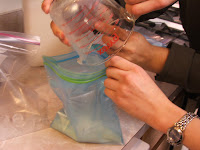 Everything's sealed in...
 Let's go!
 Shaking it up.
 End time.
 The outside of the two inside bags.
 The majority of our finished product.

Results
We did get some ice cream, but the inside most bag broke open, so it was really just a taste for each of us. Oh, and lots of sugar-vanilla-milk.
Conclusions
Happy National Chemistry Week!

Last week, three of your New Voices bloggers got together to try an at-home experiment...
Question
Can three highly educated bloggers make quick ice cream with ingredients found in a regular kitchen?
Hypothesis
Yes.
Materials

- 1 tablespoon sugar
- 1/2 cup milk or half & half
- 1/4 teaspoon vanilla
- 6 tablespoons rock salt
- 2 pint-size plastic bags
- 1 gallon-size plastic bags
- Ice cubes (about 4 cups)
- Measuring cup
- Gloves
- Safety goggles (you never know what might happen)
- Bowl
- Spoon
- Combine milk, sugar and vanilla. Stir until sugar is dissolved. (Trust us on the stirring, because we didn't.)
- Put ice cubes in large gallon-sized bag.
- Pour milk mixture into one of the small plastic bags. Seal with as little air inside as possible. Place this bag inside second small plastic bag. (This will help if the first one does not remain sealed.)
- Put the small bag(s) in the large bag with the ice.
- Pour salt over the ice and seal the large bag, trying to remove as much air as possible.
- Shake, toss, massage, etc. for 5 to 9 minutes, until ice cream thickens.
- Remove small bag from other bags. (Warning: outside bags are salty, do not cross contaminate. Again, trust us.)
- Enjoy.
 Everything's sealed in...
 Let's go!
 Shaking it up.
 End time.
 The outside of the two inside bags.
 The majority of our finished product.
Results
We did get some ice cream, but the inside most bag broke open, so it was really just a taste for each of us. Oh, and lots of sugar-vanilla-milk.
Conclusions
- The right materials are necessary to make quick and delicious homemade ice cream. For example, frozen peas and carrots will not, in fact, provide the same amount of exothermic energy as ice (read:frozen H2O), so make sure your roommates have not emptied the ice tray before beginning this experiment.
- Sugar-vanilla-milk is not as delicious as ice cream.
- Safety first helps to prevent very cold fingers.
Happy National Chemistry Week!

Friday, October 23, 2009
Happy Mole Day!
It began at 6:02 this morning and ends at 6:02 this evening, and any fan of Avogadro knows why we're celebrating today.
In honor of this constant from basic chemistry (which was used so much between high school and college I plugged it into my graphing calculator as its own variable) and National Chemistry Week, we're sharing some of our favorite chemistry experiments today.
Instant Ice
Have you ever seen an entire bottle of water freeze instantly? This is easy to do, and makes a good demonstration and party trick.
Ingredients: An unopened bottle of spring water, a bucket, rock salt, ice, and a thermometer.
Directions: Fill the bucket ¾ full with ice and cover the ice with rock salt. Then put the bottle of water in the bucket and place the thermometer next to the bottle. Wait until the temperature of the bottle has been at about 17 degrees for about 10 minutes (if it gets too cold this won’t work). After this time, gently remove the bottle of water and twist open the top. All of the water will turn to ice as soon as the cap is removed.
This is an example of supercooling, which is when a liquid is cooled past its crystallization point without becoming solid.
Hot Ice
Instant Ice - Watch more Funny Videos
“Hot ice” (sodium acetate) is a liquid that turns into a warm solid when poured. It's cool to see, although you probably don’t want to consume it.
Ingredients: One cup of clear vinegar and 1 tablespoon of baking powder to make the sodium acetate.
Directions: Pour the vinegar into a saucepan and then slowly add the baking soda (if you do it too quickly you’ll end up with a volcano instead). Heat the mixture until a thin film forms on the surface, then remove from heat, transfer to a smooth, clean glass or bottle and cover immediately. If there are any crystals in the solution, add a small amount of vinegar to dissolve them. Cool the solution in the fridge.
When you take it out, pour it onto a dish and you'll see it turn into a solid. Heat will be released because crystallization is an exothermic process.
Sweet Hot Lemonade
 Image credit: Alasam
If you’re someone who has tried to sweeten lemonade with extra sugar and found that you can’t get it to dissolve, we have the solution to your problem. This recipe makes drinks that are sweeter than normal and perfect for warming up on a cool fall day.
Ingredients: Water and lemonade mix (you can also use Tang).
Directions: Boil the water on the stove and then add the drink mix to taste. You’ll find that you can add more mix than you would be able to with regular water.
What’s the science behind this? It is an example of supersaturation, which occurs when a change in the condition (in this case temperature) of a substance (water) enables it to hold more of a dissolved material (lemonade mix) than would be possible under normal conditions.
Experiment write-ups by Ilse.
In honor of this constant from basic chemistry (which was used so much between high school and college I plugged it into my graphing calculator as its own variable) and National Chemistry Week, we're sharing some of our favorite chemistry experiments today.
Instant Ice
Have you ever seen an entire bottle of water freeze instantly? This is easy to do, and makes a good demonstration and party trick.
Ingredients: An unopened bottle of spring water, a bucket, rock salt, ice, and a thermometer.
Directions: Fill the bucket ¾ full with ice and cover the ice with rock salt. Then put the bottle of water in the bucket and place the thermometer next to the bottle. Wait until the temperature of the bottle has been at about 17 degrees for about 10 minutes (if it gets too cold this won’t work). After this time, gently remove the bottle of water and twist open the top. All of the water will turn to ice as soon as the cap is removed.
This is an example of supercooling, which is when a liquid is cooled past its crystallization point without becoming solid.
Hot Ice
Instant Ice - Watch more Funny Videos
“Hot ice” (sodium acetate) is a liquid that turns into a warm solid when poured. It's cool to see, although you probably don’t want to consume it.
Ingredients: One cup of clear vinegar and 1 tablespoon of baking powder to make the sodium acetate.
Directions: Pour the vinegar into a saucepan and then slowly add the baking soda (if you do it too quickly you’ll end up with a volcano instead). Heat the mixture until a thin film forms on the surface, then remove from heat, transfer to a smooth, clean glass or bottle and cover immediately. If there are any crystals in the solution, add a small amount of vinegar to dissolve them. Cool the solution in the fridge.
When you take it out, pour it onto a dish and you'll see it turn into a solid. Heat will be released because crystallization is an exothermic process.
Sweet Hot Lemonade
 Image credit: Alasam
If you’re someone who has tried to sweeten lemonade with extra sugar and found that you can’t get it to dissolve, we have the solution to your problem. This recipe makes drinks that are sweeter than normal and perfect for warming up on a cool fall day.
Ingredients: Water and lemonade mix (you can also use Tang).
Directions: Boil the water on the stove and then add the drink mix to taste. You’ll find that you can add more mix than you would be able to with regular water.
What’s the science behind this? It is an example of supersaturation, which occurs when a change in the condition (in this case temperature) of a substance (water) enables it to hold more of a dissolved material (lemonade mix) than would be possible under normal conditions.
Experiment write-ups by Ilse.
Thursday, October 22, 2009
Darwinius Revisited
 An interesting post on Not Exactly Rocket Science caught our attention earlier this week: apparently Ida - our Darwinius ancestor or missing link - is no such thing. This is shocking because it was only a few months ago when the media storm took over and wrote over some of what we thought we knew about human evolution and knocked Lucy from her place in history.
This poses an interesting question for those of us interested in science communication: Should new scientific findings be immediately publicized or should there be some sort of process for releasing scientific data - especially revolutionary research - so that the general public doesn't get mixed messages about scientific "facts"?
The scientific community potentially has the worst public relations system around; meaning there doesn't seem to be one at all. So much of the exciting research going on in science never gets explained to people outside of a specific field, better yet to the public.
When a chance comes along to really publicize something that people can sink their teeth into, building up a media storm is a great idea. First, because it engages the public. That increased interest may help build public support and perhaps funding for future research. Plus, if celebrities and politicians can vacillate on positions in the news, why shouldn't scientists do the same? Science is a fluid field where things change, so it just makes sense.
However, as a PR professional, it would be irresponsible to not mention the other side of that argument: not all press is good press. Look at the Large Hadron Collider. Everyone knew about it, everyone was watching, and it didn't work. Most of the public (and the media for that matter) will never check back in and see that the whole project wasn't a waste.
The American school system teaches science as a series of facts or rules that everything works in. Now, if you pursue science beyond the basics, you learn that those rules can bent, but the majority of the public thinks of science as something hard, fast, and sure. Which is why when a group of astronomers decides that Pluto is no longer a planet, there's a loss of faith in the whole system.
No wonder people question the value of vaccines when they're told, "This'll work" and then it doesn't - or worse. Unless the scientific community can pull their communications together and develop a crisis plan for when things don't pan out, it should be a fact before it gets out there.
Or, you can just hope for good press.
My gut response to this is to shrug it off with the understanding that this is how science works. Science is a dynamic process. It’s about discovery, and the ability to build on this discovery. In some cases, this means supporting and expanding the initial hypothesis; in others, it means challenging your finding and modifying your hypothesis. It’s this constant irony of science that makes it both exciting and frustrating at any given moment.
My next response is to ask why the story was handled so irresponsibly. And it’s not just this. There are a number of examples of findings that are pushed out the door and stated as fact from the get-go. That’s not how the scientific process works! Think back to some of the big names in science---Charles Darwin, Gregor Mendel, Francesco Redi. They were responsible for the theory of evolution, genetic inheritance, and germ theory, respectively. It took the scientific community years to accept their hypotheses as theories. The initial experiments that they performed paved the way for more experiments that eventually led to this. There was no mass media frenzy the day after Mendel did his first pea-experiment saying, “Hey look, we now know inheritance happens---it’s a known fact.” It was through long-term evidence-based discovery that this happened.
My point is that in the case of Darwinius, the finding was certainly valid in terms of how the researchers interpreted the data, but it should not have been presented as fact. It was and is the responsibility of the scientists, science journals, and media to make sure that scientific findings are presented at face value. As a scientist, it is exciting to, after years of work, finally experience an “AHA” moment, but we need to stay true to the scientific process, and accept it for what it is---not an overnight phenomenon, but rather an extended process.
There are many reasons why major scientific findings should be reported to the public soon after the results are published, but the coverage of such discoveries must be responsible.
Reporting landmark discoveries is important because it generates greater enthusiasm and support for scientific research, and members of the public often have a direct stake in research that entitles them to such knowledge. Many member of the public may be directly impacted by such findings at some point. For instance, research on heart disease may lead to new treatment options in the future. The public is furthermore entitled to know about such work because a significant portion of research is funded by taxpayer dollars.
Announcing findings too soon however—without reasonable verification of the results and without giving journalists time to do adequate research prior to writing their article—is irresponsible and misleading. Premature or incomplete reports can be confusing: if one study suggests that a certain food is beneficial to health and another suggests that the same thing is harmful, the public will be left unsure about what is “true.” Sensationalizing research can also create a false sense of progress and unrealistic expectations which may lead to disappointment.
The best approach is to encourage the best science possible, reasonable verification of results to the extent allowed by funding and time restraints, and journalism that contextualizes discoveries in prior findings, allowing readers to better understand the progress being made without creating a disproportionate sense of progress.
Your thoughts?
Wednesday, October 21, 2009
Lots of Opportunities
Here at New Voices we're always encouraging people to get out there and actively engage in communication and advocacy, and today we've got a couple different ways for you to get engaged, learn something, help us learn something, and maybe earn yourself a scholarship.
 SEA Workshop on Fundraising
This workshop features expert fundraisers of national, local, and online campaigns from across the political spectrum. Presentations will revisit the theme of our July workshop: presenting a clear, focused message to the press and the public, but this time, within the context of both offline and online fundraising activities.
Fundraising experts from Campaign Advantage, Rep. Rush Holt campaigns, Campaign Solutions, and ActBlue will review strategies, and offer advice for members of the scientific community who are considering candidacy for public office.
Date: Saturday, October 24, 2009
Time: 1:00 PM EST – 4:00 PM EST
DC Location: ACS Othmer Building 1550 M Street NW
Online streaming video
Virtual attendees can participate in the Q&A session through an online chat room.
Access codes to the chat room will be emailed to those who register.
 Global Health Essay Competition
The CSIS Commission on Smart Global Health is seeking essay submissions that answer the following question in 500-800 words by midnight, November 20th 2009:
The CSIS Commission on Smart Global Health Policy focuses on practical solutions that maximize efficiency, produce measurable results, and engage the American public. They are looking for fresh, innovative approaches to global health problems. The author of the winning essay will receive a $1,000 scholarship with a chance to be published in the Commission's final report. Complete details are available here.
 New Voices Scientist Survey
Take the scientist survey and/or share it with your friends today! Thank you to everyone who has reached out and helped so far, we are more than half way to our total response goal, but still need a couple dozen responses to close out the survey. For it to be truly representative, we need our male and minority readers especially to respond as soon as possible! Each response helps, so take 10 minutes today!
You can read all the details about the survey here.
 SEA Workshop on Fundraising
This workshop features expert fundraisers of national, local, and online campaigns from across the political spectrum. Presentations will revisit the theme of our July workshop: presenting a clear, focused message to the press and the public, but this time, within the context of both offline and online fundraising activities.
Fundraising experts from Campaign Advantage, Rep. Rush Holt campaigns, Campaign Solutions, and ActBlue will review strategies, and offer advice for members of the scientific community who are considering candidacy for public office.
Date: Saturday, October 24, 2009
Time: 1:00 PM EST – 4:00 PM EST
DC Location: ACS Othmer Building 1550 M Street NW
Online streaming video
Virtual attendees can participate in the Q&A session through an online chat room.
Access codes to the chat room will be emailed to those who register.
 Global Health Essay Competition
The CSIS Commission on Smart Global Health is seeking essay submissions that answer the following question in 500-800 words by midnight, November 20th 2009:
"What is the most important thing the U.S. can do to improve global health over the next 15 years?"
New Voices Scientist SurveyTake the scientist survey and/or share it with your friends today! Thank you to everyone who has reached out and helped so far, we are more than half way to our total response goal, but still need a couple dozen responses to close out the survey. For it to be truly representative, we need our male and minority readers especially to respond as soon as possible! Each response helps, so take 10 minutes today!
You can read all the details about the survey here.
Tuesday, October 20, 2009
Urge President Obama to Support Increases for NIH
 Join advocates across the U.S. in asking President Barack Obama to make research to improve health a national priority and support robust funding for the National Institutes of Health.
 To coincide with National Medical Research Day on Wednesday, October 21, the ResearchMeansHope.org campaign, Research!America and other groups are rallying advocates to contact the White House this week in support of significant annual increases for NIH.
Now is a particularly important time for President Obama to hear from research advocates because he is working with his administration to determine the FY 2011 budget priorities. Take action and write to President Obama now!
Monday, October 19, 2009
Let's Take a Look at the Life Science Industry
Welcome to the final installment in our entrepreneurship series. Today, I’ll show you how our case study states, North Carolina, Minnesota, and Kansas stack up in terms of entrepreneurial and economic development indicators.
As I mentioned earlier, it’s difficult to compare these states on their programs alone, so we have to use economic indicators to gain a better picture of where each state stands. I’ll show you three indicators:
• Research funding—remember the importance of research funding as the beginning of the economic development pipeline?
• Venture capital funds—VC is the one of the sources of financing available to help entrepreneurs start a new business.
• Number of life sciences jobs—"jobs, jobs, jobs, it’s all about the job." We’ve heard that plenty of times before. Remember, these are high-paying jobs.
OK, let's take a look . . .
 This figure goes to show how sporadic (and unreliable) venture capital is. Up one year, down the next, up, down, up, down . . . . You can't be on it. This is why those sources of public finance that I mentioned earlier as so important. Also look at the spike for Kansas in 2007. This was the first spike Kansas has seen, and it happened after the Kansas Economic Growth Act had be implemented.
Number of life sciences jobs
 Finally, jobs, jobs, job. In terms of life science employment as a percentage of total population, these three states are actually pretty comparable. The differences come in terms of actual number. It takes a significant number of business in North Carolina, for example, to account the additional 13,000 life sciences jobs it has over Kansas.
So now that you are an expert in everything and anything about entrepreneurship and the life sciences industry, what do you do with all this information? Here are a few key take-aways:
This is Part 8 of 8 in our Entrepreneurship series.
Part 1 - Science and Entrepreneurship: An Introduction
Part 2 - It's All About the Ideas (and Money)
Part 3 - Financing a New Business in the Life Sciences
Part 4 - Leading Life Science States
Part 5 - Life Sciences in North Carolina
Part 6 - Life Sciences in Minnesota
Part 7 - Life Sciences in Kansas
Part 8 - Life Science Industry Overall
As I mentioned earlier, it’s difficult to compare these states on their programs alone, so we have to use economic indicators to gain a better picture of where each state stands. I’ll show you three indicators:
• Research funding—remember the importance of research funding as the beginning of the economic development pipeline?
• Venture capital funds—VC is the one of the sources of financing available to help entrepreneurs start a new business.
• Number of life sciences jobs—"jobs, jobs, jobs, it’s all about the job." We’ve heard that plenty of times before. Remember, these are high-paying jobs.
OK, let's take a look . . .
Research funding


You'll notice North Carolina is significantly ahead of Minnesota and Kansas in terms of attracting NIH dollars. Granted, NC has a larger population than MN and KS , but look at the positive slope of NC compared to the rest!! North Carolina has shown significant growth over the past decade.
Even more interesting is the significant drop in North Carolina's research funds between 2007 and 2008. This is because NIH has not released number for 2008's R&D contracts, of which a significant amount go to industry. Add those grants in and North Carolina stays on track for growth.
Venture capital fundsEven more interesting is the significant drop in North Carolina's research funds between 2007 and 2008. This is because NIH has not released number for 2008's R&D contracts, of which a significant amount go to industry. Add those grants in and North Carolina stays on track for growth.
 This figure goes to show how sporadic (and unreliable) venture capital is. Up one year, down the next, up, down, up, down . . . . You can't be on it. This is why those sources of public finance that I mentioned earlier as so important. Also look at the spike for Kansas in 2007. This was the first spike Kansas has seen, and it happened after the Kansas Economic Growth Act had be implemented.
 Number of life sciences jobs
 Finally, jobs, jobs, job. In terms of life science employment as a percentage of total population, these three states are actually pretty comparable. The differences come in terms of actual number. It takes a significant number of business in North Carolina, for example, to account the additional 13,000 life sciences jobs it has over Kansas.
So now that you are an expert in everything and anything about entrepreneurship and the life sciences industry, what do you do with all this information? Here are a few key take-aways:
- First, all states are not the same in terms of the resources and benefits offered for new businesses. It pays to look around and find a states that offers the resources you need. The Battelle/BIO report is a good place to start.
- Second, this may all seem very overwhelming, but don't forget, there is help! The North Carolina Biotechnology Center, Minnesota BioBusiness Alliance, and Kansas Bioscience Authority are examples of resouces centers in each of the states we discussed.
- Finally, and perhaps most important, we can't forget that research funding in the beginning of this entire process. Without reasearch funding, the great ideas that could become a business will never flourish.
This is Part 8 of 8 in our Entrepreneurship series.
Part 1 - Science and Entrepreneurship: An Introduction
Part 2 - It's All About the Ideas (and Money)
Part 3 - Financing a New Business in the Life Sciences
Part 4 - Leading Life Science States
Part 5 - Life Sciences in North Carolina
Part 6 - Life Sciences in Minnesota
Part 7 - Life Sciences in Kansas
Part 8 - Life Science Industry Overall
Subscribe to:
Posts (Atom)