Wednesday, July 7, 2010

Wait, where's the microscope?

Upon arriving at my workspace my first day here at Research!America, my first thought was, something's missing. It had been four years since my job hadn't required any kind of scientific equipment, and it seemed obviously lacking at my new desk.

Five weeks into my first ever policy job, I’ve learned a few things:
1. Despite the lack of a microscope, I can get a lot done here.
2. I should never drink the instant coffee in the break room except in dire need.
3. And, most importantly, I can reach an audience, keep them engaged, and deliver a message so they actually hear and understand it (maybe even use it in the future).

Working as a science policy intern for Research!America has certainly been an eye-opening experience. Spending the last four years in school and at the lab bench has prepared me for a job in the policy world more than I would have previously believed.

The thought process needed to solve the problems presented to us at Research!America can often be better understood through the lens of a scientific mind. Especially when considering one of the main groups that we try to reach here, especially in New Voices, is that of the men and women doing research today. What better way to connect with your audience than having been one of them, and having that in common to discuss and bond over.

One of my more interesting experiences so far was a chance to view a Capitol Hill hearing in which the director of the NIH, Dr. Francis Collins, testified before the Subcommittee on Health in the Energy and Commerce Committee. Dr. Collins explained the importance of the NIH budget and fielded questions from members of Congress on a huge array of issues.

Watching Dr. Collins, I felt intense gratitude that there was someone so qualified to speak to Congress that day on the importance of science research in this country’s future. But what about the other days? Who contacts Congress on the other hundreds of days a year to advocate for science research?

The answer is, not nearly enough people. While Research!America strives to show members of Congress the importance of basic research, it needs to come from the constituents and the scientists themselves to get the most reaction from the members.

The best part about that? Scientists ARE constituents.

If scientists can take time out of their admittedly busy schedule to visit a congressional office, write a letter, send an e-mail, or even offer their expertise on an issue that the member might be dealing with, the change could be dramatic and hugely powerful. So when is the last time you contacted your representative or senator? Let them know today that you think science research funding is important for our country’s future.


Bookmark and Share

Tuesday, July 6, 2010

The Chemistry of Fireworks

Chances are you saw some fireworks this weekend; felt the thump of the sonic booms as the dizzying array of colors lit up the night sky. If you missed them, here’s a short clip of my view of the fireworks on the National Mall.


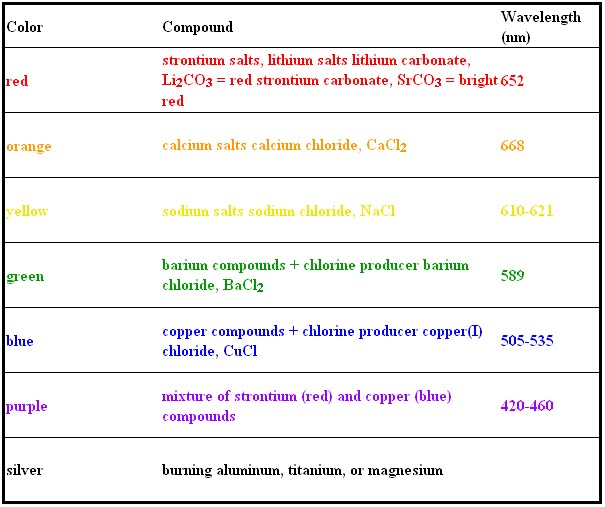
If you’re the science-type, you probably know that the types of metals in each of the fireworks is what makes them appear different colors – but what chemicals are making what colors?


So based on the table above, what chemicals do you think were in the fireworks Ryan and Alissa saw on the 4th of July?

Ryan's view from Antietam Battlefield in Maryland.

Alissa's view from Gahanna, Ohio.


Bookmark and Share

Friday, July 2, 2010

Do Scientists Understand the Public?

First thing first: there is no such thing as one public. If there were, we’d only have one type of clothing store, one political party, one television channel … there are lots of people in a variety of publics out there. That being said, it is much easier to call all of those diverse audiences “the public” rather than parse them all out each time.

Second thing second: although scientists are their own special breed of people, they still qualify as being part of the public! In just the short history of New Voices, I’m sure I’ve said that scientists need to communicate better with the public – which, in a way, makes it as if scientists are not part of the public. That is not at all what I meant.

Scientists live in their communities (even if it feels like they live in their labs), vote in the same elections, eat in restaurants, buy new tech gadgets, drive on interstates … they are the public. We are ALL the public. But again, it is a bit easier to type “the public” than “non-scientific audiences.”

Now that we’ve cleared up that we’re only using the phrase “the public” because it is convenient, let’s get into the question of the day: do scientists understand the public?

To answer that, I think we have to look at what makes scientists different from the rest of the public. The number one thing is probably thought processes. From the four focus groups mentioned in the Mooney article to countless other examples throughout history, it seems as if the approach scientists take to an issue is incredibly different from the approach of someone without scientific training.

Some claim that the emotion that the public brings to a debate leads to impractical decisions. Others say that the lack of (com)passion shown by scientists in a debate denotes a lack of interest in any position but their own. This isn’t a gulf or even a two cultures issue – this is simply a communication problem.

As with any relationship, knowing others and how they work makes things easier. Just as men being from Mars and women being from Venus doesn’t stop male-female interaction, scientists and the public can successfully come together and understand each other. But everyone must take the time to get to know everyone else instead of resorting to stereotypes and popular (mis)conceptions.

Mooney presented a number of other issues in the piece. What struck you as most important? What are the next steps to answering the title question? To better communication between scientists and the public?


Bookmark and Share

Thursday, July 1, 2010

More of the Barresi Lab, Smith College

Last week we took a look around the Barresi Lab at Smith College. This week, we're back in the same place looking at more of the tools they use for their developmental neurobiology research.

Instant Ocean salt, used to keep the proper levels of salinity in the system


Racks of clean supplies ready to be used for new fish


Brine shrimp hatcheries, breakfast and dinner for the zebrafish


Racks with tanks of about 15 fish each


More fish in tanks, in the second fish room.

This week's Images from Around the Lab were contributed by the Barresi Lab at Smith College. Special thanks to Rachel Stein for organizing the photo shoot and Michael Barresi, PhD for letting us take a peek into the lab.


We want to see images from your workspace too! Email hbenson at researchamerica.org to share your photos in New Voices Images from Around the Lab.

Bookmark and Share

Wednesday, June 30, 2010

Your Mission, Should You Choose to Accept It

...is to read, "Do Scientists Understand the Public?" by Chris Mooney.

It's a quick read, incredibly thought-provoking and we'll be discussing it on Friday. See you back here then!


Bookmark and Share

Tuesday, June 29, 2010

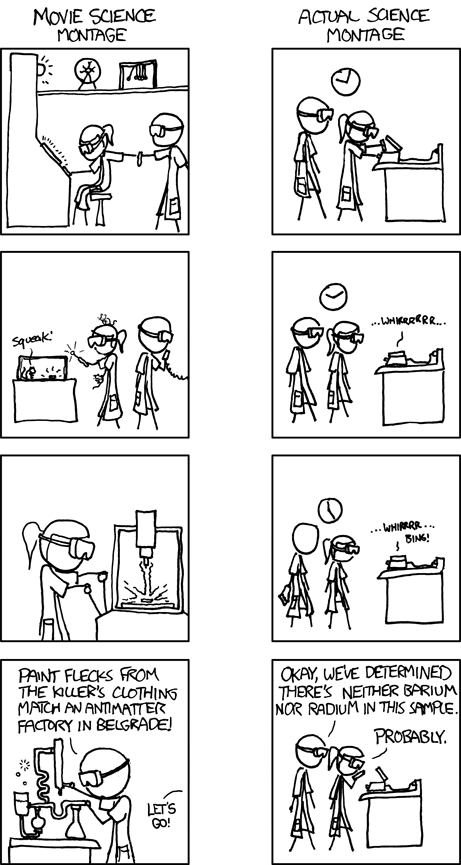
Science Montage

Image credit: xkcd.com

Could this be a clue as to why there are so many bad science movies?

Bookmark and Share

Monday, June 28, 2010

Protect your Eyes? Aye.

Where did eye patches originate? You'd probably guess it was an early and low-tech way to conceal an unsightly eye injury. While this may be partially true it is more likely that patches were first used by individuals with two perfectly good eyes. There is speculation that sailors, in order to keep one eye adjusted to seeing in the darkness below deck, used an eye patch. Whether scurrying below deck to modify rigging or reloading weapons, keeping one eye adapted to seeing in low levels of light could save a valuable few minutes in a crucial situation.

Today eye patches are typically used as costume pieces or to protect an injured eye. Research has brought us a variety of innovative treatments for eye maladies, but many visual problems are caused by injury. Here are some of the most common injuries - some of which may earn you an eye patch:

Corneal Abrasion: A corneal abrasion is essentially a scratch on the transparent covering of the eye. Abrasions can occur from walking into foreign objects such as hanging tree branches, or by rubbing the eye when something like dust or sand is present. Abrasions are usually minor but the risk of infection from bacteria can be a serious threat. Antibiotic eye drops and a topical pain reliever is the most common treatment.

Chemical exposure: Being splashed by anything but clean water is a risk to the eyes. Many acids, such as vinegar, lemon juice, and some shampoos, may cause significant redness and burning, but can be washed out with no real damage. Chemicals that are basic (a pH over 7) such as bleach, ammonia, or lye, are a more serious threat but may not seem so as many do not cause immediate eye pain or redness. As soon as possible after exposure the eye should be flushed with warm tap water for 15 minutes. Long term treatment depends on the type of chemical exposure and if tissue damage occurred.

Swelling: What do moving baseballs, flying fists, bathroom sinks, and stepping on a rake have in common? They all can result in some mean black eyes. Being struck in the eye with just about anything causes swelling followed by discoloration. The swelling is the result of simple tissue inflammation, whereas the discoloration is due to swollen or ruptured blood vessels. The best treatment is to put an ice pack over the affected area to reduce swelling. Despite being an old wives tale, placing a steak or a pork chop on a black eye is not an effective treatment.

Eye bruising/bleeding: Being struck in the vicinity of the eye often causes the small, delicate blood vessels under the whites of the eyes to break and discolor the eye. This is called a subconjunctival hemorrhage and looks much worse than it actually is. It is quite common and despite its dramatic appearance, actually poses little risk of any long term visual or cosmetic damage. Other than looking scary for 7 to 10 days and waiting for the blood vessels to heal themselves there is not much of a treatment for this condition. Over time the blood clears on its own and the eye returns to normal appearance.

For more information about eye injuries the National Institutes of Health has a good online resource. This 4th of July be sure to keep the bottle rockets aimed away from your face.

Bookmark and Share

Friday, June 25, 2010

Are You Positive You’re Negative?

According to the Center for Disease Control (CDC) over 20% of people infected with HIV in the US today do not know they have the virus. This means they are at a higher risk for transmitting the virus to others, because they do not know they have it.

To be completely sure you are not carrying HIV, get tested. Find a clinic near you today. And while you may be thinking, “I don’t need to get tested, I know I’m negative.” Just beware of these facts. The top five states with the most visitors to New Voices for Research are also all high on the list of total cases of AIDS (according to the CDC):
  • Maryland, #9 with 31,931 cases
  • Pennsylvania, #6 with 35,489 cases
  • Florida, #3 with 109,524 cases
  • California, #2 with 148,949 cases
  • New York, #1 with 181,461 cases
Not all HIV tests require a blood draw from your arm. Some can be much quicker and pain free.

Bottom line: Get tested. Today.


Bookmark and Share

Thursday, June 24, 2010

Barresi Lab, Smith College

The 'scope room'

The Lumar, our live action and fluorescent microscope


A collaboration between students and professor


The Axio Imager, a compound fluorescent microscope for looking at fixed tissue


A bottle of Embryo Medium to grow up baby fish, and an oxygen tank to pressurize our injection needles


Our incubator to keep the baby fish at an ideal temperature for growth and development


This week's Images from Around the Lab were contributed by the Barresi Lab at Smith College. Come back next Thursday for a closer look at their work.

Bookmark and Share

Wednesday, June 23, 2010

Meet Susan Maya, Clinical Research Coordinator

Today we have an inside look at clinical research. Susan Maya, a clinical research coordinator in the Department of Neurology at Massachusetts General Hospital was kind enough to tell us about her current position.

NV: Question 1. What do you do?

Susan: A little bit of everything. In a nut shell, each of the three to six research coordinators in our group is responsible for clinical trials. Some studies are externally sponsored and others are internal.

I’m responsible for the day to day function of the “smaller” multi-site studies. I spend 50% of my time doing the administrative stuff: IRB paperwork, data entry, calling patients to schedule appointments and such. The other half is actually running studies. For each of the drug studies we run, patients have to come in multiple times for the study. We do different types of testing to make sure the study drug isn’t harming them and to see if the study drug is effective.

I’m the first point of contact for the patients if they experience side-effects or need information. Coordinators do everything from taking vitals and EKGs to drawing blood. Then the neurologist – our PI – will come and do her assessments.

The last thing I do – which is not directly related to the studies – is a bi-monthly disorders clinic where our PI sees people outside the regular research studies on Huntington’s. It’s interesting because it is a multi-faceted team that really focuses on disease management, which is important since there isn’t a treatment for Huntington’s at this time.

I also sometimes have the opportunity to help those who are interested in getting involved in the studies.

NV: Question 2. How does your background in science – and research particularly – help you?

Susan: What I do day-to-day is not directly related to what I would be doing in a bench research setting. I do spend a good amount of time processing blood samples; which is good because I’m invested in the patients – since I work directly with them. But I can learn about the research that’s going on, and participating in the process helps me to understand it better.

NV: Question 3. What is the most exciting component of what you do?

Susan: I like drawing blood. But really, it’s getting to work with the patients.

One of the nice things about clinical research – especially with a long-term disease like Huntington’s - is that you really get to form relationships with the people involved in the studies. I can see this with our neurologist, who really KNOWS our patients.

NV: Question 4. What advice would you give to someone who wanted to become a clinical research coordinator? An advocate for Huntington’s research?

Susan: There aren’t that many technical skills involved in being a coordinator, because we get our training on the job. But you have to be flexible, work collaboratively with the other members of our team.

In terms of advocacy – there is a great community already. Huntington’s Disease Society of America is great about educating families and patients about trials, new drugs and discovery.

NV: Question 5. What’s your next step?

Susan: I’m going to medical school in August. I definitely see myself doing research while I’m there. Not because I have to (since Yale requires it) but because I want to. I see myself pursuing research further.


Thank you to Susan for giving us a few minutes by phone to learn more about her and her career. We look forward to following up with her soon to hear about how her passion for research exhibits itself in medical school. For more information about Huntington's Disease, please visit the HDlighthouse.

This is part of the ongoing Profiling New Voices series.

Bookmark and Share