Friday, December 31, 2010
Happy 2011!
Thursday, December 30, 2010
Top 2010 Moments?
As we head into 2011, we're strategizing for the future of New Voices. To help us get a grasp on what you like best about the blog, we're asking you to help us put together a top 2010 list. What was your favorite post this year? What links did you share with all of your friends?
We'll use what you've got to make an overall New Voices 2010 in Review list.
Wednesday, December 29, 2010
New Year, New Job?
| Image credit: http://positivesharing.com/2007/01/how-to-find-a-job-youll-love/ |
Thinking about making some resolutions for 2011? Guest blogger Rosemary Benson-Salotti has some advice.
Although they have some really cool stuff on their site, you don’t need to check with the National Institute of Standards and Technology to know that New Year’s Day is creeping up, and resolutions are flying around with as much chance of follow-through as Frosty’s vacation in El Azizia. But it is the traditional time to do a self-check, so here’s a question: are you passionate about your job? If you wonder if you’re in the right job, or you’re looking for a new one, do what scientists do: observe.
Start by listing what you like about your current situation. Look around. What is it about your job that gets you up in the morning? What could you live without, and which aspects do you dread? How are your strengths put to use?
It’s important to take the time to break down the elements of your current job, including the physical environment, communication effectiveness, levels of responsibility, compensation, and opportunity. Merely rating your satisfaction levels in each of these areas will allow you to see where your preferences lie.
Then, evaluate your preferences. Are you a good communicator, more comfortable interacting with colleagues regularly, or would you prefer working in solitude? Do you seek opportunities to share your knowledge? If so, would you rather do so in person or by publishing? Are you satisfied working on small segments of a project, or do you need to see an outcome or end product?
Experiment: play, "What if?" What if you could do whatever you love and be paid for it? Assume that the position as head taster on Cake Boss is already filled. What would your perfect job look like? Consider the previous categories, and list your Utopian conditions. Then look around. Who has a job like that?
Explore your social networks, counterparts at other institutions, and association websites to track down people who do what you’d love to be doing. Don’t underestimate the effectiveness of lurking! Connect with them. Most people are flattered to be asked about their work. See if the functions and features of their jobs converge with your ideals. Once you determine what kind of job will give you the most satisfaction, you’ll be ready to seek out a specific position.
Expect the process to take a while, but look at it this way: you don’t need to know about oscillation frequencies to know that time flies. Your ideal job is out there. Resolve to find out what makes you tick.
Special thanks to New Voices guest blogger Rosemary Benson-Salotti, consultant at the QUEST Career Exploration Program who has agreed to respond to any questions or comments left in the comments and to make appropriate offline connections.
Tuesday, December 28, 2010
Monday, December 27, 2010
ARRA: Putting America to Work
Much of the country, including scientists, benefited from the stimulus plan set forth by President Obama when the economy took a downturn. Biomedical researchers celebrated when this stimulus, the American Recovery and Reinvestment Act of 2009 (ARRA), allotted $10 billion to the National Institutes of Health (NIH), over $8 billion of which went to extramural researchers, creating jobs and supporting innovative research across the country.
Research!America has been tracking where the NIH ARRA money went. Every state and most of the US territories received funding for research projects from the NIH. In total, 15,614 projects were funded by ARRA money from the NIH. You can see how your state fared at the Research!America website.
California was awarded the most NIH ARRA money, bringing in $1.3 billion for 2,117 projects. Stanford University Medical School alone was able to create or save 45 medical research jobs because of the stimulus. These researchers are able to continue studying a range of important biomedical issues, including cancer, congenital heart disease in children, and the functioning of the immune system.
Duke University in North Carolina was able to create or save 166 jobs with the ARRA funding it received. North Carolina ranked sixth in the nation for the $359 million it was awarded in NIH ARRA money. In fact, North Carolina’s fourth district, encompassing Duke University and the University of North Carolina, was the third highest ranked district in the nation, underscoring the excellent research being performed at these universities.
Many researchers agree that the stimulus was a much-needed shot of money. Before ARRA, NIH funding had been flat, meaning it wasn't even keeping up with inflation, resulting in only 20% of the grants submitted being awarded money. This low percentage means brilliant ideas go unstudied and young scientists look for jobs elsewhere. These results are detrimental at a time when the country is worrying about its global competitiveness in science.
Yes, the stimulus helped, but it was only a temporary fix. The ARRA grants will run out in 2011, creating a huge dropoff in research money. The rate of successful grants could fall to 15%, leaving a glut of scientists who again can’t find money for their research. The NIH must receive more funding to be able to support these scientists.The President is now considering the federal budget for 2012. Urge him to propose $35 billion for the NIH budget because robust investment in science is critical to creating jobs, improving health, encouraging innovation and revitalizing the economy.
Friday, December 24, 2010
'Twas the Night Before Christmas
Thursday, December 23, 2010
Gluten-Free Baking
Wednesday, December 22, 2010
Our Rights as an Engaged Citizen
Last Wednesday, the U.S. celebrated Bill of Rights Day. For those of you scratching your head, remember that the Bill of Rights consists of the first 10 amendments of the US Constitution. In honor of Bill of Rights Day, I’d like to write about my favorite amendment - the First Amendment.
The First provides the basic liberties of freedom of expression, speech, religion, press, assembly, along with the right to petition the government. To Americans, and those living in affluent democratic societies, these rights do seem basic or fundamental even though they are still out of reach for much of the world.
So what’s so great about the First? It allows Americans to live without fear of government reprisal, but more importantly, it gives engaged citizens a voice and the power to remake public policy. But this power is only granted to engaged citizens – informed members of society who take the time to vote and advocate.
Yes, we are all busy and inundated with the minutia of our lives. How are we supposed to find the time to advocate, vote, and keep up on the issues? There are countless ways to get involved and range in commitment from sending an email to running for office.
Those who fail to remain engaged have essentially given up their voice; their Constitutional authority to improve the government. Without engaged citizens, we risk ineffective policy making that could impact any one of our lives. So for those reading this today, I urge you to chose action over indifference and exercise your rights as an engaged citizen.
Tuesday, December 21, 2010
Morning Health News
Those of us looking to become stronger science communicators can learn a lot from how medicine and science news is translated. So for this Tuneage Tuesday, check out this clip from Good Morning America. What can we learn from how this surgical procedure is being explained?
Monday, December 20, 2010
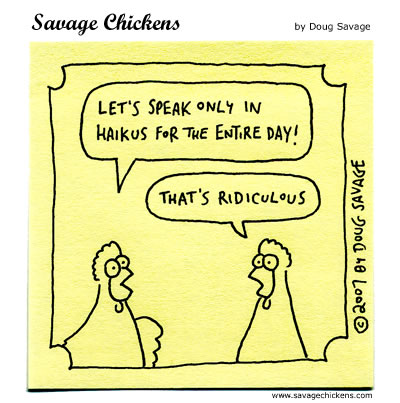
A Haiku for You
Though not technically correct, English-language haiku are typically written with 17 syllables: 3 stanzas of 5,7, and 5 syllables respectively. Haiku has become a fun pastime for amateur poets because of its short length and independence from difficult rules, like rhyming or rhythm--a haiku can be easily formulated in a matter of minutes.
I am challenging you to take a moment to create a haiku. Tell us what you think is important in verse. Please share it with the community via the comments section. Here are a few to inspire you:
From Kate:
Hope for the future
Seen through microscopes and slides
What will research find?
Research is vital
To live a healthier life
Tell Congress today
Communicate it
New Voices can show you how