Showing posts with label NSF. Show all posts

Monday, May 9, 2011

S&T Challenges in FY 2012: A View from the Helm


Last week, I attended the annual Science and Technology Policy forum convened by the American Association for the Advancement of Science. The conference was kicked off by John P. Holdren, the Science Advisor to the President and the Director of the White House Office of Science and Technology Policy (OSTP).

Dr. Holdren provided a glowing assessment of the President’s commitment to science, exclaiming that President Obama ‘gets it’ when it comes to the importance of science and technology. But with the recent debates over fiscal policy, the honeymoon is clearly over. We’ve already seen budget cuts to many of the research agencies and more may be on the horizon.

Dr. Holdren laid out what he believes to be some of the challenges facing federal R&D over the coming months. Basic research at the Department of Defense will likely come under increased scrutiny. The Department of Energy, which saw significant cuts during the recent budget deal, can expect attempts to downsize or eliminate programs like carbon capture and fusion.

At the National Science Foundation (NSF), the Directorate for Social, Behavioral, and Economic Sciences will likely be targeted. This particular Directorate was already singled out in Eric Cantor’s YouCut initiative. Historically, social sciences have always been a controversial component of the NSF portfolio and the current fiscal debate provides a new impetus for criticism.

Regulatory practices by the Food and Drug Administration will probably be challenged on the grounds that overly burdensome regulation slows job creation and dissuades companies from commercializing new products. Lastly, Dr. Holdren pointed out that programs supporting international collaboration will be squeezed, likely on the grounds that we shouldn’t be sending domestic dollars overseas.

Clearly, science is facing an uphill battle in an increasingly tumultuous political environment. If you care about the important research that our government supports, now is the time to speak out.

Bookmark and Share

Wednesday, April 27, 2011

Urge Your Members of Congress to Participate in Your Congress-Your Health


Research!America and our partners have launched Your Congress-Your Health. Every Member of Congress has been invited to respond to a questionnaire about medical research, the deficit, and support for federal agencies that conduct research to improve health (NIH, FDA, CDC, NSF, and AHRQ). Please contact your Representative and Senators TODAY to urge them to respond to the questionnaire.

Cuts to research funding have already occurred at NIH, NSF, CDC, and AHRQ. That is why it is more important than ever for Americans know where lawmakers stand on these critical issues.

Take action now!

Bookmark and Share

Friday, April 15, 2011

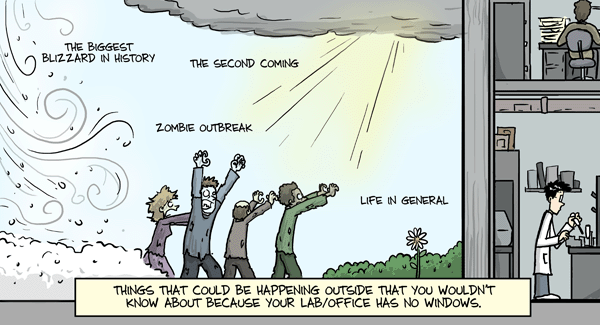
Lovely Weather, Rainy Day Reading

Comic credit: PhD Comics
The weather has been lovely this week in Washington, DC. As usual, as soon as we don't need to be at our desks (read: Saturday), the forecast turns gloomy. But, it means we'll have plenty of time to read up on stuff we missed this week. Here are five things we haven't missed (and don't think you should either):
  1. Last week's budget deal made its way through Congress this week, and now awaits President Obama's signature. Read these Science stories for more on how the deal affects research funding overall, as well as the NIH and NSF in particular.
  2. The royal wedding is just two weeks away, and Cell has an amusing, scientific perspective on the union of Prince William and Kate Middleton. (If you don't have a subscription, there's a summary here.)
  3. Looking for a job in public service? This book tells you how you can get paid to change the world.
  4. You've heard of the dot.com bubble and the housing bubble, but is there a higher education bubble? If so, is it about to burst?
  5. Ed Yong explains how breast cells may be able to revert to stem cells. What would that mean for the future of stem cell research?
Finally, if you like Earth Day activities, get a head start this year and submit a photo or video to the Consumer Electronics Association's contest to show what you'll be celebrating. Submissions are due April 17th, so be sure to get yours in soon!

Happy reading and we'll see you next week!

Bookmark and Share

Wednesday, March 30, 2011

Do You Know Your Members of Congress?

Either way, today is the day to get in touch with your member in the House of Representatives.

The House is currently crafting a spending bill that may include unprecedented funding cuts to NIH, NSF, CDC, AHRQ and FDA. These cuts represent a major threat to the nation’s health, job growth and competitiveness.

It is critical that you contact your representatives TODAY so they know that cuts to American research are unacceptable.

It's about your job. Your health and the future well-being of your family. It takes 30 seconds to send a message and another 30 seconds to share with your contacts via email or Facebook.

Your minute could be the constituent voice that convinces Congress to protect research.

Bookmark and Share

Friday, July 23, 2010

Charm, Competition, and Communication

In the early 90’s, administrators at MIT realized that many of its students, while brilliant, were socially challenged. The bastion of engineering was producing geniuses that couldn’t give a decent handshake, talk to strangers, or dress reasonably. The solution? Charm School.

The university offered students the opportunity to fill any social holes that might have developed as a byproduct of possessing a superior technical intellect. The program was deemed a huge a success, and now in its 17th year, is popular and thriving.

Science researchers are another smart group that suffers from social deficits – namely the ability to communicating the importance of their work to those outside their fields. Should they be required to attend “Communication School”?

In 2007 there was a push from Congress to require scientists to do exactly that. The America Competes Act, which was a bill that intended to funnel big bucks to research powerhouses like the National Science Foundation (NSF), NASA, and the Dept of Energy, contained provisions requiring graduate students “to be trained in the communication of the substance and importance of their research to non-scientist audiences”. While the 2007 Competes Act made it through both houses of Congress, and was signed by the President, select pieces of it were not funded during appropriations. One of the casualties was the science communication training.

The science outreach community was disappointed by the 2007 Competes Act, and hoped for a chance of redemption this year when the 2010 America Competes Act was being written. Unfortunately, any language concerning communicating to non-science audiences is conspicuously absent in the 2010 version. Nearly all of the outreach wording in the 2010 Competes Act specifically focuses on energy, STEM education, and commercial applications of research - a sign of the times.

There may be a glimmer of hope. For some time, NSF has required researchers to address the broader impact of their research when applying for grant money. It is unclear exactly how much weight is placed up this review criteria but applicants are supposed to emphasis how the work benefits society and/or broadens dissemination of scientific and technological understanding. This is a good start and there are murmurs the NIH will soon follow suit and require similar activities from their grant applicants.

It may seem like an impossible feat to get scientists communicating about their work, but if the students at MIT's Charm School can learn Israeli folk dance, surely scientists can learn to do a better job of explaining why people should care about their research.

Bookmark and Share