Showing posts with label knowledge-based economy. Show all posts

Thursday, January 27, 2011

Thoughts on the State of the Union Address

Now that it's had a bit of time to sink in, here are our thoughts on the State of the Union address made Tuesday evening.

The following passages are the opinions of the authors alone and do not necessarily represent those of any affiliated organizations.

Max's Take:
Science in the SOTU

Innovation is the light at the end of the tunnel for Obama. In his State of the Union speech, he spent an unprecedented amount of time discussing the role of science and research in leading the nation toward renewed prosperity. His remarks were undergirded by a fundamental belief in the societal benefits of science and pursuit of basic knowledge.

Even in the face of shifting national priorities and at a time when both sides of the isle are talking about cuts, Obama has been resolute in his support of science. This is especially striking given that many of the scientific investments being made today may not bear fruit in the short term, and probably not in time for the coming Presidential election.

Obama specifically mentioned the role of government support in the creation of the Internet, GPS, and computer chips. What other groundbreaking innovations should be included here? This is a tremendous opportunity for you to share how research has improved our world.

Heather's Impressions
Structural Integrity

By now you've read all of the promises about investing in biomedical research. Word is spreading far and wide about President Obama's call for innovation and more simply regulated salmon. Our Sputnik moment is upon us. And while others are discussing the verbage, I can't stop thinking about the construct.

I have a bit of a background in speechwriting and oral communications, so much of my time watching speeches is paying attention to rhetorical devices and style. Structurally, the president started with formalities and then led his content sections with science and education. Although I believe it is a priority for him - and that should be reflected in the upcoming budget as promised - I don't think that's why he led with it.

Science and education paved the way in the SOTU because they are topics everyone can get behind (as evidenced by years of public opinion data). No one wants America to be left behind. But it was more than just a warm-up; a unifying set of topics to bring on the applause.

Investment in research and innovation are about to face an epic fight for funding, and by framing it his way first, the president was attempting to counter early attacks. The position in the speech is just as important as the words he used.

As contradictions in the text of the speech already show, not everything mentioned on Tuesday night is going to happen. (I challenge anyone to find a SOTU where everything mentioned was actually accomplished as laid out in the speech.) However, that isn't the point of the SOTU. It's about goals, a vision, an ideal look at the future.

Beyond the structure of the speech is the structural integrity of its vision. Will the president be able to make his vision reality in the face of the worst economic situation since the Great Depression and a Congress with other plans? For the sake of science, I hope so.

Bookmark and Share

Tuesday, January 25, 2011

Macintosh Saves the World?


On January 24, 1984, Apple introduced Macintosh. Macintosh would launch a new philosophy toward computing, one that would eventually lead to the ubiquity of computers and proliferation of mobile computing.

The advertisement that launched this new product was nothing short of striking, profound, and groundbreaking. Some consider it to be the most effective television advertisement ever conceived.

The commercial was directed by Ridley Scott, who had recently directed Alien (1979) and clearly adapted thematic elements from the film to the Macintosh commercial.

In the first 10 seconds of the ad, we immediately get a sense of the world that Scott has created. It is bleak, monochromatic, orderly, and authoritarian. At the time, it was thought that this world was an allusion to the current business leader of computing – IBM – a company that was known for its strict standards that even applied to the style of ties that employees could wear. In sharp contrast is the heroine. She is the only female in the commercial and committed to rousing the proletarians.

The ad concludes with a reference to Orwell’s 1984. The implication is that Macintosh will ‘save’ us from the conformity and tyranny offered by Apple’s competitors. Clearly, Apple is making a profound statement and they did it in just 60 seconds.

Has Apple changed the world? What would the technological landscape look like without Macintosh?

Bookmark and Share

Monday, August 30, 2010

A=B; B=A

Ever wonder how connected science policy and science research is? About as much as Siamese twins attached at the head. Look at some of the current policy issues that affect research (and vice versa).

Climate Change
Serious health and environmental concerns may be triggered by increases in UV radiation and a depleted ozone layer. A climate change bill passed through the House in ‘09 but is facing obstacles in the Senate. The success or failure of current and future climate change legislation will be influenced by scientists and researchers

Stem Cell Regulation
In ’05 and ’07 the Stem Cell Research Enhancement Act was passed by Congress but was vetoed by the President. Although President Obama has lifted some barriers to stem cell research, the ‘09 version of the Stem Cell Bill has not passed either branch of Congress.

Genetic Testing
Should consumers have the right to personally administer genetic tests on themselves? In 2008 the Genetic Information Nondiscrimination Act (GINA) restricted employers and insurance company from discrimination based on results from genetic tests, but no federal policy regulates how the tests are conducted.

The Environment and Offshore Drilling
Researchers and engineers will play an integral role in determining the Congressional legislative reaction to the BP oil spill. In ‘08, a 27 year offshore drilling ban was lifted, which may now be reinstated.

Cloning
The FDA allows animals to be cloned and their meat sold for human consumption - should scientists be allowed to clone human organs for research or transplant? Should we be allowed to clone extinct or endangered species? Legislation addressing such issues will be framed soon.

Health Records and Internet Privacy
Should restrictions exist when accessing health records electronically? Do search engines have the right to save search data? In ‘10 an online privacy bill was presented in the House, which will effect digital privacy laws and medical record storage. Doctors and researchers will dictate these quality of these regulations.

Tax Credit for Research
The Federal Research and Development tax credit was worth $5.6 billion to U.S. companies in ‘09. The credit includes qualified research, computer time-sharing costs, and a percentage of contract research expenses. It is a temporary program that has been renewed annually for 28 years, but whether it becomes part of the permanent tax code has not been decided.

Competitiveness
The 2010 America COMPETES Act is currently being considered by Congress. It will not only affect NSF funding for the next five years, but legislate energy, STEM education, and technology transfer efforts.

No matter what field you're in or what type of research you do, you should work to affect the policies that affect research.


This is Part 3 of 3 in the Science of Advocacy series.
Part 1 - Senator PhD?
Part 2 - Baby don't cry, baby don't get no milk
Part 3 - A=B; B=A

Bookmark and Share

Wednesday, May 19, 2010

AAAS Science & Technology Policy Forum - Day 2

Yesterday, we started sharing some of the themes captured by your New Voices bloggers at the AAAS Science & Technology Policy Forum. Today we continue by sharing our notes from two of Friday's sessions.

Also - be sure to check out the New Voices Twitter feed for direct quotes from the speakers.

Strengthening the U.S. Climate for Innovation
  • Innovation is using new knowledge to generate payback.
  • Innovation has accounted for half of U.S. productivity growth over the pat 50 years (see slide above, courtesy of Andrew Taylor of The Boston Consulting Group).
  • Increased direct government spending yields results.
  • Excellence in science and technology is not enough to be a world leader.
  • We need to remove barriers and encourage creativity.
  • We need new kinds of scientists and engineers with: communication skills, multicultural understanding, foreign languages, and training in psychology and the creative arts
  • What can the U.S. do?
  1. Promote science & technology education
  2. Increase innovation spending
  3. Promote industry clusters & centers of excellence
  4. Remove bureaucratic barriers
  5. Promote intellectual property protections
National Security and the Roles for Science and Technology
  • Cyber security is uncharted territory; there are no rules of war.
  • There is a relationship between higher education and intelligence communities. One mechanism for collaboration is the NSHEAB - National Security Higher Education Advisory Board which works with federal intelligence community.

Bookmark and Share

Wednesday, May 27, 2009

Advocating for Human Capital

Welcome to Part 6 in our series on Human capital and knowledge-based economy.

In the past we have examined what it takes to train a scientist and how tough the competition is to become an independent researcher. The statistics look rather bleak for Dr. Cy Ence and his band of fellow researchers. So what can we do about it?

Become advocates for science and scientists.

Funding science (and therefore scientists) is not only about satisfying our intellectual curiosities and finding cures for diseases, today it is about having an edge in the knowledge-economy. Training and supporting the next generation of researchers ensures our capacity to continue innovating and thus continue to be a competitive economy.

When people want to know why we should care about research and researchers, you can tell them all about the issues we explored in the last 4 posts. You can talk to them about the predicament of the current generation of post-docs and grad students and you can pull out statistics and numbers. You can also make three simple points:
  • Research is the foundation for a better tomorrow.
  • Investing in research ensures that we will have a better quality of life.
  • Research will also allow us to have a healthy, strong and vibrant economic future.
If you're reading this, you already have the foundation you need to become a strong advocate for science. Here are some simple steps:

We hope you've enjoyed our series on Human capital and knowledge-based economy and we look forward to your comments and thoughts.


This is Part 6 of 6 in our Human Capital and Knowledge-based Economy series.
Part 1 - A Knowledge-based Economy
Part 2 - U.S Competitiveness and Innovation

Part 3 - The Making of a Scientist
Part 4 - From Training to Practice: Joining the Faculty
Part 5 - A Race to Save the Lab Rats
Part 6 - Advocating for Human Capital

Tuesday, May 26, 2009

A Race to Save the Lab Rats

Welcome back to our series on Human Capital and the Knowledge-based Economy.

Today we will continue examining Dr. Cy Ence's career path.

Assuming Dr. Ence does get a tenure-track position at Prestigious American University, he now has to find money to run his lab. Since he is in the life sciences, he will have to do that by getting some grants funded.

First, he (and/or his students) will have to collect preliminary data in support of his research hypothesis. Based on the initial results, he will have to write a research proposal and submit a grant to a funding agency. The largest funding agency in the life sciences is the National Institutes of Health (NIH). There, his grant will be reviewed by a committee of his peers and then further by a committee of professional grant managers. Then his grant will be scored and depending on his score, he may or may not get funded.

Just like when he was applying for faculty positions , the numbers don't look so good for Cy. The number of first time NIH grant winners has declined from about 1,800 in 1980 to about 1,350 in 2007.

One reason for this is an increasing hyper-competitive environment for grants. When Dr. Ence starts up his lab, he will be competing with established researchers who have had labs for five, ten, or 15 years and therefore 5,10 or 15 years to establish themselves as opposed to our favorite newbie Cy. They are all applying for the same pool of money, and grants are graded and scored the same way.


A result of this system has been a steady decline in the number of first time investigators as compared to established investigators winning grants in any given year. It has gone from about 40% of first time investigators being successful in the early 60's to only about 24% being successful in 2006.

Why is this important?

When a researcher can't get funding, they are basically unable to keep their research program going - meaning no money for research personnel, for chemicals, for animals etc. It means that
they can't carry out experiments in a timely fashion, which results in few or no publications which in the worst case scenario means that they run the risk of losing their lab.

The current crop of graduate students and post-docs are watching this happen around them everyday and fewer and fewer of them want to even attempt a career as faculty in academia.

Basically, we are pulling the rug from underneath the feet of the next generation of academic researchers.
You can lose a generation of researchers pretty fast—in five or ten years. Once it happens, we won’t get those people back.”
Joshua Boger, PhD
founder, Vertex Pharmaceuticals,
& chairman, BIO
Another consequence of this funding environment has been the reluctance of granting agencies to fund the more high-risk, high-reward projects.There is a limited pool of resources which they are responsible for distributing and are also accountable for. So, they have done what every other agency in their position would do- they have chosen to bet on the sure horse; they primarily fund more traditional, conservative science. This means that although we are making steady progress- it is progress in small steps instead of progress in leaps and bounds.

So, is everything just dismal and negative? Should we just give up?

On Thursday we'll wrap up this series by responding to your comments and suggesting next steps for improving the way our country invests in the future of science.


Sources: National Institutes of Health (NIH)/Office of Extramural Research (OER), A broken pipeline?


This is Part 5 of 6 in our Human Capital and Knowledge-based Economy series.
Part 1 - A Knowledge-based Economy
Part 2 - U.S Competitiveness and Innovation

Part 3 - The Making of a Scientist
Part 4 - From Training to Practice: Joining the Faculty
Part 5 - A Race to Save the Lab Rats
Part 6 - Advocating for Human Capital

Click image for full comic strip. Credit: PhD Comics

Wednesday, May 20, 2009

From Training to Practice: Joining the Faculty

Welcome to Part 4 of the Human Capital and the Knowledge-based Economy series. Last time we examined the investment needed to train a single independent researcher - Dr.Cy Ence. Today, lets look at what it will take for Dr. Ence to become an independent researcher at Amazing American University.

But before that a quick re-cap: Dr. Ence is now in his late 30s. He has finished 7 years of graduate school and 9 years of post-doctoral training. He has published great articles, attended conferences and given talks. He's putting together his curriculum vitae (CV), so he can start applying for jobs as an assistant professor. What are his chances?

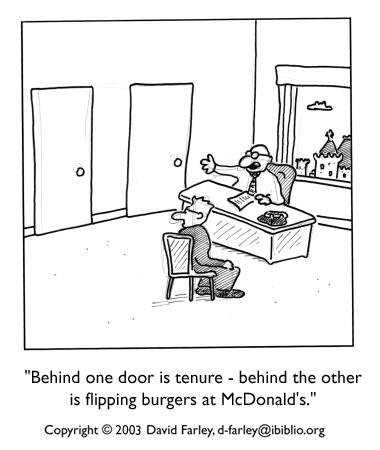
According to a forum convened by the National Academies, the chances of a life scientist under the age of 35 getting a tenure-track position fell from 10% in 1993 to 7% in 2003; as the number of life sciences PhD graduates went from 11,000 to 16,000 and tenure-track positions held steady at about 1,200 positions. That means that Dr. Ence has to be one of the top 7 out of every 100 life science PhDs applying for a job as an independent researcher to get the position.
“These trends have made job competition among young scientists very Darwinian.”
~Norka Ruiz Bravo, former deputy director for intramural research at NIH

In medical schools the numbers are worse. In the graph below, the blue bars represent the total number of medical school faculty members with a PhD and the red bars are the number of new faculty hires with a PhD in a given year. The green trend line represents the percentage of new hires when compared to the total number of faculty with a PhD.

Graph 6 - Trends in Medical School Faculty Positions
So, for example in 1970, the total number of PhD faculty in med schools* was about 8,800 and med schools hired about 1,100 new faculty with a PhD, which is about 13% of the total. By 2006, the number of faculty with PhDs in med schools had increased to about 38,000. But, only about 1,100 new faculty were hired meaning a increase of about 3%.

These are dismal numbers. Cy and others like him have an incredible battle before them. Why is it so difficult to get a faculty position? How did the competition get so steep? What happens after getting a faculty position? Is everything roses then?

We'll explore these questions and more next week, as we continue our series on Human Capital and Knowledge-based Economy.


*Medical schools certainly hire MDs, MD/PhDs and other graduate degree holders, but this just looks at PhD hires because it is the most reliable and readily available data.


Sources: National Institutes of Health (NIH)/Office of Extramural Research (OER), Association of American Medical Colleges (AAMC)


This is Part 4 of 6 in our Human Capital and Knowledge-based Economy series.
Part 1 - A Knowledge-based Economy
Part 2 - U.S Competitiveness and Innovation

Part 3 - The Making of a Scientist
Part 4 - From Training to Practice: Joining the Faculty
Part 5 - A Race to Save the Lab Rats
Part 6 - Advocating for Human Capital

Monday, May 18, 2009

The Making of a Scientist

Welcome back to the Human Capital and Knowledge-based Economy series. As I mentioned in previous posts, the economy is changing and ideas and innovation are drivers of the knowledge-based economy. Hence, researchers are one of the bases of the economic infrastructure. I've examine what it takes to train a researcher- the investment needed both financial and in terms of time and I wanted to focus on life scientists.

To become a researcher today one can take many routes, and the options are ever increasing. To make things easier lets follow the journey of Cy Ence. He's about to finish his first year in kindergarten, and though he doesn't know it yet, he has just taken his first step on his path towards becoming an independent researcher. Like many who'll enter the life sciences, Cy will eventually want to become an independent academic researcher* (a principal investigator or PI) so he can spend his days working in his own lab at a university.

But that's a long time from now. Right now, he's looking forward to a summer of catching tadpoles and we're going to look at how much time and money it's going to take to get Cy from Hometown Elementary to his dream job. All of this will be based on using the most recent numbers available and assuming that nothing changes in the next 30 some-odd years.

So here's Cy's basic path**:
  1. K-12 Education (13 years)
  2. College (4 years)
  3. Graduate School- PhD (7 years)
  4. Post-doctoral training(2-7 years)
  5. Independent researcher
Step1- K-12 education.

The Department of Education charts the average cost per student per school year across the U.S. They have been maintaining their records going back to the early 1900s. I've started in the late 70s- a time when some of you (and many of today's young researchers) started school.

Graph 1 - U.S Investment in K-12 education

In the late 70's, the average investment per child per school year was $1,855. Today, that figure stands at $8,701. These are just the directly measurable costs meaning, teacher's salaries, school lunches, books etc., so the actual number is a lot higher. But, for simplicity's sake, we'll stick with the smaller and more easily obtainable data.

So the investment in young Cy (@ $8,701 / year - if nothing changes) - will be about $113,000.

After he graduates high school, Cy will be heading off to Average American University.

Graph 2 - Average Annual Cost for U.S. Undergraduate Education (room, board, tuition)

As the graph shows, the investment in room, board and tuition alone per student per year of college across the U.S (both public and private schools) was $7,452 in the early 90's. Today, that figure is about $14,629. This of course, does not take into account all the other expenses associated with college - books, transportation, beer and the like.

For Cy - the minimum investment will probably be about $58,000 and 4 years.

Since Cy Ence, B.S. will not be enough for our favorite student, he's going to head off to another university to work towards his PhD. Assuming it takes him the median seven years*** to finish his doctoral degree, the total investment for his graduate stipend will be about $145,000. This is not accounting for the reagents he uses for his experiments, his animals etc.

Graph 3 - Average Annual Graduate Student Stipends


Now it is officially Dr. Cy Ence and he is well on his way to becoming an independent academic researcher. In the life sciences, there is often one more step: post-doctoral training. Post-docs can range from two to seven years and it is becoming common to do more than one post-doc.

Graph 4 - Average Annual Post-doc Stipends


Since Cy Ence, PhD is the average American researcher, he is not going to immediately find a permanent academic position. Instead, he is going to follow his first (short) post-doc with a much longer one. When he is finally done being a student (29 years from now), the minimum investment in his education and training will be about $633,000 dollars.

Graph 5 - Total Educational Investment in Cy Ence
That's right. Training a single independent researcher requires a minimum investment of $630 thousand dollars and over 30 years.

We'll continue following Cy and discuss what the future holds for him as we continue our series on Wednesday with a look at the competition for academic positions and how independent researchers are funded.


*Independent researchers can be employed in many sectors - Academia, Industry, Government etc. I have chosen to focus on Academia because, our current graduate curricula are largely structured to train Academic researchers.

**This is the most common path today, but by no means the only path taken to become a researcher ;some people go to community college first or work towards Masters, Medical, or Veterinary degrees, etc. before becoming researchers.

*** According to NSF, the median time for graduating with a PhD in the life sciences today is 7 years.

Sources: Department of Education, National Center for Education Statistics, National Institutes of Health (NIH)/Office of Extramural Research (OER), National Research Service Award (NRSA), National Science Foundation (NSF)/Division of Science Resources Statistics (SRS).


This is Part 3 of 6 in our Human Capital and Knowledge-based Economy series.
Part 1 - A Knowledge-based Economy
Part 2 - U.S Competitiveness and Innovation

Part 3 - The Making of a Scientist
Part 4 - From Training to Practice: Joining the Faculty
Part 5 - A Race to Save the Lab Rats
Part 6 - Advocating for Human Capital

Wednesday, May 13, 2009

U.S Competitiveness and Innovation

In my last post, I talked about how we are moving towards a knowledge-based economy and what that term means.

In today's post, I want to talk about U.S competitiveness, especially with respect to a knowledge-based economy.

Several reports about U.S. competitiveness and innovation in the global economy have been compiled. Although they all use slightly different methodologies, they all reach the same basic conclusion. We are not doing enough to spur research and innovation and we need to wake up before its too late.

The latest report is from ITIF an independent think-tank, here in DC. ITIF specifically focused on the science and technology (S&T) sector, so I'll give some details from their report- The Atlantic Century, which uses 16 different parameters like innovation, productivity, S&T policy, trade policy, etc. to grade and rank 40 different countries on how innovative and competitive they are.

The crucial data from the report are summarized below:

Table 1: How innovative and competitive are we?

Out of 40 countries, we came in 6th. Perhaps, not time to push the panic button yet, but far from the magical #1 slot that most people believe we enjoy.

The report goes further and examines what these 40 countries have been doing to actively encourage innovation and competition in their countries over the past decade.

Table 2: Has our score improved?


This is the most striking result of their analysis- we came in dead last. Out of the 40 countries they studied: the U.S was doing the LEAST to spur innovation.

The results are particularly distressing because countries like Singapore and Luxembourg - already ranked higher than us in innovation and competition - are also doing more than us (a lot more) to spur innovation, meaning we'll have much farther to go to catch up.

The cornerstone for the future of U.S. competitiveness and innovation lies in supporting our research infrastructure, and more specifically researchers. In my next post, I'll discuss the most common path to becoming a scientific researcher in the U.S. and the time and financial investment it requires.


This is Part 2 of 6 in our Human Capital and Knowledge-based Economy series.
Part 1 - A Knowledge-based Economy
Part 2 - U.S Competitiveness and Innovation

Part 3 - The Making of a Scientist
Part 4 - From Training to Practice: Joining the Faculty
Part 5 - A Race to Save the Lab Rats
Part 6 - Advocating for Human Capital

Monday, May 11, 2009

A Knowledge-based Economy

Comic credit: Scott Adams

I hope everyone had a happy Mother's day yesterday. Like Dilbert's mom, the first time I tried explaining what I did to my mom, she was more concerned about how I'd be making any money as a scientist than with understanding my research. Now that I am a policy fellow, the value of my work may be even more difficult to measure.

For the past few months I have been working on issues of building human capital for the knowledge based economy. That is quite a mouthful, so let me break it down:
  • Human capital is the basically assets in the form of well-qualified, trained people in other words - labor;
So, I've been working on how to increase our workforce (a.k.a people) for a knowledge-based economy (a.k.a the world we live in now).

This is an issue that has fascinated me for some time now, so I was ecstatic when the good folks at Research!America said that I could work on it.

Why is this issue important? For me (and many of you), it is important because I am a scientist, and this issue directly impacts my workforce.

It is also important in the larger context of our economy. Pretty much everyone now realizes that the days of a manufacturing-based economy are over. We are moving towards a knowledge-based economy . We are moving from jobs that largely require manual skills (like assembly line jobs) to jobs that require intellectual skills (like doing research). Our economy is now trading in goods that are more the product of the mind than the hand (eg. trading in fuel-cell technology has more value than selling a car).

We are also a mature economy and the jobs that promise to stay in America are not the manufacturing jobs but rather the intellectual jobs. The rise of inexpensive and reliable telecommunications and transport has led to the export of jobs requiring intensive input of manual labor and a demand for jobs requiring input of intellectual skills. In other words, a company that trades its products globally is minimizing its manufacturing costs by shipping those jobs overseas, while keeping its R&D facilities - and thus those jobs - here in the US.

So, if we are moving to an economy where intellectual skills and research are going to be valuable, don't we need a trained workforce? Do we need more people who can do research? If so, how will we train these individuals? How much will we need to invest and how long will it take?

I'll be exploring these and other questions over the next few weeks throughout a series of posts on building human capital in a knowledge-based economy. Stay tuned!


This is Part 1 of 6 in our Human Capital and Knowledge-based Economy series.
Part 1 - A Knowledge-based Economy
Part 2 - U.S Competitiveness and Innovation

Part 3 - The Making of a Scientist
Part 4 - From Training to Practice: Joining the Faculty
Part 5 - A Race to Save the Lab Rats
Part 6 - Advocating for Human Capital