Wednesday, January 12, 2011
The Civic Scientist
Monday, August 30, 2010
A=B; B=A
Ever wonder how connected science policy and science research is? About as much as Siamese twins attached at the head. Look at some of the current policy issues that affect research (and vice versa).Climate Change
Serious health and environmental concerns may be triggered by increases in UV radiation and a depleted ozone layer. A climate change bill passed through the House in ‘09 but is facing obstacles in the Senate. The success or failure of current and future climate change legislation will be influenced by scientists and researchers
Stem Cell Regulation
In ’05 and ’07 the Stem Cell Research Enhancement Act was passed by Congress but was vetoed by the President. Although President Obama has lifted some barriers to stem cell research, the ‘09 version of the Stem Cell Bill has not passed either branch of Congress.
Genetic Testing
Should consumers have the right to personally administer genetic tests on themselves? In 2008 the Genetic Information Nondiscrimination Act (GINA) restricted employers and insurance company from discrimination based on results from genetic tests, but no federal policy regulates how the tests are conducted.
The Environment and Offshore Drilling
Researchers and engineers will play an integral role in determining the Congressional legislative reaction to the BP oil spill. In ‘08, a 27 year offshore drilling ban was lifted, which may now be reinstated.

Cloning
The FDA allows animals to be cloned and their meat sold for human consumption - should scientists be allowed to clone human organs for research or transplant? Should we be allowed to clone extinct or endangered species? Legislation addressing such issues will be framed soon.
Health Records and Internet Privacy
Should restrictions exist when accessing health records electronically? Do search engines have the right to save search data? In ‘10 an online privacy bill was presented in the House, which will effect digital privacy laws and medical record storage. Doctors and researchers will dictate these quality of these regulations.
Tax Credit for Research
The Federal Research and Development tax credit was worth $5.6 billion to U.S. companies in ‘09. The credit includes qualified research, computer time-sharing costs, and a percentage of contract research expenses. It is a temporary program that has been renewed annually for 28 years, but whether it becomes part of the permanent tax code has not been decided.
Competitiveness
The 2010 America COMPETES Act is currently being considered by Congress. It will not only affect NSF funding for the next five years, but legislate energy, STEM education, and technology transfer efforts.
No matter what field you're in or what type of research you do, you should work to affect the policies that affect research.
This is Part 3 of 3 in the Science of Advocacy series.
Part 1 - Senator PhD?
Part 2 - Baby don't cry, baby don't get no milk
Part 3 - A=B; B=A
Wednesday, August 11, 2010
Meet Jamie Vernon, PhD, Molecular Biologist
NV: What do you do?
Jamie: I'm a Postdoctoral Fellow, NIH funded, and I work in a lab with Dr. Alan Lambowitz, a biochemist and microbiologist who studies mobile elements. Our lab is working on developing a gene targeting technology that could potentially be used for gene therapy and genetic engineering. This technology is based on something many people consider to be "junk DNA." These days it's becoming more and more evident that there is no such thing as "junk DNA." If it's conserved in our genomes, it probably serves a purpose.
Specifically, we study group II introns from bacteria and eukaryotic organelles. Our lab has determined that these mobile elements can be re-targeted to controllably insert into any DNA sequence. We call these re-targeted introns "targetrons" and they work very well in bacteria for creating gene knock-outs. My job is to make them target genes in eukaryotic cells, including human cells.
NV: How did you get started in outreach/advocacy?
Jamie: I think the Bush administration was a trigger. The policies related to stem cell research motivated me to act. I felt that the Bush administration's stem cell policies were not based on the best science. What was being touted was that we had all these existing stem cell lines, "why couldn't we do the research on those and get the answers we need?" But there were problems with those lines. We need a much broader collection of lines in order to deal with different diseases and different genomic backgrounds. There weren't adequate cell lines to address all these concerns. That's what sucked me in.
Now, climate change has become one area that needs to be addressed,the next calamity in science policy. Actually, there are countless science-related policy issues such as geoengineering, genomic privacy,forensic science and, of course the big one, alternative energy, that need to be carefully deliberated before we make the wrong policy decisions.
NV: What motivates you to do advocacy?
Jamie: My main motivation is that I think that science has so much to offer but it's being limited by the current policies. I truly believe that communicating science and gaining partnerships out in the public will have a positive effect on how much science is getting done.
The climate change bill is a huge issue for me. There's little room for compromise. If we don't act, the consequences down the road could be much greater than any financial investment we have to make today. You can't lose by investing in technologies that improve the environment. If the facts hold true, and I assume they will, the ramifications are dire for everyone.
NV: What limits your ability to do advocacy?
Jamie: I would say that I'm constrained by the same things as young professors. You have to produce to be considered effective. I have no incentive to do advocacy other my personal beliefs and desire to make science commonplace in the public discourse. I'm also limited by the fact that by the time I had graduated I had a family, a wife and a daughter, and that requires personal time. Mainly, I need to have a high level of productivity in order to compete and build my own research career.
There's little out there to support young scientists who wish to do outreach. For these reasons, I'm torn on which direction I want to go full-time. Science advocacy is very rewarding, but I'm a scientist at heart. It's difficult to be successful at both and it's almost an impossible decision to choose one over the other.
NV: Do you think outreach and advocacy should be required of scientists?
Jamie: No, I don't. I think there are enough scientists who care about outreach and have the communication skills to do it; rather, it should be incentivized in some way. If you force them, especially if they don't have the proper communication skills and don't want to be out there, they could make mistakes and say some stupid stuff. You need people who understand the sensitivities of the community and understand the arguments within the community. You need the public to feel that there position is being considered and appreciated when science policy decisions are being made.
Want to learn more about the issues Jamie mentioned above? Check out his blog!
This is part of the ongoing Profiling New Voices series.
Monday, July 19, 2010
Science and the Supremes
Edwards v. Aguillard (1987) – Creationism cannot be taught in science classesIn 1982 the Louisiana state legislature passed the “Balanced Treatment for Creation-Science and Evolution-Science in Public School Instruction Act”, which required that when evolution was taught in a public school, “creationism science” must be taught as well. Lower courts ruled against Louisiana citing that the actual purpose of “creation science” was to promote a specific religious doctrine. The State of Louisiana appealed to the Supreme Court.
In 1987, in a 7-2 to vote, the Act was ruled unconstitutional. The Supreme Court found that although the Louisiana legislature claimed the Act protected academic freedom, it actually limited a teacher’s ability to decide what scientific principles to teach.
Daubert v. Dow Pharmaceuticals (1993) – Scientific evidence can only be presented in court if the scientific method was used
Jason Daubert was born with serious birth defects. His parents believed that Bendectin, a drug used to treat morning sickness manufactured by Dow Pharmaceuticals, was the cause of the defects. The Dauberts sued Dow, and during the trial submitted scientific evidence that the defense claimed was based on questionable animal research and reanalysis of other published studies. A district court sided with Dow Pharmaceuticals when judges on the case determined that the Dauberts' medical evidence was not scientifically valid. The Supreme Court was asked to review the decision and agreed to do so.
In 1993, in a unanimous 9-0 vote, the Court ruled in favor of the Dauberts. The previous standard for submitting scientific evidence vaguely stated "the thing from which the deduction is made must be sufficiently established to have gained general acceptance in the particular field in which it belongs." The Daubert case forced the Court to get more specific, and they outlined the The Standard on Governing Expert Testimony:1) Testimony must be scientific in nature and grounded in knowledge – this has since been interpreted as meaning that the scientific method must be used
2) The scientific knowledge must assist in the understanding of the specific issues at hand
3) The judge decides if rule 2 is met
Massachusetts v. Environmental Protection Agency (2007) – The EPA must regulate carbon dioxide and other greenhouse gases
In 2003 the EPA decided that under the Clean Air Act, it lacked the authority to regulate carbon dioxide or greenhouse gases for climate change purposes. Twelve U.S. states took the EPA to court in an attempt to get the Agency to change this determination. In 2006, the Supreme Court agreed to hear the case.
In a highly controversial and super charged political trial the Supreme Court voted 5-4 against the EPA. The Court rejected the EPA's argument that the Clean Air Act was not meant to refer to carbon emissions. The four dissenting judges argued that there was not enough evidence to claim that greenhouse gas emissions contribute to climate change, but they found themselves in the minority.Considering the current political climate, we can expect Elena Kagan to have many opportunities to weigh-in on cases involving science. Issues of cloning, stem cell research, and energy policy will most likely appear before the nine black robed powers in the very near future.
Tuesday, May 18, 2010
AAAS Science & Technology Policy Forum - Day 1
The themes are captured here, and we'll be sharing quotes starting tomorrow morning on our Twitter feed - so follow us @NV4Research for even more coverage of the forum.
Budgetary and Policy Context for R&D in FY2011
- The budget for research is increasing in fiscal year 2011
- The Obama administration cares about science; demonstrated by 30 members of the National Academies of Sciences on his staff.
- Investment at the federal level is more important than ever as state economies suffer from the recession and deal with budget cuts.
- It's hard to change institutions, because due to unions, firing people is difficult.
- Extending the Bush tax cuts would be terrible for the economy
- There is a long, slow gray area between a good and a bad economy, and we are in that gray area right now.
- Greater health directly relates to greater wealth.
- It is hard to analyze the impact of R&D, because there is often not a direct link between the two.
- Geo-engineering poses a number of both scientific and moral questions, not the least of which is, who's hand is on the thermostat if we do have the ability to change the climate?
- Energy and climate change are inherently security issues, because they serve as threat multipliers for instability in the world.
- Who are the experts and which experts do you trust on which issues?
- There is a mismatch between agencies with social science expertise and those with environmental missions, which makes explaining the complexity of climate change an even more difficult task.
- We need more strategies for adapting to climate change, including advanced disease surveillance that accounts for differences in regional climates.
Thursday, April 22, 2010
Environmental Re-Revolution
Nelson said, “I was satisfied that if we could tap into the environmental concerns of the general public and infuse the student anti-war energy into the environmental cause, we could generate a demonstration that would force this issue onto the political agenda.”
At the end of the day, it was clear Earth Day was a success. The widespread involvement has been attributed to the grassroots organizing, with more than 20 million people participating. April 22, 1970 was the first Earth Day, but also marked the beginning of the modern environmental movement.
Forty years later, Earth Day is more widely attended and has become an international celebration. However, the event does not carry the same sense of urgency. Recent polls highlight the trend of the American public’s dampened concern over environmental issues. Americans increasingly believe that environmental issues, such as climate change are being over exaggerated.
This societal shift is, in part, because the environmental threats we face today are not things we can easily observe. In the 1970s, celebrating Earth Day was taking action against clouds of smog in Los Angeles, oil soaked wildlife that companies were not held accountable for, and a river in Ohio that caught fire. Today, Earth Day raises awareness for several environmental issues that are difficult to perceive for most Americans. Worldwide, drinkable water is becoming scarcer, yet in the U.S. it flows freely from our taps. The average global temperature has been on a long-term upward trend, but this winter Mother Nature crippled cities like Washington, DC and Baltimore, MD with record-breaking snowfall.
It is time to renew the call to action. Here's a powerful video put together by Greenpeace, evoking the memory of JFK to deliver a call to action for world leaders to address environmental issues, such as climate change.
Video credit: Greenpeace
If you aren’t using it, unplug it. Even though you’ve turned an appliance off, if it is plugged into an outlet it is still drawing power. Unplugging appliances could result in a reduction in 10% of your household energy use, which can add up to real savings. If you appliances are plugged into a power strip, you can simply turn the power off.
Switch from bottled to filtered water. Bottled water requires much more energy to package and ship AND it costs you more money in the end.
Eat less meat. Meat production is estimated to produce 18% of global CO2 emissions.
Eat local. I was surprised to learn that the food we buy in the supermarket has traveled 1,500 miles on average to get from where it is grown to our plate. That requires a large amount of energy used just to move your food from point A to your plate.
Stop the leaky faucet. Not only is it an irritating sound to hear, it is also costing you money. The EPA website has some information about how you can do-it-yourself.
Be mindful of your water usage. Do you ever notice the person in the public restroom who leaves the water running not only while they lather their hands, but also while they go for the paper towels to dry off? I sure do. There are many times you can conserve by not leaving the water running, like washing your hands, brushing your teeth, or hand washing dishes.
Reduce Toxic Exposures. The EPA has started a great program called “Design for the Environment.” Companies with the label have worked with the EPA to reformulate products with safer chemicals.
Recycle Your Electronic Waste. Seventy percent of the heavy metals that end up in our landfills come from our discarded electronics, even though they are only about 2% of our discarded waste. Recycling keeps these toxic chemicals out of our environment.
How will you celebrate?
I myself will be attending “The Climate Rally” Earth Day event which is taking place this Sunday on the National Mall in Washington, DC. Festivities start at 11am and go on until at least 7pm. So if you are in the DC area, stop on by!
Wednesday, March 10, 2010
Searching for a Link between Health and the Environment
A great motto I try to live by is “everything in moderation.” But there some things that, even in moderation, are not safe.
The second World War marked a dramatic increase in the production of synthetic chemicals; compounds that do not occur naturally. Man-made chemicals were developed to be used as pesticides, industrial solvents, and cleaning products. Initially, they were used widely without much thought about their impact on human health. Rachel Carson’s groundbreaking book Silent Spring changed everything. The book pointed to concrete evidence that chemicals, such as DDT, were having lasting impacts on the environment and health.
Today we understand the potential adverse effects the chemicals we use every day can have on our bodies. Ensuring that they are safe for their intended use, however, has turned out to be a challenging problem. Increasingly, researchers are voicing concerns of possible lasting harmful effects on one specific group: our children. Experiments have still been largely unable to determine the exact consequences of chemical exposures during development and can only provide us with inexact correlations to a cluster of illnesses.
The National Children’s Study has been developed to find answers for these unanswered questions. We are seeing the incidence of chronic diseases, such as asthma and obesity, occurring at rates never seen before. But we do not yet know if these illnesses are a result of our genetics, our exposure to environmental chemicals, or the interaction of the two. Understanding how exposures at critical periods impact our children’s long-term health will enable us to work towards the prevention of these illnesses.
The National Children’s Study is designed to follow the development of 100,000 children from before their birth to 21 years of age. By sampling environmental exposures for a nationally representative group of children, it will attempt to determine a link between environmental factors and human health.
Currently they are recruiting pregnant mothers in their first trimester. It may seem like a large commitment since there will be a study representative visiting your home to collect samples from you, your child and the environment until they are 21. However, the bulk of the visits will be when the child is young, and are predicted to be only every two years once the child is older.
This is a landmark study that should revolutionize environmental health. Would you be willing to participate?
Tuesday, February 9, 2010
Snow Days

New Voices is based in Alexandria, Virginia. An amazingly historical city just inside the Beltway (which marks the DC metro area). If you haven't seen the news, Mother Nature has decided to dump many, many inches of snow on us. (As is evident by the view from my office window above; that's a 2.5-3 foot wall on the balcony.)
Since most of the blogging team has been snowed away from the office, we are going to delay the (now upcoming) series The View from Venus by a few days while we shovel out.
If you're local to DC, stay warm and dry; remember to hydrate, and watch for falling icicles. If you're not someplace snowy, I'm jealous.
Friday, November 13, 2009
Does Recycling Matter?
So, given that this Sunday, November 15th is America Recycles Day, I decided to conduct an experiment. I can spout statistics all day, but I prefer to do the work for myself. So, let’s examine how much one recycling household contributes to decreasing energy use and waste.
Question
Hypothesis
Method
1. Assess the contents of a recycle bin that has been collecting recyclables for 4 days in a household with three adults by cataloging and weighing all items in the bin.
2. Use the EPA iWARM program to estimate the energy saved by recycling these items.
Results
1. Contents of recycle bin:
- 2 glass bottles (12 fl. oz.)
- 1 glass bottle (0.75L)
- 50 plastic bags
- 108 oz. paper (~4-inch stack)
- 7 plastic containers
- 1 gallon plastic container
- 1 non-corrugated cardboard box
2. iWARM results
Net energy saved is equivalent to 12.8 kiloWatt hours (kWh)
Discussion:
Overall, the amount of recyclables collected in a four day period saved 12.8 kWh of energy. This is equivalent to the amount of energy needed to run: a room air condition for 8.6 hours, a ceiling fan for 107.1 hours, a hairdryer for 8.4 hours, a clothes washer for 30.2 hours, a dishwasher for 5.4 hours, a laptop computer for 257 hours, or a 60W fluorescent light bulb for 988.4 hours. That's a lot of energy saved over the course of a year!
This amount also equates to 260 lbs. of trash kept out of landfills in one year, or ~22,000 lbs. kept out in an average (86 year) lifetime.
Conclusion:
America Recycles Day
Earth911
Recycling tips:
- If you're cleaning out used items, don't thrown them away, Freecycle them.
- If you're upgrading your electronics or appliances, stores often provide exchange programs and will recycle your old model when you purchase the new. Be sure to ask.
- There are a number of products that can and should be recycled because of their chemical content. Below is the short list. Click on each product to find out how to recycle them.
Electronics
Batteries
Finally, to find out your local recycling guidelines, consult your local government's Solid Waste Department webpage.
Thursday, June 4, 2009
Climate Change and Health: Extreme Weather Events
Throughout this series we've talked about a number of ways that climate change effects human health. Anyone familiar with the topic of climate change has heard the horror stories about the catastrophic events that are in store for out planet if we don't curb carbon emissions. Today we're going to look at how those extreme weather events could alter human health.
A few recent examples of extreme weather events include the tornadoes in Oklahoma in February - outside of regular tornado season - and the floods in North Dakota in March, caused by heavy rains and blizzards, which President Obama cited as an example of the need to act on global warming. Additionally, we are likely to see more intense and frequent hurricanes, windstorms, and mudslides.
A particularly horrific example of how climate change can intensify natural disasters is the wildfires in Australia. Though the fires were caused by arson, they were spurred on – at least in part – by global warming, which had caused excessive drought and heat in the region.
The NASA map below shows land surface temperature across Australia from January 25 to February 1, 2009 compared to the average mid-summer temperatures the continent experienced between 2000-2008. During this time period, temperatures differed up to 10 degrees Celsius: cooler in blue regions, normal temperatures in white regions, and hotter temperatures in red regions.

As we approach hurricane season (Cyclone Aila has already made landfall) and the dog days of summer more and more people will be talking about climate change. The question is, what changes will we fight for to help save our planet and our health?
For more on this topic, check out these Science Progress resources: Global Ailing, The Human Toll of Climate Change, and this map.
This is Part 7 of 7 in our Climate Change and Health series.
Part 1 - Climate Change and Health
Part 2 - Heat-Related Issues
Part 3 - Malaria
Part 4 - Lyme Disease
Part 5 - Mental Health
Part 6 - Water-borne Disease
Part 7 - Extreme Weather Events
Tuesday, May 12, 2009
Climate Change and Health: Water-Borne Diseases
The posts in our climate change and health series have been discussing the range of consequences climate change may have on human health.
Increased precipitation could cause flooding & lead to water supply contamination, spreading water-borne diseases such as cholera & parasitic illnesses.
A report published in the American Journal of Preventive Medicine in October 2008 predicts increased risk for water-borne illness around the Great Lakes, potentially affecting 40 million people, due to an increase in climate-related extreme rainfall that could overwhelm storm water and sewage systems, potentially diverting raw sewage to Lake Michigan - a key source of drinking water.
While some regions will be effected by extreme precipitation, others will experience drought. These drier conditions can also spread water-borne illness as a single infected source could be shared by more people than usual.
This is Part 6 of 7 in our Climate Change and Health series.
Part 1 - Climate Change and Health
Part 2 - Heat-Related Issues
Part 3 - Malaria
Part 4 - Lyme Disease
Part 5 - Mental Health
Part 6 - Water-borne Disease
Part 7 - Extreme Weather Events
Monday, May 4, 2009
Panel Discussion on Climate, Energy, and Health
Last week I attended a panel discussion at the AAAS Forum on Science and Technology Policy called Climate, Energy, and Health: Policy Implications. The speakers discussed the intersection of these three big issues, and nearly all of them spoke about climate change’s likely increase in malaria incidence (validating my project!).
Andrew Dobson, Professor of Ecology and Evolutionary Biology at Princeton University, spoke about the role of climate change for infectious diseases. He strongly suggested that vaccines won’t work for diseases like malaria and cholera because immunity builds too quickly, and risk groups would need to be vaccinated every year, which is not a practical long-term solution. To make the disease seem more real, Dobson told the group that malaria is like one 9/11 every day, killing roughly 3,000 children per day in Africa. Studies tracking mosquitoes have shown that 99% of their bites are on cows, somewhat limiting the spread of malaria and that many ticks bite squirrels, somewhat limiting the spread of West Nile Virus. Therefore, higher biodiversity leads to lower vector-borne disease transmission rates. As diseases move out of the tropics there will be a less attractive variety of hosts (animals, etc.), so they will focus on humans.
Reid Detchon, executive director of Energy and Climate at the UN Foundation made the case for why toxic aromatics, like benzene, should be taken out of gasoline. Aromatics replaced lead to provide octane, but could be replaced by biofuels which are potentially low in GHGs and have less negative health effects.
Click here for more about the panel sessions held at the AAAS forum.
Friday, May 1, 2009
Climate Change and Health: Mental Health
Post traumatic stress disorder, anxiety, and depression due to extreme weather events or social upheaval are just some of the predicted impacts of climate change on mental health.*
Extreme weather events, sustained droughts, flooding, and changes in traditional food sources are incredibly stressful and many people may choose (or be forced) to leave their homes. Climate change refugees will not only have to deal with displacement but potentially the emotional stress of losing friends and family.
Poor mental health can reduce productivity and increase unrest. Additionally, declining mental health can result in increases in injury and suicide. In the short years following Hurricane Katrina (certainly an example of extreme weather, if not evidence of climate change), suicide rates tripled.
May is Mental Health Month, and here at New Voices we’re going to be posting throughout the month about the importance of mental health research, advocacy opportunities, and profiling leaders in mental health advocacy.
For an introduction to Mental Health Month, we recommend seeing the experts over at Mental Health America; they have some great features including a website dedicated to living well.
*Patz, J.A. Defining the current and future health risks of climate change. Program and abstracts of the American Public Health Association 135th Annual Meeting; November 6, 2007; Washington, DC. Presentation 4077.2.
This is Part 5 of 7 in our Climate Change and Health series.
Part 1 - Climate Change and Health
Part 2 - Heat-Related Issues
Part 3 - Malaria
Part 4 - Lyme Disease
Part 5 - Mental Health
Part 6 - Water-borne Disease
Part 7 - Extreme Weather Events
Monday, April 27, 2009
Climate Change and Health: Lyme Disease
Photo Credit: FDAIn a continuation of our Climate Change and Health series, today's post is about Lyme disease. Like malaria, Lyme disease is also likely to spread due to climate change. While malaria largely affects countries overseas, Lyme disease is the most common vector-borne disease in the U.S. with more than 21,000 cases reported each year. Typical symptoms for Lyme disease include fever, headache, fatigue, and a skin rash. If it is untreated, the infection can spread to joints, the heart, and the nervous system.
Predicted milder winters will increase the survival of disease-carrying deer ticks, which can then infect humans. A recent study by researchers at Yale has shown that the severity of Lyme disease may increase as tick's seasonal feeding cycles changes due to climate. Currently, Lyme disease is most prevalent in the Northeast, as illustrated by the map below.
This is Part 4 of 7 in our Climate Change and Health series.
Part 1 - Climate Change and Health
Part 2 - Heat-Related Issues
Part 3 - Malaria
Part 4 - Lyme Disease
Part 5 - Mental Health
Part 6 - Water-borne Disease
Part 7 - Extreme Weather Events
Friday, April 24, 2009
Climate Change and Health: Malaria
Tomorrow is World Malaria Day, which fits right in with the theme of my climate change and health project, since I used malaria as an example of how vector-borne diseases may spread. Vector-borne diseases are infections that are transmitted to humans and other animals by blood-feeding insects, such as mosquitoes, ticks, and fleas (hence, vector=bug).
Malaria is the most deadly global vector-borne disease. It is a blood infection that is transmitted by female Anopheles mosquitoes. The mosquito transmits a parasite that infects the liver and spreads to red blood cells. Currently, 41% of the world's population live in areas where malaria is transmitted. Each year 350–500 million cases of malaria occur worldwide, and 1-3 million people die, 80% of them in sub-Saharan Africa.
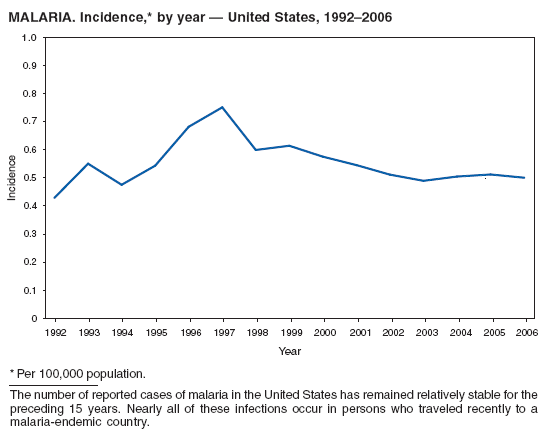
The majority of malaria infections in the U.S. occur among travelers that bring the infection back from another country. The CDC reported 1,564 cases of malaria in the US in 2006. In many temperate areas, such as Western Europe and the US, economic development and public health measures have eliminated malaria. However, most of these areas have mosquitoes that can transmit malaria, and reintroduction of the disease is a risk.
Climate change and its effect on the spread of vector borne diseases is challenging to model. However, significant relationships have been documented between the El Niño Southern Oscillation and epidemic malaria in Asia and South America. El Niño is a cyclical weather event that lasts from 1.5-2 years and builds up warm surface water off the coast of South America, increasing air temperature and the chances of rain and floods.
El Niño could be an indicator for the effect of climate change on malaria incidence. The annual total number of malaria cases is strongly correlated with sea surface temperature changes in the eastern equatorial Pacific. One study showed that in Colombia, malaria cases increased 17.3% during a Niño year and by 35.1% in the post-Niño year. Though these changes are more sudden than what we can expect to occur from climate change, the health impact could still be severe.
Geographic distribution of malaria and the number of cases are expected to change as climate changes, like during El Niño years. This map presents a possible scenario for malaria in 2050 and shows regions that have endemic malaria now and regions where it may spread. In some areas where climate could decrease rainfall, the number of mosquitoes may decrease and so would malaria transmission rates.
Changes in malaria distribution on a global scale is still an area of active research. Despite the strong connection between malaria and climate, there is still uncertainty about future malaria transmission rates because there are many other factors that affect the disease’s spread, such as socioeconomic development, drug resistance, and immunity.
Tune in tomorrow for a special Saturday post for World Malaria Day.
This is Part 3 of 7 in our Climate Change and Health series.
Part 1 - Climate Change and Health
Part 2 - Heat-Related Issues
Part 3 - Malaria
Part 4 - Lyme Disease
Part 5 - Mental Health
Part 6 - Water-borne Disease
Part 7 - Extreme Weather Events
Thursday, April 23, 2009
Climate Change and Health: Heat-Related Issues
A thermal image of Atlanta, GA in May 1997.Daytime temperatures averaged 80°F (26.7°C) but some surface temperatures reached 118°F (47.8°C).
Source: NASA/Goddard Space Flight Center Scientific Visualization Studio
Climate change is going to have various impacts on health and society. Since the Administration is open to addressing it, advocacy messages surrounding the health implications of climate change will be important. President Obama has prioritized energy, health care, and education as three areas that are critical to our economic future. Climate change and health are the intersection of these priorities and awareness about the possible health impact of climate change is crucial so that we can promote research and action to lessen these effects.
Heat related illnesses and death are expected to increase due to climate change, mostly caused by cardiovascular and respiratory issues associated with higher temperatures. Heat is the leading cause of weather-related deaths in the U.S., and was responsible for more than 3,400 deaths between 1999 and 2003. According to the CDC, heat waves already cause more deaths per year than hurricanes, tornadoes, floods, and earthquakes combined. They are likely to increase in intensity and frequency as temperatures rise over the coming decades.
The urban heat island effect traps heat in concrete and asphalt, which can cause temperatures in urban areas to range up to 22°F (12°C) warmer than the surrounding countryside. Some researchers have predicted there could be a 47-95% increase in heat-related premature deaths due to climate change in the New York City region.
When I was working at a planning commission in New Hampshire, I learned that chemicals like carbon monoxide, ozone, and particulate matter are measured, and state environmental departments will issue air quality alerts, typically in the summer when heat and weather intensify the problem. Excessive heat will contribute to an increase in air quality alerts, limiting outdoor activities. In general, healthy people will have an increased risk of developing respiratory issues like asthma and allergies.
Approximately 40 million Americans have indoor/outdoor allergies, including 10-20% of Americans who suffer from ragweed allergy, or hay fever. One study has shown that ragweed grew faster and produced more pollen in urban areas, with temperatures that were 3.4° to 3.6°F (1.8° to 2.0°C) higher and greater CO2 levels than cooler rural environments.* Allergies (hay fever) is the fifth leading chronic disease for adults, causing nearly 4 million missed or lost workdays annually, and costing more than $700 million in total lost productivity.**
* Journal of Allergy and Clinical Immunology, Volume 111, Issue 2, Pages 290-295
** "Chronic Conditions: A Challenge for the 21st Century," National Academy on an Aging Society, 2000
This is Part 2 of 7 in our Climate Change and Health series.
Part 1 - Climate Change and Health
Part 2 - Heat-Related Issues
Part 3 - Malaria
Part 4 - Lyme Disease
Part 5 - Mental Health
Part 6 - Water-borne Disease
Part 7 - Extreme Weather Events
Wednesday, April 22, 2009
Climate Change and Health

Chronicles of a Science Policy Intern
Happy Earth Day! For the past few months, I have been researching the health impacts of climate change as part of my internship. This is an incredibly broad topic, and it was challenging to narrow it down to a focus area for a 20 minute presentation to my coworkers. So in honor of Earth Day, and to celebrate the completion of my project, we're posting about climate change and health.
Climate change has been well documented and is widely agreed upon by most scientists, though it can still be politically divisive. In 2007, the Intergovernmental Panel on Climate Change (IPCC), the premier working group on climate change that is overseen by the UN, released a report that compiled the best scientific projections about climate change up until that point. The report stated that 11 of the 12 years from 1995-2006 rank among the warmest years since we began recording global surface temperature in 1850.
Temperature fluctuations are part of climate’s natural variability, but there has been a general warming trend over the past century. IPCC projections suggested that global average air temperature could rise from between 2-11.5 degrees F and sea level could rise between 7 inches and 2 feet by 2100.
However, scientists are now warning that there has been a noticeable speed-up in the causes and symptoms of climate change. For example, newer local projections suggest that in New York, mean annual temperatures may increase by up to 3 degrees and average sea levels could rise by 2 to 5 inches by the 2020s. By the 2080s, temperatures could increase by up to 7 ½ degrees, and sea levels could rise 12 to 23 inches, a much higher rate of change than the IPCC predicted.
Climate change is already affecting health, and will continue to do so as it progresses. The EPA recently announced that greenhouse gases, which are a major contributor to climate change, are hazardous to human health. The good news is, this opens the door for regulations of greenhouse gases, so hopefully we don't wind up in this scenario, with temperatures in parts of the world increasing as much as 8 degrees Celsius, or almost 15 degrees Fahrenheit. Imagine the difference between a 75 degree and 90 degree day... for extended periods of time.Obviously, those sorts of climate changes are going to have noticeable implications for human health. Over the next few days, we'll be looking at a number of the ways that climate change could alter human health.
This is Part 1 of 7 in our Climate Change and Health series.
Part 1 - Climate Change and Health
Part 2 - Heat-Related Issues
Part 3 - Malaria
Part 4 - Lyme Disease
Part 5 - Mental Health
Part 6 - Water-borne Disease
Part 7 - Extreme Weather Events