Thursday, November 11, 2010

Military Research Benefits All Americans

Do you agree or disagree with the following statement? “The U.S. military investment in research to improve health for service members and veterans is a good use of my tax dollars.”


A recent Research!America survey found that 87% of Americans think it is worthwhile investment. Throughout the past few election cycles there has been a lot of discussion about budgets and military spending, but the health benefits Americans gain from research conducted by the military on disease prevention, surgical techniques, safety gear, and any number of other topics doesn't just stay within the armed services. It comes back to the community as body armor for police, vaccines for travelers, limb replacement techniques, better football helmets for kids, and safer vehicles on the road.

While you're thanking veterans for their service today (and everyday!) don't forget to thank them for the extraordinary research they're doing too.


Bookmark and Share

Wednesday, November 10, 2010

Meet Allison Bland, Communications Program Assistant

Welcome to New Voice Allison Bland, Communications Program Assistant at the American Society of Clinical Oncology (ASCO).

NV: What do you do?

Allison: I help maintain ASCO's patient website, Cancer.Net, by working with oncologists to review and update the latest information on cancer treatment and care. I also work with Cancer.Net's social media on Twitter and Facebook.

NV: What is the most challenging part of what you do?

Allison: Another part of my job is to help answer phone calls, emails, and letters from people with cancer and their families. People turn to ASCO looking for resources at any point during their cancer treatment. I help these people by directing them towards the best resources and information, but it can be difficult because I'm not able to give medical advice. Many times, patients are very educated about their diagnosis and come to us looking for the next step. It's challenging to explain complex medical information to someone who is dealing with a cancer diagnosis over the phone.

NV: When did you first become interested in science?

Allison: My dad is a physicist, but he never pushed me towards a career in science. I have always been a writer, and dabbled in science because I was interested in how new discoveries can make the world better. Combining the two led me to science communication, and I'm following that track now.

NV: What’s the most common misconception about scientists?

Allison: I think one of the most common misconceptions about scientists is that there is a single-track, vaguely defined career for a "scientist." The reality is that there are many kinds of jobs in the science field, and these types of jobs are becoming more important all the time.

NV: What advice would you give to someone who wants to get involved in advocacy and/or outreach?

Allison: Take full advantage of online tools. The communities that form around online platforms like blogging networks or Twitter attract people who know the issues and have similar interests in science outreach and advocacy. I think the best way to get involved is through participation in online communities and then finding face-to-face events -- conferences, science cafes, happy hours -- to take the next step.

Some of you may remember that Allison was a contributor to the New Voices blog. We thank Allison for sharing her experience and advice about science communications and advocacy. This is part of the ongoing Profiling New Voices series.


Bookmark and Share

Bookmark and Share

Tuesday, November 9, 2010

Dance Your PhD

My co-blogger Kate found these awesome videos from a Science competition to "dance your PhD." At New Voices we're constantly trying to think of ways to communicate science so everyone can understand it, and these are some great examples! Congratulations to the winners (two are below).

In Chemistry:

Selection of a DNA aptamer for homocysteine using SELEX from Maureen McKeague on Vimeo.

In Biology:

How does your brain analyze incoming visual information? - Dance Your PhD contest 2010 from Maartje C. de Jong on Vimeo.

To see all of the entries, visit: http://gonzolabs.org/dance/videos/

Bookmark and Share

Monday, November 8, 2010

Books to Inspire Young Scientists

I have always been interested in learning how things work, particularly the biology in the world around me, which is why it wasn't surprising for me to major in Biology. I don't know when I picked up this curiosity in living things, but it could have started with my love of reading and the books I chose. I've compiled a list of books, both fictional and true, that will stimulate young adults' interest in learning about science.

 
Death Be Not Proud by John Gunther. A touching true story following the author’s son’s battle with a brain tumor at 17. John Gunther describes Johnny’s selflessness and courage as he struggles with the transition from a curious, budding scientist to clinical research subject.


The Scent of Desire: Discovering Our Enigmatic Sense of Smell by Rachel Herz. This book explores the sense of smell and its importance to our lives. The author is able to clearly describe neurobiological principles and make them interesting. This book is sure to stimulate your curiosity in psychology and neuroscience.


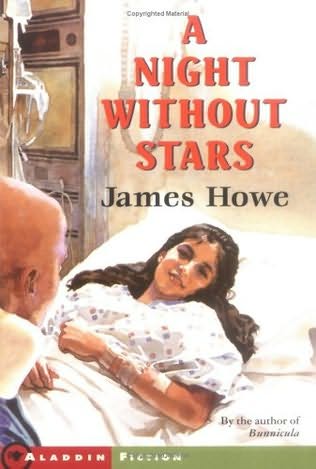
 A Night Without Stars by James Howe. A young girl must undergo open-heart surgery, but no one will tell her what’s going on. This story explores her fear and her friendship with another patient at the hospital.


Welcome to Your Brain: Why You Lose Your Car Keys But Never Forget How to Drive and Other Puzzles of Everyday Life by Sandra Aarnodt and Sam Wang. An “owner’s manual” for your brain, this book covers a wide range of everyday topics helping describe how the brain works. Welcome to Your Brain manages to be informative, interesting and easy-to-read.

Too Young to Die by Lurlene McDaniel. A talented high school student learns new lessons when she is diagnosed with leukemia. This is a touching story of friendship and life that also describes the diagnosis of cancer and the treatment process. A moving and informative story for all young adults learning about life.


Bookmark and Share

Friday, November 5, 2010

New Voices Entertainment Roundup


Happy Friday! We gathered some of our posts together to keep you entertained this beautiful fall weekend. Enjoy!

There is sure to be football on many TVs this weekend. Keep this in mind while watching your favorite football team.

Or, for those of you who don't watch football, here's something else to watch: our list of 5 great science movies to curl up to this weekend.

But if movies and TV aren't your thing, we've also compiled some fun books to help you unwind.

Have a great weekend!


Bookmark and Share

Thursday, November 4, 2010

Next Steps to Understanding Blood Cancer


Last week, we started talking about the different types of blood cancer: leukemia, lymphoma and myeloma and the importance of research into them. I hope you are gaining an understanding of some of the distinguishing characteristics.

Hang on, though; we're not done yet! We saw last week that the different blood cancers can be distinguished partly based on the type of cell involved, myeloid or lymphoid. In addition, leukemia is broken down by growth characteristics. There is fast-growing leukemia, called acute leukemia, or slower-growing leukemia, called chronic leukemia. This means the general classifications of leukemia are:
  • acute myeloid leukemia (AML)
  • acute lymphoid leukemia (ALL)
  • chronic myeloid leukemia (CML)
  • chronic lymphoid leukemia (CLL)

Furthermore, lymphomas are classified as Hodgkin lymphoma and non-Hodgkin lymphoma.
  • Hodgkin lymphoma is defined by the presence of a certain type of large, malignant (cancerous) cell, called a Reed-Sternberg cell, in the lymphoma tissue.
  • Non-Hodgkin lymphoma is a diverse group of cancers containing the remaining types of lymphoma.
Here’s a cheat sheet:


I only go through all this because, as I mentioned last week, these are each very distinct diseases.
  • Hodgkin lymphoma is more common in children and young adults. In contrast, the risk for developing non-Hodgkin lymphoma increases with age and typically appears between the ages of 40 and 70.
  • The median age of a myeloma patient is 70-years-old, and it rarely occurs in anyone under the age of 45.
  • Of the leukemias, children most often develop ALL, whereas adults most often develop AML.
  • Gleevec is a successful treatment for CML patients with a particular mutation, called BCR-Abl, but it is not used to treat CLL.
  • The five-year survival rates for each type of leukemia are dramatically different:
  • AML: 24.2%
  • ALL: 66.4%
  • CML: 54.6%
  • CLL: 79.7%
There is still a lot of work to be done so that we can understand all the differences among these diseases.

One area under investigation is understanding the different genetic changes that cause the cancer. The next step would be to identify which genetic change, or mutation, each patient has, and then they can receive the best treatment for their disease, called personalized medicine.

For instance, a patient with the BCR-Abl mutation can be given Gleevec, and a patient who does not have that mutation can be given a different treatment, because Gleevec won't work for them.

Researchers are working hard to identify cancer-causing mutations as well as therapies targeted to those mutations. This type of innovative research will help increase the five-year survival rates for all cancers.

Bookmark and Share

Wednesday, November 3, 2010

The Power of a Lame Duck


We had an election yesterday, and, as you've no-doubt heard, many members of Congress lost their seats. Interestingly, they haven't yet lost their jobs. The newly elected members of Congress don't take their seats until January 3, 2011, and, because the exiting Congress was unable to finish some important matters on their agenda before leaving for campaign season, they will have to return after the election. This is commonly referred to as a lame duck session.

There is a lot of fear of the lame duck session, particularly of the lame duck members who lost their seats in the election, because they are thought to no longer be accountable. There is whispering that these members might pass bills that wouldn't have been debated during the campaign season or that won't get passed in the next Congress. This fear is especially rampant in years that a congressional house changes party, such as this year.

However, Norman Ornstein argues that many of these fears are unfounded. Besides, it’s perennially the incoming party that is fearful of a lame duck Congress…until it’s their turn. Most of the whispering is just hot air.

In fact, the lame duck session is incredibly important, not something to fear. Any bills that are still pending at the end of this session are considered dead and will have to be reintroduced in the new Congress and go through the whole process all over again—what a waste of time! The lame duck session will allow many of the pending issues one last chance to be debated before going to the graveyard.

An incredibly important piece of legislation that we hope this lame duck Congress will take up is the Stem Cell Research Advancement Act (H.R. 4808 and S. 3766), which would allow federal funding of embryonic stem cell research (ESCR). As we've seen in the past few months, the funding for this important area of investigation is volatile, with a single judge able to gridlock the country’s research.

Fixing this problem is time-sensitive because we cannot afford to have these gridlocks occur over and over again. Research cannot be stopped and started intermittently, particularly when working with sensitive materials like embryonic stem cells. It can take researchers weeks or months to prepare for important experiments--that time is lost when research is halted, and doubled when research is restarted. Furthermore, if these experiments are discontinued prematurely, all the data can be lost.

ESCR legislation has been passed by both houses of Congress twice before, only to be vetoed by President Bush. In addition, Research!America polls show that a majority of Americans think that the government should fund ESCR. So why don’t we have a law to reflect how the people feel?

Please, urge your representative and senator to pass the Stem Cell Research Advancement Act (H.R. 4808 in the House and S. 3766 in the Senate) this year. Let’s put those lame ducks to work.


Bookmark and Share

Tuesday, November 2, 2010

You CAN make a difference--VOTE


You might have heard, there’s an election today. Or maybe you haven’t.

I know when I was a student at The Ohio State University, the only midterms I was worried about were exams. Looking back, I realize that I missed an opportunity to make a difference: to make a difference in how the job market would look when I graduated; in whether or not I’d be covered by health insurance; or if the United States would be going to war. All because I didn’t vote.

I wasn’t alone. Midterm elections historically have low turnouts. In fact, in 2006 only 25 percent of 18- to 29-year-olds voted. That’s a shame because choosing who sits in Congress is just as important as who sits in the White House.

The members of Congress we vote for in midterm elections are the ones who debate the policies that shape our country. They represent us and are our voices nationally. It’s our job to make sure the candidates who best represent us get into office and fight for the issues we care about.

For me, the big issues this election are the economy and the future of scientific research.
Scientific and medical research is a big driver of the economy, creating jobs and bringing money to the state – especially in a state with a huge research university like OSU. In fact, last year Ohio received more than $1 billion in funding from four federal health agencies for research.

Americans consistently describe both health and research as important, yet just 8 percent say they are well-informed about their elected officials’ positions on these issues. That’s not how it should be! If health and research are so important, they should be at the forefront of our voting decisions.

As a fellow at Research!America, I’ve been working on Your Candidates – Your Health, an online voter education initiative designed to fill the information gap. Every candidate for Congress has been invited to complete a questionnaire addressing health and research issues.

This website is a tool to inform voters like you of how candidates feel about the importance of research and the role it plays in the economy and improving our health—before the elections.

So visit the site to see what your candidates think. Let your candidates know that these topics are important to you and our country, and urge them to answer the questions if they haven’t already.

Your vote is your voice. November 2nd is your chance to speak up.

Bookmark and Share

Get Out and VOTE!


Today is election day. You must go vote to have your voice heard. No matter your party or the issues you care about--just VOTE!


Bookmark and Share

Monday, November 1, 2010

Vote Tomorrow!

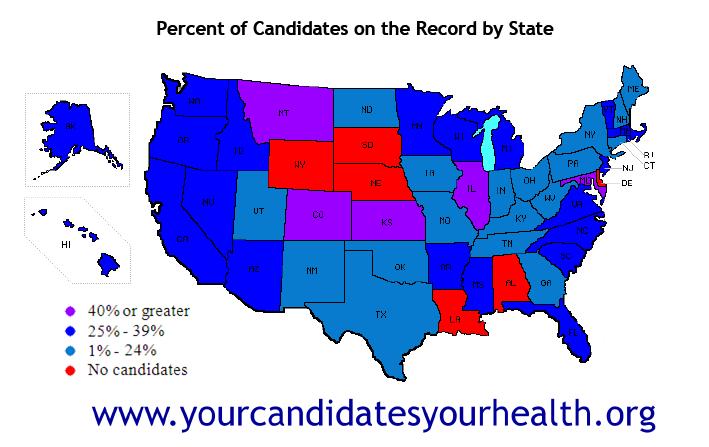
Sure, we all know we're supposed to get out and vote, but will we? Voting is the only way to get your voice out there, make your opinions known. So if health, science, and research are important to you, there's no better resource than www.yourcandidatesyourhealth.org to help educate your vote. Lots of candidates are on the record around the country:

Find out where your elected officials stand on the issues important to you, then grab your ID and head to your polling place. Vote. Know your vote. Let your voice be heard.

Bookmark and Share