Friday, January 14, 2011

Vacation?


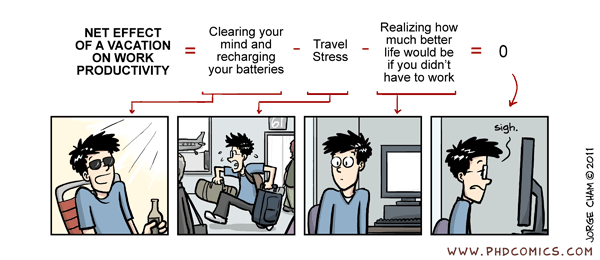
For many of our university-affiliated readers, this is the last weekend of winter break. Hope your batteries are recharged for an exciting year ahead full of great New Voices posts!

Bookmark and Share

Thursday, January 13, 2011

Ciao


Given that this is my last day at Research!America, I looked up the definition to “bittersweet” to get some inspiration. Here is what I found:

Bittersweet: poisonous perennial Old World vine having violet flowers and oval coral-red berries

Whoa, that’s not right. I don’t equate this experience with poison!

Let’s try again--this is more like it:

Bittersweet: tinged with sadness

I have had the amazing opportunity to be a Science Policy Fellow at Research!America for the past 5 months, but it’s now time to move on. While I am excited to try something new and test the skills I have developed, I am sad to leave the wonderful people I have worked with and the excellent initiatives I have undertaken.

I have learned so much over the course of such a short time. I sought this position so that I could learn more about the governmental process and science policy, but I will be taking much more away.

I have seen how important advocacy is, in particular the necessity for scientists to be involved, and I have learned how to effectively advocate. My newfound insight into the legislative process and Congress will help me navigate the system.

I have seen my writing style change from academic to…well…a little less academic. But at least through that process I have learned how to better communicate scientific principles to non-scientists. In fact, my experience writing for New Voices opened my eyes to a whole new career opportunity – science writing - an area I will be joining after my fellowship.

Though I may not be involved in policy for my job, I am sure to remain active in the policy community. I fully believe in Research!America’s mission and I now have the skills and knowledge to support that mission.

Thus, today is bittersweet. I am grateful for this opportunity and the knowledge I’ve gained, so will be sad to leave, but I look toward an exciting future.


Bookmark and Share

Wednesday, January 12, 2011

The Civic Scientist


Our jobs encompass a major part of our lives. When we think about our professions, it is essential to consider how our community of professionals is perceived by others, especially policymakers.
This is true for scientists. Science is vital to the well being of our nation and that is why practicing scientists and even students of science receive special treatment from the government, often in the form of grants, subsidies, or scholarships.

At the end of the day, we have policymakers (often without science backgrounds) making decisions about science that could have negative impacts on research and the scientific community. The scientific community often criticizes policymakers on the grounds that they don’t really ‘get’ science, yet few scientists have any training or interest in policy or politics.

However, when scientists combine their academic credentials along with a desire to change the world, the results can be dramatic. Well known examples include Albert Einstein, whose writings on the threat of nuclear proliferation informed policymakers on the specter of a nuclear armed world. James Hansen, now at Columbia University, was the first to alert members of Congress about the dangers of climate change. You may not recognize his name, but a PhD physicist and former professor, Dr. Vern Ehlers recently stepped down as the representative from Michigan’s 3rd district after a distinguished career in Congress.

What these individuals all have in common is a commitment to science, but also an awareness of the role that science plays in the well being of our nation. They dedicated their intellect and zeal to ensure that science would continue to serve society, while advocating for a government that was willing to support a vibrant scientific community.

Bookmark and Share

Tuesday, January 11, 2011

Health Disparities

As we approach MLK day next week, New Voices is taking a look at health disparities. Here's the start of PBS special on the topic:


Thoughts?

Bookmark and Share

Monday, January 10, 2011

Arizona’s Eighth Congressional District


Flags at half mast in front of the US Capitol.

By now, I’m sure you have all read about the shooting that took place over the weekend that claimed six lives and wounded 14 people. As we learn more about the victims and those affected, it is clear that they all had one thing in common – they cared deeply about our nation. These were individuals who dedicated their lives to improving the lives of Americans.

I actually had the pleasure and privilege to work with Congresswoman Giffords on the House Science Committee. I remember when we met - we had great discussion about solar energy and it was not until later that I realized I had been speaking with a Congresswoman. She is without a doubt, Congress’s expert on solar power and she has always recognized that initiating new policies for solar development and deployment are good for Arizona and good for the country. I found her to be one of the most dynamic and personable representatives on the Hill.

The assassination attempt represents an attack upon democracy. It was an assault upon the free society that is core to America. It raised questions of why this happened, how it happened, and what the country should learn from this great tragedy. We have already heard calls for a more civil political dialogue, one that avoids the vitriol that has colored recent campaigns and elections. This is not the first time that a concerted call for civility has been made. It wasn’t long ago that John Stewart convened the Rally to Restore Sanity on the Mall in Washington, DC.

It is difficult to say just what lessons the country will take away from this event. Without a doubt, the country needs more moderated and grounded voices that can shift the discourse from one of political retribution to reasoned compromise.

Bookmark and Share

Friday, January 7, 2011

We're Not Gonna Take It


The U.S. is ranked 35th in math and 29th in science worldwide. We've talked about these rankings on New Voices before. You've heard them for ages. Of course everyone wants us to be number 1. But what can any one person do? What's the point?

The truth is, if you're reading this post you know the statistics. You know we're dismally behind other industrialized countries where math and the sciences are concerned. You can blame it on the variance in international school systems. You can account for differences in total students being educated or percentage of education funded by the federal government. You can say that American students are just getting a more well-rounded education.

Or you can stand up and say, "We're not going to take it anymore."

You can pledge to get involved. To stand up for American students by personally interacting with an American student. This isn't someone else's responsibility. It is mine and yours.

Maybe your area doesn't have a wide variety of options for young people to get engaged in exciting STEM enrichment activities; but there are two things you can do right now:

1. Volunteer as a mentor or tutor. Local communities and schools have many after school and sometimes evening programs to help engage students with academic topics.

2. Invite a local science or math class to come and see where you work. If you're not sure that your work environment is worth a visit, try to remember what it was like to go on field trips as a kid. Anywhere new is exciting and interesting.(a la Fever Pitch below)


Connect a mind in your community. If not you, than who?


Bookmark and Share

Thursday, January 6, 2011

Your New Congress


Yesterday, your new Congress was sworn into office for the 112th time in America’s history. I was lucky enough to be on the Hill for the occasion, watching the ceremonies from a closed circuit television at a reception in the Library of Congress.

One of the most symbolic moments of the ceremony was when the House gavel transferred from the outgoing Speaker of the House, Nancy Pelosi, to the new speaker. As John Boehner stood by, waiting for Speaker Pelosi to conclude her remarks and hand off the gavel, he was visibly nervous, fidgeting, and seemed anxious for his turn to offer his thoughts to the chamber. Not surprisingly, he was wiping away tears before he even began to speak.

Members of Congress aren’t that different from you or me. They have weaknesses, make mistakes, and often have only a surface-level understanding of the multitude of issues that cross their desk. This is why they rely heavily upon their staff, who in turn rely heavily upon experts to provide them with the best information possible. Hence, your expertise and awareness can make a difference in changing policy in the US. But in order for that to happen you must not be afraid to reach out to your representatives, tell them your story, and why they should listen. It could be the first step in improving our nation.


Bookmark and Share

Wednesday, January 5, 2011

Women in Science

We all know of some amazing women in science: Marie Curie, known for her work on radioactivity, Rosalind Franklin for identifying the structure of DNA, and Barbara McClintock who described gene transposition. So why is there always a fuss about not enough women in science?

Women have historically been underrepresented in the sciences, though there are certainly more women in science now than there have been in the past. In 1996, 35% of doctorate degrees in STEM fields went to women; in 2006, that number jumped to 46%. But the numbers are still grim in the workforce. In 2006, only 28% of tenured or tenure-track academicians were women. Of course, we can’t compare that to the number of doctoral degrees awarded to women in the same year, so I’ll walk through time.

In 1988, women earned 41% of bachelor’s degrees in science and engineering. By 1990, when those students would be earning their next degree, only 34% of master’s degrees went to women. In 1996, women earned 34% of doctorate degrees, and ten years later women represent only 28% of tenured or tenure-track faculty. There is a continued decrease in the percentage of women at these milestones.

Some may argue that women are “choosing” to drop out of science to have a family, but why should women have to make that choice? Surely, there are men in science who have families, and they aren’t leaving the field. There are still still factors above and beyond life choices that are making it difficult for women to attain the highest levels in science.

My point is certainly not to discourage women from entering the sciences. Quite the opposite. Women are valuable employees and can bring strong and important perspectives to their jobs. A recent study showed that groups that include women are better at problem-solving, and with the renewed focus on scientific collaboration, group problem solving will be integral.

Marie Curie once said, “Life is not easy for any of us. But what of that? We must have perseverance and above all confidence in ourselves. We must believe that we are gifted for something, and that this thing, at whatever cost, must be attained.”

Great strides have been made in diminishing the gender gap, but this issue must remain at the forefront so the gap will continue to improve.


Statistics from National Science Foundation's Science and Engineering Indicators: 2010 and 2000


Bookmark and Share

Tuesday, January 4, 2011

Science of Pop Music

On the surface, science and music don't seem to have much in common. However, from solving musical mysteries by studying frequencies to technology programs that break down what makes a song popular, it's evident that there's plenty of crossover. So why do we like the music we do? The race is on between scientists and musical artists to crack the code of great music. Some comedians have also gotten into the act...

**This clip contains some explicit language**


Hat tip to GrrlScientist for her post on the Axis of Awesome last spring.

Bookmark and Share

Monday, January 3, 2011

Budget Bewilderment


It’s a new year and time for a new budget! President Obama is expected to release his federal budget request for 2012 in early February. This makes for a confusing navigation of budgets, though. You see, Congress may receive the President’s request for the fiscal year (FY) 2012 budget before they have even passed the FY 2011 budget, despite the fact that FY 2011 started three months ago. And this means that most agencies are operating at FY 2010 levels. Whew!

The budget process itself is dizzying. For one, what is the fiscal year? Unfortunately, the fiscal year is not concurrent with the calendar year, which just confuses everything. The fiscal year begins October 1 of the previous year and ends September 30 of the following year. So FY 2011 began October 1, 2010 and will end September 30, 2011. Ideally, the FY 2011 budget, the layout for how much money government agencies receive for that fiscal year, should have been passed by the two chambers of Congress before the fiscal year began on October 1, 2010, but that is rarely the case, especially in an election year.

There is a lot for the chambers of Congress to get through and agree upon before they can pass the budget. After receiving the President’s budget request, the House and Senate Budget Committees each develop a budget resolution, which is a ceiling for how much money Congress can spend in certain categories, or “functions”. This is the allocations process. Then, each chamber debates the budget resolution. Finally, a House-Senate conference resolves the differences between the House and Senate resolutions, and the conference report must be passed by both houses. This is all supposed to be accomplished by April 15th, but rarely makes that mark.

Although the budget resolution is an incredibly important step, it’s not a bill and doesn’t actually give any money to anyone, but sets the spending limit for government functions. Legislation for spending, or appropriations bills, must also be passed in the House and the Senate and the spending must fall within the allocations laid out in the budget resolution.

Because the FY 2011 budget is not yet decided upon, you may have heard words thrown around like “continuing resolution,” “omnibus” and “government shutdown.” Technically, if appropriations have not been made by the beginning of a fiscal year, the government agencies should not be able to continue work and would shutdown. However, in these circumstances, Congress usually passes a continuing resolution for a set amount of time, perhaps another month, so that the government can continue operating at the previous year’s levels while Congress continues to work on an appropriations bill. For FY 2011, Congress has passed four continuing resolutions, the most recent lasting until March 4, 2011, halfway through the fiscal year!

Oftentimes, when appropriations have not been made before the start of the fiscal year, the spending is combined into one large omnibus appropriations bill rather than separate bills. Congress just withdrew an omnibus bill for FY 2011 in favor of a continuing resolution in order to avoid a government shutdown. Now the incoming Congress will have to finish the FY 2011 budget and start debating the FY 2012 budget nearly simultaneously.

Let’s hope this year’s budget process goes a little more smoothly than last.

Bookmark and Share