Wednesday, April 20, 2011

Parallel Structures: Internet Memes and Genetic Code

Cross-posted with Research!America

Twenty years after scoring his first hit, British singer Rick Astley became an Internet phenomenon.
Chain letters, whose origins date to nearly a century before the Internet, viral marketing and even Rickrolling all have a curious, scientific parallel: the genetic code.

According to a story in the May issue of Smithsonian magazine, memes (ideas that are spread to others) and the genetic code have several common characteristics: each meme is passed on to a new host; they can rearrange elements of their makeup; and they can evolve over time.

That observation comes from Jacques Monod, PhD, a Nobel laureate in 1965 who died 11 years later – just as the first publications were being written about ARPANET, the Internet’s predecessor. The story’s author, James Gleick, notes that this observation preceded even the DARPA-era Internet, when only a handful of academic centers were connected through a network. Noted evolutionary biologist Richard Dawkins, DPhil, picked up the theme – it was Dawkins who coined the term “meme.”

The article, which clocks in at nearly 3,950 words according to LongReads.com, is a fascinating look at where memes came from, how they’re classified and what makes them carry on as they do.
A sample, with some themes most familiar to researchers:
Like genes, memes have effects on the wide world beyond themselves. In some cases (the meme for making fire; for wearing clothes; for the resurrection of Jesus) the effects can be powerful indeed. As they broadcast their influence on the world, memes thus influence the conditions affecting their own chances of survival. The meme or memes comprising Morse code had strong positive feedback effects …
Perhaps the analogy with disease was inevitable. Before anyone understood anything of epidemiology, its language was applied to species of information. An emotion can be infectious, a tune catchy, a habit contagious. “From look to look, contagious through the crowd / The panic runs,” wrote the poet James Thomson in 1730. Lust, likewise, according to Milton: “Eve, whose eye darted contagious fire.” But only in the new millennium, in the time of global electronic transmission, has the identification become second nature. Ours is the age of virality: viral education, viral marketing, viral e-mail and video and networking. Researchers studying the Internet itself as a medium—crowdsourcing, collective attention, social networking and resource allocation—employ not only the language but also the mathematical principles of epidemiology.
Indeed, in the communication age, information needs seconds to travel globally. Contrast that with one of Gleick’s examples, Sir Isaac Newton. Despite being one of the most famous men in England in his day, only a few thousand people had any idea what he looked like. Today, people around the world recognize the likeness of President Barack Obama or basketball player LeBron James.

Gleick also cites “jumping the shark” as another example; in the days of digital communication, there are boundless others: Rickrolling, “all your base are belong to us,” Cigar Guy and a Coke geyser – all being continually updated, passed on and giving way to the latest sensation.


Special thanks to today's guest blogger, Brian Hunsicker, a communications specialist at Research!America. Prior to his position at Research!America, Brian was a sportswriter and copy editor at The News & Messenger in Woodbridge, Virginia.


Bookmark and Share

Monday, April 18, 2011

Endgame for FY 2011

On Friday, President Obama signed off on the budget deal brokered with Congress. The final tally was $38.5 billion in discretionary cuts, although even the CBO has questioned this number.

How did health research fare? We’ve seen better days. The NIH and NSF were both cut by 1.2%, about $300M and $60M respectively. The Agency for Healthcare Research and quality was cut by $25M or 6%, while the FDA was actually provided with $107M increase. The CDC has been hit with the worst of the cuts to health research, totaling $820M – a cut of nearly 13%.

So let’s think about this. At a time when our deficit is being driven by the cost of healthcare and American business is losing its competitiveness to pay for healthcare, our government has decided that prevention is not a priority. Cutting the CDC might save us $820M (0.0002% of total federal spending) in the short run, but how will those cuts impact our health, our deficit, and our economy in five years?

Some have suggested that this budget deal could have been much worse. The budget that was previously passed by the House and defeated by the Senate, HR 1, contained much deeper discretionary cuts that would have been devastating to health research and science.

Now that FY 2011 has come to a conspicuous end, Congress and the White House have already begun to set their sights on FY 2012 and beyond. Paul Ryan recently released his budget plan, ‘The Path to Prosperity’, and President Obama has put forth a plan entitled the ‘President’s Framework for Shared Prosperity and Shared Fiscal Responsibility.’

Which plan do you support?


Bookmark and Share

Friday, April 15, 2011

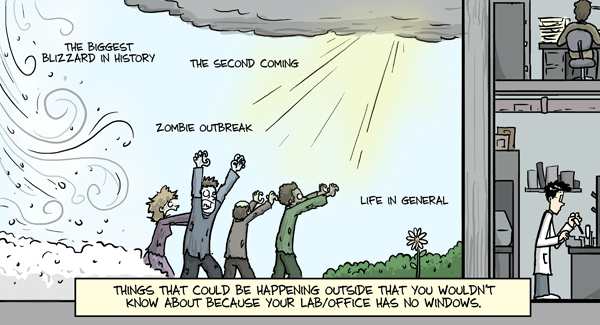
Lovely Weather, Rainy Day Reading

Comic credit: PhD Comics
The weather has been lovely this week in Washington, DC. As usual, as soon as we don't need to be at our desks (read: Saturday), the forecast turns gloomy. But, it means we'll have plenty of time to read up on stuff we missed this week. Here are five things we haven't missed (and don't think you should either):
  1. Last week's budget deal made its way through Congress this week, and now awaits President Obama's signature. Read these Science stories for more on how the deal affects research funding overall, as well as the NIH and NSF in particular.
  2. The royal wedding is just two weeks away, and Cell has an amusing, scientific perspective on the union of Prince William and Kate Middleton. (If you don't have a subscription, there's a summary here.)
  3. Looking for a job in public service? This book tells you how you can get paid to change the world.
  4. You've heard of the dot.com bubble and the housing bubble, but is there a higher education bubble? If so, is it about to burst?
  5. Ed Yong explains how breast cells may be able to revert to stem cells. What would that mean for the future of stem cell research?
Finally, if you like Earth Day activities, get a head start this year and submit a photo or video to the Consumer Electronics Association's contest to show what you'll be celebrating. Submissions are due April 17th, so be sure to get yours in soon!

Happy reading and we'll see you next week!

Bookmark and Share

Tuesday, April 12, 2011

NIAID Director Anthony Fauci on The Colbert Report

It isn't easy to have a conversation about AIDS with Anthony Fauci, the director of the National Institute of Allergy and Infectious Diseases, and make it funny.

Stephen Colbert did it last night, however, and he made the conversation interesting and incisive, too.


This is an excellent example of making science accessible to the public. Fauci provides statistics, explanations, and a bit of commentary on US health policy, while Colbert makes it fun and entertaining.

Here's a bonus: NIH Director Francis Collins and Colbert back in October 2009.

The Colbert ReportMon - Thurs 11:30pm / 10:30c
Francis Collins
www.colbertnation.com
Colbert Report Full EpisodesPolitical Humor & Satire BlogVideo Archive


Bookmark and Share

Monday, April 11, 2011

Crisis Averted, For Now


Some government employees may have been looking forward to a long weekend. But a government shutdown is no laughing matter. It’s clear that government employees throughout the nation were bracing for the absence of essential income in a difficult economic environment. But a deal was cut and appropriations will continue through the end of this fiscal year. So ends the long standing battle over FY 2011 budgeting, which culminated this past weekend with the 7th CR, and nearly furloughed 800,000 federal employees.

It’s hard to say just who came out ahead in this deal. All sides are claiming victory even though it is becoming increasingly clear that this was really just one of the first upcoming budget battles and tougher fights are still come (e.g. debt ceiling and entitlements).

Health research and science may emerge unscathed by this most recent budget debate, despite the fact that these areas were clearly targeted for cuts in H.R. 1 – the House spending bill that never passed the Senate.

Some have suggested that H.R. 1 should be viewed as a policy document that lays out the priorities of House Republicans and will continue to guide their approach to governing. Hence, while research programs may appear safe for now, they could be targeted again during debates over the FY 2012 budget.

This is why it is essential for all those who care about health research to continue to reach out to Congress and demonstrate the local impact and importance of these programs. Remember, that at the end of the day your representatives are ultimately accountable to you. Make sure they know that you didn’t send them to Washington to cut medical research.


Bookmark and Share

Friday, April 8, 2011

Government Shutdown(?) Round-Up

Cartoon credit: Tom Toles
No one's sure whether the federal government is going to have a last minute save or shutdown tonight; but whether you're headed to work on Monday or not, we've got some good reads for you this weekend.

Is the next Einstein a 12 year-old from Indiana? It doesn't look like he's tipping the balance for Indiana, but you may be interested to see where your state ranks in a new study about education standards; is your state smarter than a fifth grader?

And speaking of young people, Neil Degrasse Tyson has some advice for young science communicators.

Developing a scientific worldview is important whether you work at a lab bench of have moved on to, say, representing New Jersey's 12th district and taking on IBM's Watson in a Jeopardy! challenge.

If you're interested in science communication/journalism theory, Alice has an interesting post on taking science journalism upstream.


Finally, here are two great examples of translating research publications for public consumption by two terrific bloggers:
  1. Tara Smith of Aetiology reviews Michael Willrich's Pox: An American History.
  2. Ed Yong of Not Exactly Rocket Science looks at a study on the origins of life started in 1958.
Happy reading everyone!

Bookmark and Share

Thursday, April 7, 2011

A Blind Date With Science

Max recently shared with me this outstanding clip of Alan Alda talking about science communication at NSF. He's done a lot of work in this field, including serving as host of Scientific American Frontiers from 1993 to 2005 and knows just how to blend fact with humor.


I definitely would love to sit in on one of these workshops.

Bookmark and Share

Wednesday, April 6, 2011

Meet Ruth Timme, GenBank Biologist

Ruth is a long-time New Voice and was kind enough to tell us about her work in a phone interview.

New Voices (NV): What do you do in your work?

Ruth: I work through a contractor for GenBank (National Center for Biotechnology Information, NCBI), a large DNA sequence database that stores and organizes data from scientists around the world. When scientists sequence a genome, they have to deposit it in a public database, so NCBI curates the data and helps in the submission process.

NV: Why is your work important, in particular to the public?

Ruth: It’s a completely “public” job; NCBI is funded by the NIH, so it’s taxpayer dollars. When the government pays to have research performed, GenBank allows the data that comes out of it to be publically available. GenBank is analogous to the Library of Congress or the Smithsonian, except DNA sequence information is entirely digital.

NV: What might the public misunderstand or misinterpret about your work?

Ruth: If anything, they don’t even know this service exists. They might imagine a computer taking in all these data, but there’s actually a team of highly trained people who go through the data with a fine-tooth comb and verify it.

NV: Are there any policy issues affecting your work?

Ruth: We’re watching the budget pretty closely because the NIH is always brought up in the discussion. It’s really important that [the government] continue to fund both research and the efforts to make it public. You can’t publically fund research and then not publish what comes out of it.

NV: How did you become interested in policy and in working with Research!America as a New Voice?

Ruth: I’ve always been a politics wonk and I follow Congress, so I naturally became interested in the policy that affects science. I like to keep my toes in the water.

NV: What would your advice be for the scientists not interested or involved in policy?

Ruth:
It’s really important to be interested and involved, but it does take a lot of work. Many scientists aren’t rewarded by their academic departments for their work in policy, and they have to do it on their own time. We need to change the system; it’s a tough problem.

This is part of the ongoing Profiling New Voices series.

Bookmark and Share

Tuesday, April 5, 2011

Food (and Drug Administration) for Thought

The Food and Drug Administration (FDA) goes through an enormous amount of work to ensure that our pharmaceuticals are safe and effective. It also, however, has to ensure that they’re real.

A recent 60 Minutes report examined the growing problem of counterfeit and poor-quality medicines. The story is yet another reminder that the FDA needs better financial support for its research and monitoring efforts, and that Congressional budget cuts to the agency could have a direct effect on you and your medicine cabinet.


For more on FDA’s regulatory work abroad, check out this Nature Medicine story, written by myself.

Bookmark and Share

Monday, April 4, 2011

A House Divided


Last week, the Tea Party came back to Washington. They rallied to express their outrage over government spending and Congress’s inability to reach agreement on the budget. Rep. Michelle Bachman (MN-6), now weighing a presidential run in 2012, addressed the crowd of about 200 people.

With a government shutdown seeming more likely, some policymakers have re-termed it as a government ‘slowdown’. And when this was mentioned at the rally, many in the crowd cheered the idea of the government shutting its doors.

But the Tea Party represents just one ideological faction that has come to be affiliated with Republican Party and they have brought their own unique approach to the budget debate. Some have openly advocated for a government shutdown, believing that to be an effective means to reducing government spending.

House Republican leadership is currently in the process of finalizing a budget for the coming fiscal year. However, several Republicans have indicated that this forthcoming budget is not sufficient to address government spending. In fact, the Republican Study Committee, a group of 175 House Republicans, announced its plan to release a so called ‘rogue budget.’ As you might have guessed, this document would cut spending at a much higher rate than the plan released by the House leadership.

In essence, there are three Republican factions within the House that have differing visions for the future of the federal government. When the House Budget Committee releases its plan for FY 2012 tomorrow, the debate will be renewed. Where do you stand?


Bookmark and Share