

Tuesday, November 30, 2010


Monday, November 29, 2010
New Voices in Transition

At that time, Stacie Propst, PhD was leading the initiative; a researcher herself, who had transitioned into science policy and wanted to make sure that others in her position would have the tools available to help them along. As Research!America grew and her responsibilities increased, she transitioned leadership of the initiative to me.
Together we developed language describing the initiative and worked to engage more researchers in the private community. However, it seemed silly to restrict so many of the postings to a small community of scientists when there were certainly more out there looking for information about science policy, advocacy, and science communication.
In December of 2008, the New Voices for Research blog launched. Aided by Research!America's talented interns and fellows we began posting five days a week on the topics we thought would most help readers. In the past two years, New Voices has evolved as more of our colleagues joined in as regular bloggers and as other New Voices moved on to pursue their careers or head back to school. Each has left their mark: unique writing styles, subject matter expertise, humor, competitions, projects, a Twitter presence; totaling - as of next week - more than 500 posts.
Despite all of that change, the last few months have been the biggest transition. Our writing team has become smaller and our fearless leader - Stacie - is departing Research!America after nine years to take the lessons she's learned in national advocacy and apply them in her home state of Alabama. Stacie will join the many New Voices operating on the state and local level around the country.
Though this time has been turbulent, we must look to the future. New Voices' mission to empower researchers to communicate about the value of their work and provide tools and resources online can only continue if we all engage. If you believe in New Voices, I ask you to make one simple step today:
Tell us that yours will be a voice that stands up for science.
Wednesday, November 24, 2010
Happy Thanksgiving!
 New Voices is on Thanksgiving break for the rest of this week, but we wanted to leave you with a fun fact to entertain you over the holiday.
This Thanksgiving many of us will probably have sweet potato casserole or candied yams on the table. Wait…which is it? Are sweet potatoes and yams the same thing?
It turns out that that’s a more complicated question than you might think. Sweet potatoes and yams are not the same—they aren’t even distantly related. Sweet potatoes come from the family Convolvulacea while yams are from the Dioscoreaceae family.
But to complicate things, what Americans call yams are actually sweet potatoes, not yams. So in the US, yams and sweet potatoes are the same. The confusion comes from the fact that there are two different varieties of sweet potatoes: “firm” sweet potatoes, which are paler and less sweet, and “soft” sweet potatoes, often called yams, which are sweeter and more orange-colored.
I hope you can enjoy your sweet potatoes this Thanksgiving!
Tuesday, November 23, 2010
Diabetic Thanksgiving: Delicious & Nutritious
Continuing our look at healthy Thanksgiving fare, here are a few recipes geared for a most delicious & nutritious national holiday. Don't let the lack of added sugar fool you - these diabetic-friendly recipes are great for everyone.!
Pumpkin Soup
 A warm treat to start everyone off while the turkey rests.
Ingredients: 6 cups pumpkin mash (either make your own with a sliced up pumpkin or can be found in cans at the grocery store), ~1 cup cream (light or heavy depending on how thick you want the soup), 1 yellow onion, olive oil, cumin, allspice (nutmeg, cinnamon, and ginger are all easily found separately too). Optional spice: cardamom.
Dice onion and saute in olive oil at bottom of a stew pot until clear. Add pumpkin mash, stirring until well blended with onions throughout. Add cream and spices to liking. Simmer for at least one hour, stirring intermittently. Taste occasionally and season as appropriate.
 Asparagus with Cranberries
Combine two awesome side-dishes without the sugar.
Ingredients: 1 bunch asparagus, 1/2 cup of cranberries, salt, pepper, olive oil
Bring a medium pot of water to boil. Cut the asparagus into 1 inch segments, and boil with cranberries for 3 to 5 minutes (add the flower end with only 2 minutes left to go to avoid mushiness).
Drain and toss with a little bit of olive oil and salt and pepper to taste.
Mashed Sweet Potatoes
 Great as a holiday dish or a way to quickly adapt leftovers.
Ingredients: 4 sweet potatoes, 1 apple or pear, allspice (or nutmeg, cinnamon & ginger), salt and pepper to taste. Optional: butter, for consistency.
Wrap sweet potatoes in aluminum foil and bake until soft throughout. Remove skin and discard.
In the same oven, bake a peeled apple or pear until soft.
Dice up softened fruit and add to the sweet potatoes. Mash in your preferred method (a fork should do it if everything is cooked through enough), and add spices to taste. Optionally, add butter to make the blending process a little smoother.
Come by tomorrow for a fun fact about sweet potatoes versus yams!
More Thanksgiving posts from New Voices
Thanksgiving Recipes
A Second Helping of Thanksgiving
Vegan Thanksgiving
Pumpkin Soup
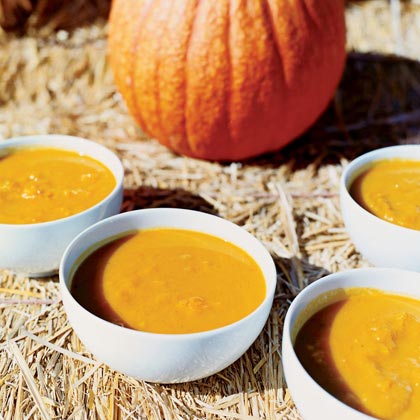 A warm treat to start everyone off while the turkey rests.
Ingredients: 6 cups pumpkin mash (either make your own with a sliced up pumpkin or can be found in cans at the grocery store), ~1 cup cream (light or heavy depending on how thick you want the soup), 1 yellow onion, olive oil, cumin, allspice (nutmeg, cinnamon, and ginger are all easily found separately too). Optional spice: cardamom.
Dice onion and saute in olive oil at bottom of a stew pot until clear. Add pumpkin mash, stirring until well blended with onions throughout. Add cream and spices to liking. Simmer for at least one hour, stirring intermittently. Taste occasionally and season as appropriate.
Special note on spices: freshly ground or zested spices will carry more flavor than dried spices. That being said, nutmeg is incredibly strong in any form and should added incrementally to taste. Always let simmer an additional five to ten minutes after adding more spices.
 Asparagus with Cranberries
Combine two awesome side-dishes without the sugar.
Ingredients: 1 bunch asparagus, 1/2 cup of cranberries, salt, pepper, olive oil
Bring a medium pot of water to boil. Cut the asparagus into 1 inch segments, and boil with cranberries for 3 to 5 minutes (add the flower end with only 2 minutes left to go to avoid mushiness).
Drain and toss with a little bit of olive oil and salt and pepper to taste.
Mashed Sweet Potatoes
Great as a holiday dish or a way to quickly adapt leftovers.Ingredients: 4 sweet potatoes, 1 apple or pear, allspice (or nutmeg, cinnamon & ginger), salt and pepper to taste. Optional: butter, for consistency.
Wrap sweet potatoes in aluminum foil and bake until soft throughout. Remove skin and discard.
In the same oven, bake a peeled apple or pear until soft.
Dice up softened fruit and add to the sweet potatoes. Mash in your preferred method (a fork should do it if everything is cooked through enough), and add spices to taste. Optionally, add butter to make the blending process a little smoother.
Come by tomorrow for a fun fact about sweet potatoes versus yams!
More Thanksgiving posts from New Voices
Thanksgiving Recipes
A Second Helping of Thanksgiving
Vegan Thanksgiving
Monday, November 22, 2010
Vegan Thanksgiving
You can't think about Thanksgiving without thinking about food, and since we at New Voices are all about healthy minds and bodies, we want to keep your food focused thoughts on some healthy alternatives this Thanksgiving week. This quickly led us to long time friend of New Voices, Dana Loy. Today, Dana will be sharing her experience in celebrating this poultry-centric holiday as a vegan.
After looking through the Trader Joe's turkey-gravy-and-stuffing advertisement mailed to my house in early November, I came to the official conclusion that Thanksgiving is the least vegan-friendly holiday ever.
After all, the crowning achievement of any holiday table in America is a golden, roasted fowl--the bigger, the better. Fortunately, it's easier to survive Thanksgiving as a vegan than one would initially think. Over the past two years, it's been nothing but fun for me to dispel people's stereotypical notions of "vegan Thanksgiving" as a slab of Tofurkey and a plateful of limp broccoli.
Perhaps the most essential tools in any vegan Thanksgiving arsenal are replacement foods. Earth Balance buttery spread is a staple in my refrigerator; it comes in both stick and tub form, perfect for spreading on rolls and for baking into cookies and pies. Tofutti makes a vegan sour cream that works especially well when blended into mashed potatoes (or dolloped onto nachos any other time of the year).
Soy milk is an excellent dairy substitute for any creamy dish; for nuttier flavors or different nutritional benefits, almond milk and hemp milk are personal favorites and particularly good in cinnamon-y baked goods. Egg replacements can run the gamut from ground flaxseed or oil to applesauce or silken tofu and are easy to find with a quick Internet search. (Just don't tell anyone about the tofu--I've found it has a surprisingly negative affect on omnivores' appetites.) And of course, flavorful vegetable broth is an easy substitute for chicken, beef, or turkey broth. Armed with these products, most of which are available at your local grocery, co-op, or health food store, you're able to substitute vegan ingredients in traditional recipes to veganize almost any Thanksgiving dish you can imagine.
Any dish, that is, except for the turkey. What to do for a main dish? Personally, I'd rather just eat the side dishes with no main course. The sides are the best part of Thanksgiving anyways! If you really want a main dish to fill you up, I'd suggest a stuffed acorn squash, a veggie pot pie with sliced portabello mushrooms, or for a meatier substitute, a seitan-based recipe (such as Vegan Yum Yum's Seitan Roulade with Chestnut Stuffing).
Once the initial shock of Thanksgiving without a turkey subsides, you'll find that there's a whole host of animal-free substitutes just begging to find a way onto your holiday dinner plate. Although you may seem overwhelmed heading into Thanksgiving as a vegan, you'll quickly find that many other vegheads are in the same situation. Take a few deep breaths and plan your menu with your personal tastes in mind.
If you're hosting dinner and feel comfortable having meat in your house, you may want to ask some omnivore guests to bring a small turkey or order a pre-cooked turkey from a grocery store. If you're attending a dinner at a meat-eater's home, be sure to contact your host ahead of time and ask what's on the menu. Don't expect them to go out of their way to prepare special dishes just for you, but offering to provide them with some of the vegan ingredients mentioned above may lead to more animal-free dishes at the gathering.
If your host isn't amenable to using vegan ingredients, I'd suggest preparing a few vegan dishes to bring and share (I usually go with two sides and a dessert) so that you'll have something to eat without inconveniencing anyone. And who knows? Once people taste the pure goodness of vegan cooking, they might be willing to try some animal-free recipes themselves. Spread the vegan love!
Dana Loy is a PhD student at University of Wisconsin Madison in the Department of Curriculum and Instruction. Dana is a long time follower of New Voices and we're thrilled she took the time to be a guest blogger.
More Thanksgiving posts from New Voices
Thanksgiving Recipes
A Second Helping of Thanksgiving
 |
| Oh no! Not vegan Thanksgiving! |
After all, the crowning achievement of any holiday table in America is a golden, roasted fowl--the bigger, the better. Fortunately, it's easier to survive Thanksgiving as a vegan than one would initially think. Over the past two years, it's been nothing but fun for me to dispel people's stereotypical notions of "vegan Thanksgiving" as a slab of Tofurkey and a plateful of limp broccoli.
Perhaps the most essential tools in any vegan Thanksgiving arsenal are replacement foods. Earth Balance buttery spread is a staple in my refrigerator; it comes in both stick and tub form, perfect for spreading on rolls and for baking into cookies and pies. Tofutti makes a vegan sour cream that works especially well when blended into mashed potatoes (or dolloped onto nachos any other time of the year).
Soy milk is an excellent dairy substitute for any creamy dish; for nuttier flavors or different nutritional benefits, almond milk and hemp milk are personal favorites and particularly good in cinnamon-y baked goods. Egg replacements can run the gamut from ground flaxseed or oil to applesauce or silken tofu and are easy to find with a quick Internet search. (Just don't tell anyone about the tofu--I've found it has a surprisingly negative affect on omnivores' appetites.) And of course, flavorful vegetable broth is an easy substitute for chicken, beef, or turkey broth. Armed with these products, most of which are available at your local grocery, co-op, or health food store, you're able to substitute vegan ingredients in traditional recipes to veganize almost any Thanksgiving dish you can imagine.
Any dish, that is, except for the turkey. What to do for a main dish? Personally, I'd rather just eat the side dishes with no main course. The sides are the best part of Thanksgiving anyways! If you really want a main dish to fill you up, I'd suggest a stuffed acorn squash, a veggie pot pie with sliced portabello mushrooms, or for a meatier substitute, a seitan-based recipe (such as Vegan Yum Yum's Seitan Roulade with Chestnut Stuffing).
Once the initial shock of Thanksgiving without a turkey subsides, you'll find that there's a whole host of animal-free substitutes just begging to find a way onto your holiday dinner plate. Although you may seem overwhelmed heading into Thanksgiving as a vegan, you'll quickly find that many other vegheads are in the same situation. Take a few deep breaths and plan your menu with your personal tastes in mind.
If you're hosting dinner and feel comfortable having meat in your house, you may want to ask some omnivore guests to bring a small turkey or order a pre-cooked turkey from a grocery store. If you're attending a dinner at a meat-eater's home, be sure to contact your host ahead of time and ask what's on the menu. Don't expect them to go out of their way to prepare special dishes just for you, but offering to provide them with some of the vegan ingredients mentioned above may lead to more animal-free dishes at the gathering.
If your host isn't amenable to using vegan ingredients, I'd suggest preparing a few vegan dishes to bring and share (I usually go with two sides and a dessert) so that you'll have something to eat without inconveniencing anyone. And who knows? Once people taste the pure goodness of vegan cooking, they might be willing to try some animal-free recipes themselves. Spread the vegan love!
Dana Loy is a PhD student at University of Wisconsin Madison in the Department of Curriculum and Instruction. Dana is a long time follower of New Voices and we're thrilled she took the time to be a guest blogger.
More Thanksgiving posts from New Voices
Thanksgiving Recipes
A Second Helping of Thanksgiving
Friday, November 19, 2010
Act Now: Urge the President to Support $35 Billion for NIH in FY2012
Final decisions about the President’s FY2012 budget recommendations are being made now, making it a critical time to take action. Cuts to the entire federal budget have been proposed – including NIH. Please remind the President that a robust investment in science is critical to creating jobs, improving health, encouraging innovation and revitalizing the economy.
Take action now. Urge President Obama to maintain his commitment to “restore science to its rightful place” by proposing and fighting for $35 billion in NIH funding in FY2012.
Take action now. Urge President Obama to maintain his commitment to “restore science to its rightful place” by proposing and fighting for $35 billion in NIH funding in FY2012.
Thursday, November 18, 2010
Great American Smokeout

Today is the Great American Smokeout—a time for smokers to quit, even if just for a day, but hopefully to make a plan to quit forever. Are you tired of hearing about the harmful effects of smoking? I’m sure you’ve heard them all before. But please take today to really listen to the reasons and think about them. They should help convince you to quit smoking today and always or, if you’re not a smoker, help a loved one to quit.
Yes, you know smoking causes cancer, but did you know tobacco use is responsible for 30% of the cancer deaths in the US? 30 percent! And only about half of the deaths caused by smoking are from cancer. Smoking is linked to heart disease and stroke and causes painful conditions like chronic bronchitis and emphysema.
 A sobering statistic is that half of all the people who continue smoking will die because of it. So, if you and your spouse have this habit together, chances are it will kill one of you.
To make it even more real, smoking shortens male smokers’ lives by 13.2 years and female smokers’ lives by 14.5 years! What would you be missing in those 13 years? Is smoking really worth that? Smoking is the single most preventable cause of death. It’s very powerful to know that you can prevent death simply by not smoking.
Research!America and many other organizations dedicate themselves to improving the health of the nation. We advocate for more funding for research so that we can find new drugs or understand diseases better, all so people can live longer. But you don’t have to be an advocate or a scientist to reach that goal. If you quit smoking or convince someone else to, you can prevent illness in the first place, so those drugs aren’t needed.
Smoking-related illnesses and treatments come at a huge cost to our society. Smoking costs more than $196 billion each year in health-related expenses; for the individual, this means about $2,247 in extra medical expenses for each adult smoker per year. Do you have an extra $2,000 lying around to spend on preventable costs? What else could you buy for that money?
 Many people are worried about our economy and the cost of health care these days, with good reason, but quitting will decrease that cost without added expense. In fact, you would additionally be saving the money you might otherwise spend on cigarettes. Someone who smokes half a pack of cigarettes a day spends around $75 per month on cigarettes or about $912 per year, money that could easily stay in your pocket.
The good news is that the benefits of quitting start immediately. Only 12 hours after quitting the carbon monoxide level in your blood returns to normal. One year after quitting, your risk of coronary heart disease is half that of a smoker’s, and it's the same as a non-smoker’s 15 years after quitting. Ten years after quitting, your cancer risk decreases and the lung cancer death rate is about half that of smokers’.
So join Americans in quitting smoking today and make a plan to quit for a lifetime.
Much of this information came from the American Cancer Society. Visit their website for more information and tips to help you quit.
Wednesday, November 17, 2010
Meet Stacie Propst, PhD, Vice President of Policy and Outreach at Research!America
Stacie has been at Research!America for nine years. She is now transitioning to operating her own business, where she will continue working on science and health policy in her home state of Alabama.
 What will you be doing in your new position? Fortunately, I will continue the work I have been privileged to do on behalf of Research!America but with a more local focus. With University of Alabama at Birmingham as the largest employer in the state, Alabama and the southeast has the opportunity to become a research and development powerhouse. My goal is to make any contribution I can to increase Alabama’s R&D competitiveness nationally and globally.
What is the most challenging part of what you do? Getting stakeholders in research to come together and push in one direction is always challenging. If united, the research advocacy community can achieve almost anything.
When did you first become interested in advocacy? When I was in graduate school, I watched several congressional briefings on embryonic stem cell research. Watching these made me realize that Congress must have a hard time understanding these complex scientific issues. There was a clear need for a more diverse range of voices for science and I wanted to help my peers speak out about the value of their work.
At the same time, I was watching many brilliant and highly trained young investigators struggle to get funding for their research. I figured if there was more money allocated to research, more transformative ideas could get funded, benefiting all of us.
I decided that instead of complaining, I would get out and do something about it. I knew Washington, DC was the place to get the national experience I needed to really make a difference back home.
What advice do you have for someone interested in advocacy and/or outreach? I know the hardest step is getting started, so you just have to get involved, even if only a little bit at a time. You can start by volunteering outside of the lab. Being an advocate will be easier if you’re involved in your community. You have to be proactive and make advocacy a priority. And, you may have to make some hard choices. I had to leave research and overcome the stigma of doing so and also move across the country where I didn’t yet have a job. But when action meets vision, you can get a lot done.
We thank Stacie for sharing her experience and advice, both for this article and through her time at Research!America. We wish Stacie the best of luck and know she will be successful!
What will you be doing in your new position? Fortunately, I will continue the work I have been privileged to do on behalf of Research!America but with a more local focus. With University of Alabama at Birmingham as the largest employer in the state, Alabama and the southeast has the opportunity to become a research and development powerhouse. My goal is to make any contribution I can to increase Alabama’s R&D competitiveness nationally and globally.What is the most challenging part of what you do? Getting stakeholders in research to come together and push in one direction is always challenging. If united, the research advocacy community can achieve almost anything.
When did you first become interested in advocacy? When I was in graduate school, I watched several congressional briefings on embryonic stem cell research. Watching these made me realize that Congress must have a hard time understanding these complex scientific issues. There was a clear need for a more diverse range of voices for science and I wanted to help my peers speak out about the value of their work.
At the same time, I was watching many brilliant and highly trained young investigators struggle to get funding for their research. I figured if there was more money allocated to research, more transformative ideas could get funded, benefiting all of us.
I decided that instead of complaining, I would get out and do something about it. I knew Washington, DC was the place to get the national experience I needed to really make a difference back home.
What advice do you have for someone interested in advocacy and/or outreach? I know the hardest step is getting started, so you just have to get involved, even if only a little bit at a time. You can start by volunteering outside of the lab. Being an advocate will be easier if you’re involved in your community. You have to be proactive and make advocacy a priority. And, you may have to make some hard choices. I had to leave research and overcome the stigma of doing so and also move across the country where I didn’t yet have a job. But when action meets vision, you can get a lot done.
We thank Stacie for sharing her experience and advice, both for this article and through her time at Research!America. We wish Stacie the best of luck and know she will be successful!
Friday, November 12, 2010
Pursuing Happiness

If I were asked at any given moment if I was happy, I might contemplate the answer “no.” I mean, my house can always be cleaner; I could always sleep more; I would love more time to relax. You know what I mean? But, if I really think about it, really stop and contemplate the question, then the answer is absolutely, “yes!”
When I hear the Declaration of Independence describe our unalienable rights--Life, Liberty, and the Pursuit of Happiness—it puts this sentiment more into perspective. Mahatma Gandhi said, “Happiness is when what you think, what you say, and what you do are in harmony.” We are lucky to have the freedom to put those paths in harmony.
So I challenge you to think about what makes you truly happy and to make an effort to pursue those aims. Many of us take for granted our true wells of happiness. Sometimes I need to stop worrying about the small things, like the clean house, and embrace the bigger picture, like my amazing family.
For me, happiness comes from feeling like I am contributing to society, being intellectually stimulated and spending time with my close friends and family. Notice that none of these things include having more money or material goods, and a clean house is never mentioned.
I am lucky to have a position that allows me to fulfill all of these roles, which keeps me happy on a daily basis. Although I am no longer a researcher, I am able to pursue my goal of advancing biomedical research. As a science policy fellow, I feel that I am using my knowledge and skills to benefit society—I can understand the science and translate it in order to advocate for better health. I am able to continue learning and discussing biomedical issues, my intellectual passion. And, though I have limited social time, I savor every moment with my friends and family.
There are many opportunities to contribute to your happiness outside of work as well. You just have to determine what really matters and find a way to incorporate it. Every day, strive to keep in perspective the most important things in life.

Thursday, November 11, 2010
Military Research Benefits All Americans
Do you agree or disagree with the following statement? “The U.S. military investment in research to improve health for service members and veterans is a good use of my tax dollars.”

A recent Research!America survey found that 87% of Americans think it is worthwhile investment. Throughout the past few election cycles there has been a lot of discussion about budgets and military spending, but the health benefits Americans gain from research conducted by the military on disease prevention, surgical techniques, safety gear, and any number of other topics doesn't just stay within the armed services. It comes back to the community as body armor for police, vaccines for travelers, limb replacement techniques, better football helmets for kids, and safer vehicles on the road.
While you're thanking veterans for their service today (and everyday!) don't forget to thank them for the extraordinary research they're doing too.

A recent Research!America survey found that 87% of Americans think it is worthwhile investment. Throughout the past few election cycles there has been a lot of discussion about budgets and military spending, but the health benefits Americans gain from research conducted by the military on disease prevention, surgical techniques, safety gear, and any number of other topics doesn't just stay within the armed services. It comes back to the community as body armor for police, vaccines for travelers, limb replacement techniques, better football helmets for kids, and safer vehicles on the road.
While you're thanking veterans for their service today (and everyday!) don't forget to thank them for the extraordinary research they're doing too.
Subscribe to:
Posts (Atom)