Thursday, April 30, 2009

Capitalizing on Our Greatest Asset

President Obama speaking with astronauts on the International Space Station March 24, 2009. From left: Sen. Kay Bailey Hutchison (TX); John Holdren, Director of the Office of Science and Technology Policy; Sen. Bill Nelson (FL), right, who flew aboard the space shuttle in 1986.
Photo Credit: White House Photo/Pete Souza

This morning John Holdren, PhD, Assistant to the President for Science and Technology and Director of the Office of Science and Technology Policy, spoke at the AAAS Forum on Science and Technology Policy. Most of what Dr. Holdren presented this morning reinforced what President Obama recently said in his address at the National Academy of Sciences.

Dr. Holdren concluded his remarks by telling the audience that our greatest asset right now is the President's engagement with science and technology. It is refreshing to have an Administration who is on the side of science, but this does not mean that we can be complacent.

Congressman Bart Gordon, Chair of the House Committee on Science and Technology, also spoke at the Forum this morning, and called on the science community to demonstrate the results of science. He said it is essential to "put a face on science" and to help the public understand that science is about jobs and quality of life because there are many competeting programs and a limited budget.

While the American Recovery and Reinvestment Act and FY 2009 appropriations have provided an infusion of funding for research and development, more work is ahead to ensure that research is a funding priority in the years ahead. Stan Collender of Qorvis Communications and a U.S. budget expert told the Forum audience that starting in 2011 there will likely be ambitious budget deficit reduction efforts, some of which will come from cuts in discretionary spending. This means that in order to pay for research, other programs would have to be cut. Collender said that it will be critical for scientists to talk to the public and Congress about why research is important to the U.S.

So, although science and technology has this tremendous asset in the White House, the overaraching message that I heard this morning is that scientists need to speak out now to ensure research continues to be a priority.

Wednesday, April 29, 2009

I Spy a Scientist

Chronicles of a Science Policy Fellow

After a long time working in labs, I am now in a workplace dominated by non-scientists. This has led to some very interesting discussions about what kind of people practice science.

I have also received comments like:

"I would have never thought you are a scientist- you are so fun."
and
"You are so not a geek, are you sure you are a scientist?"

This got me thinking- what characteristics do people associate with the word scientist?

I did some research and found some great articles talking about the image of scientist in the zeitgeist. In a great piece Marcel C. LaFollette summarizes the work of many authors tracking the changing image of scientists. Early in the 20th century scientists tended to be portrayed as slightly eccentric heroes who burned the midnight oil and saved the world by their amazing discoveries. This average Dr. Joe was white and male [surprise :( ].

By mid-century, the age of "Big Science" had begun. People were awed and terrified by the power of science and consequently scientists began to be portrayed as Dr. Jekyll and Mr. Hyde. More Dr. Jekyll - thankfully - than Mr. Hyde. But they were still male and white.

Most adults think of Einstein when asked to name a scientist and his most famous images, of course show him with his frizzy, disheveled hair, rumpled clothing and an absent-minded, wistful expression on his face.

Studies that have looked at how scientists are portrayed in today's popular media have concluded that the image is largely positive. Scientists are mostly shown as people who work for the betterment of mankind and are people worthy of trust and respect. Most people also respect science as a profession and think scientists are the best spokespersons when it comes to explaining research findings (check out slides 16,17 and 18 from the poll).

If this true, I wonder why more scientists are not using this image to their advantage and advocating for science? or even speaking out more on issues that directly impact science and society?

What do you think?

Tuesday, April 28, 2009

How To: Use Twitter

Here at New Voices we like to stay on top of the new things going on in the world. In the process, we realized we haven't been able to go anywhere without hearing about people tweeting. So we sought out a friend of New Voices, Allison Bland, to tell us about the (not so) new social media tool Twitter.

***
By now, you’ve probably heard of Twitter. You may have even tried it out.

How do you use this thing? What is Twitter all about?


I manage the Twitter account for Research!America, and while it continues to be a learning process for me, I think it’s a helpful advocacy tool and an exciting new way to communicate. In 140 characters or less, Twitter users broadcast messages to “followers” who read a stream of tweets from users they have chosen to follow. Users can respond to each other by adding the @ symbol before another username or respond to threads of conversations by adding # in front of an agreed upon tag for the topic (#science and #health are some of my favorites).

I’ve been happy to discover a lively group of Twitterers who frequently tweet about the evolution of science communication. You might be interested in following @BoraZ, @nancyshute, @girlscientist, and @Bridge2Science.

Some tips for your tweets:

Share. Twitter is a great way to get a message out to a receptive audience, but you add value to your tweets by helping others and providing useful information: alert your followers to new Twitter users they might be interested in, link to original content, and retweet relevant tweets.

Talk to the right people. Finding the right audience for your tweets can be one of the biggest challenges. How do you know if your followers are really listening? I use bit.ly, which is primarily a URL-shortening application, but it has a lot of other neat features. Your bit.ly account will show how many people clicked through the links in your tweets and who retweeted the same link. Using bit.ly, I’ve found that global health-related links are especially popular with our followers.

Listen. I imagine Twitter as a huge room of people having a conversation. Tune in and tap into what people are saying to stay connected. A quick scan through the latest tweets will give you a sense of the most current topics, whether it’s a major conference or Ashton Kutcher and malaria nets.

Stay active. Twitter is habit-forming, so this shouldn’t be a problem, but make it a point to be an engaged user. Tweet every day, follow people who have followed you back, and participate in conversations. Soon your network will grow and you will be part of the Twitterverse!
Follow @ResearchAmerica!

Allison Bland is a communications intern at Research!America and a recent graduate of McGill University with degrees in English and history of science.
***

This is Part 3 in the New Voices series on helpful technology for science communicators and advocates.
Part 1 - How To: Subscribe to Your Favorite Websites
Part 2 - How To: Use Google Reader

Monday, April 27, 2009

Climate Change and Health: Lyme Disease

Photo Credit: FDA

In a continuation of our Climate Change and Health series, today's post is about Lyme disease. Like malaria, Lyme disease is also likely to spread due to climate change. While malaria largely affects countries overseas, Lyme disease is the most common vector-borne disease in the U.S. with more than 21,000 cases reported each year. Typical symptoms for Lyme disease include fever, headache, fatigue, and a skin rash. If it is untreated, the infection can spread to joints, the heart, and the nervous system.

Predicted milder winters will increase the survival of disease-carrying deer ticks, which can then infect humans. A recent study by researchers at Yale has shown that the severity of Lyme disease may increase as tick's seasonal feeding cycles changes due to climate. Currently, Lyme disease is most prevalent in the Northeast, as illustrated by the map below.


This is Part 4 of 7 in our Climate Change and Health series.
Part 1 - Climate Change and Health
Part 2 - Heat-Related Issues
Part 3 - Malaria
Part 4 - Lyme Disease
Part 5 - Mental Health
Part 6 - Water-borne Disease
Part 7 - Extreme Weather Events

Saturday, April 25, 2009

World Malaria Day


Yesterday's post about the potential impact of climate change on malaria incidence details why paying attention to the disease is so important. We’ve made significant advances in malaria control with the money invested so far, but more research for malaria still needs to be done. In honor of World Malaria Day, we've complied a short list of resources, interesting projects, and some great people working in the field.

Resources
Innovative Collaborations
  • Artemisinin Project — is a collaboration between the Gates Foundation, Sanofi Aventis, Amyris Biotechnologies, a researcher at University of California, & the first nonprofit drug developer in the U.S.—to develop lower cost, semi-synthetic artimisinin.
  • GlaxoSmithKline's Patent Pool — Glaxo recently donated 800 of its patents related to neglected tropical diseases to a patent pool. These diseases are considered largely unprofitable ventures, since they mostly affect people in poor countries. Glaxo is trying to encourage global collaboration for research to find better treatments.
  • We know a lot of you out there are jealous of Luke's lightsaber. Well soon, you can have your own mosquito zapping laser gun!
To put a face on the exciting malaria research that is being done, check out some of our Global Health Ambassadors:
  • Ambassador Barry Beaty runs a program called Casa Segura (Safe House), which uses interventions-such as insecticide treated bed nets- to prevent vector transmission in homes.
  • Ambassador Jim Kazura has been studying malaria in children, and those that acquire immunity to the disease, to learn more about the relationship between their responses to the disease and their immunity.
  • Ambassador Frank Collins has been helping to sequence or map the Anopheles gambiae, the mosquito that is the primary transmitter of malaria parasites in sub-Saharan Africa.
Random Fun Fact
  • Last week, Ashton Kutcher and CNN got in a race to see who get get the most "followers" on Twitter... with a goal of reaching 1 million. Ashton won, and is donating $100,000 (10,000 bednets) to fight malaria in Africa, using Twitter as a social tool to raise awareness for World Malaria Day.

Friday, April 24, 2009

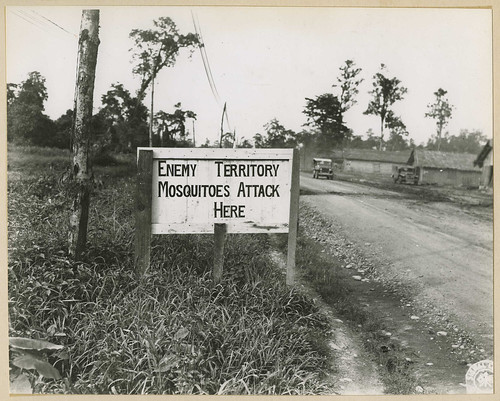
Climate Change and Health: Malaria

Photo Credit: Otisarchives2 on Flickr

Tomorrow is World Malaria Day, which fits right in with the theme of my climate change and health project, since I used malaria as an example of how vector-borne diseases may spread. Vector-borne diseases are infections that are transmitted to humans and other animals by blood-feeding insects, such as mosquitoes, ticks, and fleas (hence, vector=bug).

Malaria is the most deadly global vector-borne disease. It is a blood infection that is transmitted by female Anopheles mosquitoes. The mosquito transmits a parasite that infects the liver and spreads to red blood cells. Currently, 41% of the world's population live in areas where malaria is transmitted. Each year 350–500 million cases of malaria occur worldwide, and 1-3 million people die, 80% of them in sub-Saharan Africa.

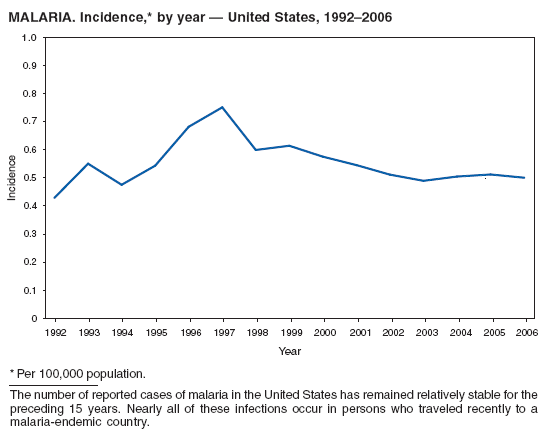
The majority of malaria infections in the U.S. occur among travelers that bring the infection back from another country. The CDC reported 1,564 cases of malaria in the US in 2006. In many temperate areas, such as Western Europe and the US, economic development and public health measures have eliminated malaria. However, most of these areas have mosquitoes that can transmit malaria, and reintroduction of the disease is a risk.

Climate change and its effect on the spread of vector borne diseases is challenging to model. However, significant relationships have been documented between the El Niño Southern Oscillation and epidemic malaria in Asia and South America. El Niño is a cyclical weather event that lasts from 1.5-2 years and builds up warm surface water off the coast of South America, increasing air temperature and the chances of rain and floods.

El Niño could be an indicator for the effect of climate change on malaria incidence. The annual total number of malaria cases is strongly correlated with sea surface temperature changes in the eastern equatorial Pacific. One study showed that in Colombia, malaria cases increased 17.3% during a Niño year and by 35.1% in the post-Niño year. Though these changes are more sudden than what we can expect to occur from climate change, the health impact could still be severe.

Geographic distribution of malaria and the number of cases are expected to change as climate changes, like during El Niño years. This map presents a possible scenario for malaria in 2050 and shows regions that have endemic malaria now and regions where it may spread. In some areas where climate could decrease rainfall, the number of mosquitoes may decrease and so would malaria transmission rates.

Changes in malaria distribution on a global scale is still an area of active research. Despite the strong connection between malaria and climate, there is still uncertainty about future malaria transmission rates because there are many other factors that affect the disease’s spread, such as socioeconomic development, drug resistance, and immunity.

Tune in tomorrow for a special Saturday post for World Malaria Day.

This is Part 3 of 7 in our Climate Change and Health series.
Part 1 - Climate Change and Health
Part 2 - Heat-Related Issues
Part 3 - Malaria
Part 4 - Lyme Disease
Part 5 - Mental Health
Part 6 - Water-borne Disease
Part 7 - Extreme Weather Events

Thursday, April 23, 2009

Climate Change and Health: Heat-Related Issues

A thermal image of Atlanta, GA in May 1997.
Daytime temperatures averaged 80
°F (26.7°C) but some surface temperatures reached 118°F (47.8°C).
Source: NASA/Goddard Space Flight Center Scientific Visualization Studio

Climate change is going to have various impacts on health and society. Since the Administration is open to addressing it, advocacy messages surrounding the health implications of climate change will be important. President Obama has prioritized energy, health care, and education as three areas that are critical to our economic future.
Climate change and health are the intersection of these priorities and awareness about the possible health impact of climate change is crucial so that we can promote research and action to lessen these effects.

Heat related illnesses and death are expected to increase due to climate change, mostly caused by cardiovascular and respiratory issues associated with higher temperatures. Heat is the leading cause of weather-related deaths in the U.S., and was responsible for more than 3,400 deaths between 1999 and 2003. According to the CDC, heat waves already cause more deaths per year than hurricanes, tornadoes, floods, and earthquakes combined. They are likely to increase in intensity and frequency as temperatures rise over the coming decades.

The urban heat island effect traps heat in concrete and asphalt, which can cause temperatures in urban areas to range up to 22°F (12°C) warmer than the surrounding countryside. Some researchers have predicted there could be a 47-95% increase in heat-related premature deaths due to climate change in the New York City region.

When I was working at a planning commission in New Hampshire, I learned that chemicals like carbon monoxide, ozone, and particulate matter are measured, and state environmental departments will issue air quality alerts, typically in the summer when heat and weather intensify the problem.
Excessive heat will contribute to an increase in air quality alerts, limiting outdoor activities. In general, healthy people will have an increased risk of developing respiratory issues like asthma and allergies.

Approximately 40 million Americans have indoor/outdoor allergies, including 10-20% of Americans who suffer from ragweed allergy, or hay fever.
One study has shown that ragweed grew faster and produced more pollen in urban areas, with temperatures that were 3.4° to 3.6°F (1.8° to 2.0°C) higher and greater CO2 levels than cooler rural environments.* Allergies (hay fever) is the fifth leading chronic disease for adults, causing nearly 4 million missed or lost workdays annually, and costing more than $700 million in total lost productivity.**

* Journal of Allergy and Clinical Immunology, Volume 111, Issue 2, Pages 290-295
**
"Chronic Conditions: A Challenge for the 21st Century," National Academy on an Aging Society, 2000


This is Part 2 of 7 in our Climate Change and Health series.
Part 1 - Climate Change and Health
Part 2 - Heat-Related Issues
Part 3 - Malaria
Part 4 - Lyme Disease
Part 5 - Mental Health
Part 6 - Water-borne Disease
Part 7 - Extreme Weather Events

Wednesday, April 22, 2009

Climate Change and Health


Chronicles of a Science Policy Intern

Happy Earth Day! For the past few months, I have been researching the health impacts of climate change as part of my internship. This is an incredibly broad topic, and it was challenging to narrow it down to a focus area for a 20 minute presentation to my coworkers. So in honor of Earth Day, and to celebrate the completion of my project, we're posting about climate change and health.

Climate change has been well documented and is widely agreed upon by most scientists, though it can still be politically divisive. In 2007, the Intergovernmental Panel on Climate Change (IPCC), the premier working group on climate change that is overseen by the UN, released a report that compiled the best scientific projections about climate change up until that point. The report stated that 11 of the 12 years from 1995-2006 rank among the warmest years since we began recording global surface temperature in 1850.

Temperature fluctuations are part of climate’s natural variability, but there has been a general warming trend over the past century. IPCC projections suggested that global average air temperature could rise from between 2-11.5 degrees F and sea level could rise between 7 inches and 2 feet by 2100.

However, scientists are now warning that there has been a noticeable speed-up in the causes and symptoms of climate change. For example, newer local projections suggest that in New York, mean annual temperatures may increase by up to 3 degrees and average sea levels could rise by 2 to 5 inches by the 2020s. By the 2080s, temperatures could increase by up to 7 ½ degrees, and sea levels could rise 12 to 23 inches, a much higher rate of change than the IPCC predicted.

Climate change is already affecting health, and will continue to do so as it progresses. The EPA recently announced that greenhouse gases, which are a major contributor to climate change, are hazardous to human health. The good news is, this opens the door for regulations of greenhouse gases, so hopefully we don't wind up in this scenario, with temperatures in parts of the world increasing as much as 8 degrees Celsius, or almost 15 degrees Fahrenheit. Imagine the difference between a 75 degree and 90 degree day... for extended periods of time.

Obviously, those sorts of climate changes are going to have noticeable implications for human health. Over the next few days, we'll be looking at a number of the ways that climate change could alter human health.


This is Part 1 of 7 in our Climate Change and Health series.
Part 1 - Climate Change and Health
Part 2 - Heat-Related Issues
Part 3 - Malaria
Part 4 - Lyme Disease
Part 5 - Mental Health
Part 6 - Water-borne Disease
Part 7 - Extreme Weather Events

Tuesday, April 21, 2009

Earth Day Events

Tomorrow is Earth Day and here at New Voices we have some interesting posts planned in celebration. We'd also recommend following along with other science bloggers talking about Earth Day including Sciencewoman's post on cost saving green options for universities (or organizations).

But, as it is a day in celebration of our wonderful planet, we hope you'll be getting out to observe the occasion and we want to show you where the fun stuff is happening! Don't worry if you have to work tomorrow (hey, we do too!), there are lots of great events planned for the weekend as well.

The largest databank of Earth Day events can be found at EPA's Earth Day website.

Highlights are included for our top readership cities/states:

California
In San Francisco, the California Academy of Sciences has a line-up for both education and outdoor exploring in Golden Gate Park.

Connecticut
From film screenings to green career fairs, Connecticut is in full Earth Day mode.

Illinois
Lincoln Park Zoo is celebrating science tomorrow, while the Chicago Park District has events throughout the week, and Loyola has a north lake shore program on Saturday.

Maryland

The University of Maryland (College Park) will have environmentally-themed lectures and musical performances Wednesday and Thursday.

Massachusetts
Honestly, we didn't go through it all, but check out this PDF for lots of events going on all over Massachusetts.

New York

Head to Grand Central Station for Earthfair if you're in the NYC area and Stony Brook locals can be part of Earthstock.

Pennsylvania
State parks throughout Pennsylvania have special presentations in honor of Earth Day

Texas
The Astros are playing green in Houston and Galveston is combining Earth Day with the Oleander Festival.

Virginia
Alexandria is holding a festival, including selling composting bins for those who want to be Earth friendly all year long (and create their own fertilizer!).

Monday, April 20, 2009

Know Your Legislators - Rep. Parker Griffith

Representing the 5th district of Alabama (The Fightin' Fifth - for Colbert Report fans) is Parker Griffith, MD.

Dr. Griffith is a retired physician having practiced radiation oncology for several years in northern Alabama. As a member of the Science and Technology committee, Congressman Griffith is involved in shaping issues directly related to NASA as well as the National Science Foundation.

Of his membership in the S&T committee, Rep. Griffith says
"This will also give me an opportunity to support our biotechnology industry and push for more science education at every level." (from The Huntsville Times)
NASA's Marshall Space Flight center is in Alabama's 5th district as are other hi-tech operations and Rep. Griffith is working to ensure that they perform at their full potential. He believes we must aggressively pursue avenues to promote scientific and technological advances.

Recently, he toured the Floyd Science building at the University of North Alabama. The 50 year old facility is in dire need of improvements. Rep. Griffith has made it one of his top priorities to secure funding to replace the aging science center.

In Congress today ...
The committee on science and technology is working with the Obama administration to implement the Advanced Research Projects Agency for Energy (ARPA-E). ARPA-E is tasked with undertaking high-risk, high-reward projects especially multi-disciplinary projects bringing together both public sector and private entities to solve the energy problems of the country.

For our readers in Alabama’s fightin’ fifth, contact Rep. Griffith and thank him for his support of science and technology initiatives. As advocates, reach out to your legislator and find out where they stand on issues that are important to you. If you’re interested in seeing your legislator profiled here on New Voices, let us know in the comments section!